

What Does Free and Clear Detergent Mean for Sensitive Skin?
Free and clear detergent is defined as a laundry detergent that contains no added fragrances or dyes. These two ingredients are the most common triggers of skin irritation, allergic reactions, and eczema flare-ups caused by laundry products. Skin irritation from detergents affects about 10% of the US population. That number makes free and clear formulas one of the most practical switches a person with sensitive skin can make. Brands like All Free Clear and Seventh Generation helped popularize this category, and dermatologists now routinely recommend it for people with eczema, contact dermatitis, and fragrance sensitivities.
What does free and clear detergent mean, exactly?
The free and clear detergent definition breaks down simply: “free” means free of dyes, and “clear” means free of added fragrances. Together, the phrase describes a formula stripped of the two ingredient categories most likely to cause skin reactions. The industry term you will see on dermatology sites and allergy guidelines is “hypoallergenic detergent,” though free and clear is the label most commonly used on store shelves.

Fragrance is the bigger concern of the two. The word “fragrance” on a label is a single term covering 20–50 undisclosed individual chemicals, many of which are potent allergens. Manufacturers are not required to list those individual chemicals because fragrance blends are protected as trade secrets. That means a person with sensitive skin has no way to know what they are actually applying to their clothes and, by extension, their skin.
Artificial dyes serve only aesthetic and marketing purposes. They add no cleaning power whatsoever. Removing them reduces the chemical burden on skin without any trade-off in washing performance. Free and clear formulas also commonly omit optical brighteners, phosphates, and preservatives like methylisothiazolinone, all of which can cause reactions in sensitive individuals.
Pro Tip: Always choose “fragrance-free” over “unscented.” Unscented products may still contain masking fragrances added to cover chemical odors. Fragrance-free means no fragrance was added at all, making it the safer choice for allergy sufferers.
Free and clear vs regular detergent: how do they compare?
The most common concern people raise about free and clear laundry soap is cleaning power. The assumption is that removing ingredients must mean removing effectiveness. That assumption is wrong. Cleaning performance depends on the full surfactant system, not on any single ingredient like SLS. High-quality free and clear formulas substitute mild surfactants that maintain cleaning efficacy while reducing irritation potential.
Baby detergents like Dreft are a separate category worth addressing directly. Many parents assume baby detergents are the safest option for sensitive skin. In practice, some baby detergents still contain fragrance. Free and clear products generally cost less per load than baby detergents and are recommended by dermatologists for eczema and fragrance sensitivities. For most families, a free and clear formula covers the same ground at a lower price.
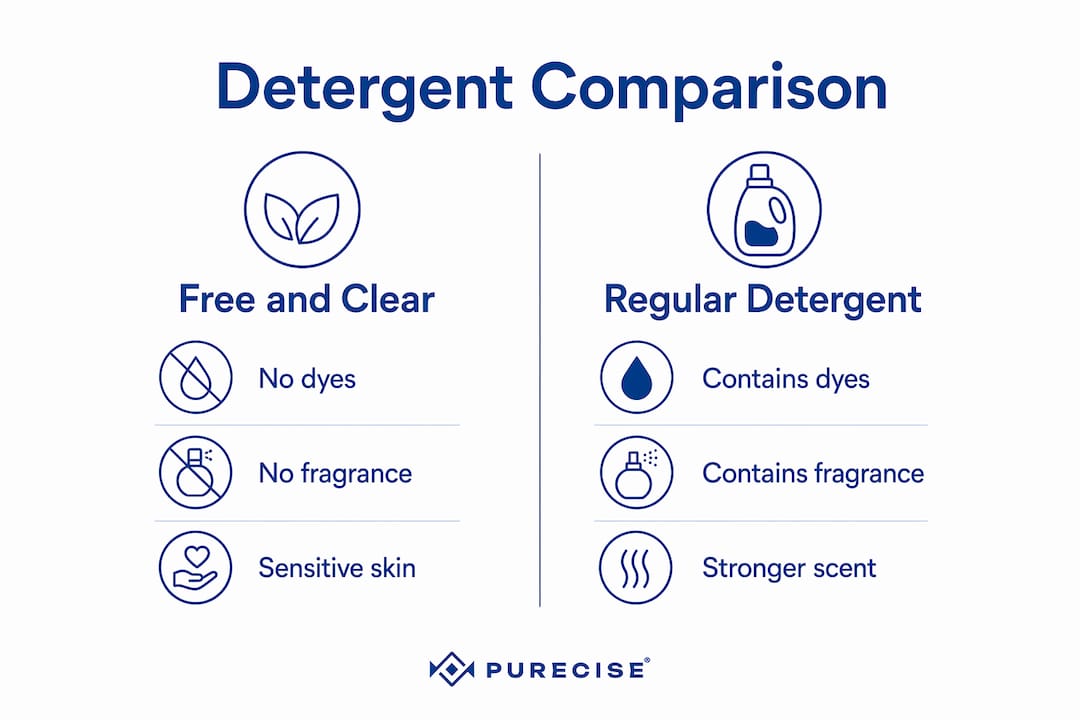
| Feature | Regular detergent | Baby detergent (e.g., Dreft) | Free and clear detergent |
|---|---|---|---|
| Contains fragrance | Yes | Often yes | No |
| Contains dyes | Yes | Sometimes | No |
| Cleaning power | High | Moderate | High |
| Cost per load | Low to moderate | Higher | Low to moderate |
| Dermatologist recommended for eczema | No | Sometimes | Yes |
| HE machine compatible | Usually | Usually | Usually |
Regular detergents also commonly contain phosphates, which improve cleaning in hard water but contribute to water pollution. What does phosphate-free detergent mean in this context? It means the formula skips an ingredient that harms aquatic ecosystems without a meaningful benefit to most households using modern machines. Free and clear formulas are frequently phosphate-free as well, which makes them a better choice for eco-conscious consumers.
Common misconceptions about the free and clear label
The free and clear label is not regulated by any government agency. No standardized definition or mandatory testing requirement exists for it. That means any brand can print “free and clear” on a bottle regardless of what the formula actually contains. This is the most important thing to understand about free and clear labeling.
Several specific risks remain even in products carrying this label:
- Optical brighteners coat fabric fibers to make clothes appear whiter under UV light. They stay on fabric after washing and can irritate skin directly.
- 1,4-dioxane is a suspected carcinogen that forms as a byproduct of ethoxylated surfactants. It is not listed on labels and cannot be detected by reading the ingredient list. Only third-party certification can verify its absence.
- Preservatives like methylisothiazolinone appear in some free and clear products and are known contact allergens.
- Masking fragrances can appear in products labeled “unscented” but not “fragrance-free.” These are chemically identical to regular fragrance ingredients.
Pro Tip: Look for the National Eczema Association (NEA) Seal of Acceptance or the EPA Safer Choice certification. These programs require independent testing and ingredient review. A product with one of these seals has cleared a higher bar than the unregulated free and clear label alone.
Third-party certifications are the most reliable shortcut for people who do not want to research every ingredient. The NEA Seal specifically evaluates products for eczema-safe use. The EPA Safer Choice program reviews the full ingredient list for human and environmental safety. Neither certification is perfect, but both are meaningfully more rigorous than a marketing label. For a deeper look at which ingredients to watch for, the laundry ingredients to avoid guide from Purecise covers the full list in plain language.
How to choose and use free and clear detergents effectively
Choosing the right free and clear laundry detergent requires more than picking any bottle with those words on the front. A structured approach saves time and reduces the risk of a reaction.
- Check for third-party certification first. The NEA Seal of Acceptance and EPA Safer Choice are the two most credible markers. Start your search there before reading individual ingredients.
- Read the full ingredient list. Look specifically for optical brighteners, methylisothiazolinone, and ethoxylated surfactants (ingredients ending in “-eth” or listed as PEG compounds). These can appear in free and clear products.
- Confirm HE compatibility. Most free and clear formulas work in both standard and high-efficiency machines, but always verify. Using a non-HE detergent in an HE machine produces excess suds that can trap residue in fabric and worsen skin reactions.
- Test with a small load first. If you have eczema or a known fragrance sensitivity, wash one item and wear it for a full day before switching your entire laundry routine. This limits exposure if a reaction occurs.
- Consider the packaging. Liquid detergents in plastic bottles contribute to plastic waste. Plant-based detergent sheets and powder formats in cardboard packaging significantly reduce that impact. What does an SLS-free detergent mean for this choice? It means the formula skips sodium lauryl sulfate, an aggressive surfactant linked to skin barrier disruption, in favor of milder alternatives.
- Use the correct dose. More detergent does not mean cleaner clothes. Excess detergent leaves residue on fabric that sits against skin between washes. Pre-dosed formats eliminate this problem entirely.
For a full comparison of how sensitive formulas stack up against standard products, the sensitive vs. regular detergent breakdown from Purecise is worth reading before you buy.
Key takeaways
Free and clear detergent removes dyes and fragrances, the two leading causes of laundry-related skin irritation, but the label is unregulated and third-party certification is the only reliable proof of safety.
| Point | Details |
|---|---|
| Core definition | Free and clear means no added dyes and no added fragrances in the formula. |
| Label is unregulated | No government standard exists, so products can still contain irritants like optical brighteners or 1,4-dioxane. |
| Fragrance-free vs. unscented | Fragrance-free is safer. Unscented may still contain masking fragrances that trigger reactions. |
| Cleaning power is not reduced | Mild surfactants replace aggressive ones, maintaining wash performance without added irritants. |
| Certifications matter | NEA Seal of Acceptance and EPA Safer Choice provide independent verification beyond the label claim. |
What Purecise has learned from years of sensitive skin laundry care
The free and clear category is genuinely useful. For people with eczema, contact dermatitis, or fragrance allergies, switching to a dye-free and fragrance-free detergent often produces a noticeable improvement within a few wash cycles. That part of the conventional wisdom is correct.
What the category gets wrong is the implied promise of safety. The label “free and clear” has no legal definition. A brand can use it freely, and some do, while still including optical brighteners, preservatives, or ethoxylated surfactants that produce 1,4-dioxane as a byproduct. Consumers who trust the label without reading further are not getting the protection they think they are.
The more useful framework is chemical simplicity. A shorter ingredient list with recognizable, plant-derived surfactants is more trustworthy than a long list of synthetic compounds with a “free and clear” banner on the front. Botanical claims and green-sounding marketing language do not substitute for actual ingredient transparency.
The practical recommendation is this: use certifications as your first filter, read the ingredient list as your second, and treat the free and clear label as a starting point rather than a conclusion. Consumers who approach detergent labels this way make better choices, spend less money on products that do not work for their skin, and reduce their household’s chemical exposure without needing a chemistry degree.
— Purecise
Purecise laundry sheets: a free and clear formula in a better format
Purecise Toss & Go laundry detergent sheets are built on the same principles as the best free and clear formulas. Each sheet is free from dyes, added fragrances, phosphates, and harsh chemicals. The plant-based formula is hypoallergenic and works in both standard and HE machines.
The format itself solves problems that liquid detergents cannot. There are no plastic bottles, no measuring, and no residue from overdosing. A full month’s supply fits in a small envelope. For families managing eczema or fragrance sensitivities, pre-dosed sheets remove the guesswork from every load. Purecise backs every purchase with a 100% money-back guarantee. Try the detergent sheets envelopes format or pick up the detergent sheets box for a longer supply.
FAQ
What does free and clear detergent mean?
Free and clear detergent means the formula contains no added dyes and no added fragrances. These are the two ingredients most commonly linked to skin irritation, allergic reactions, and eczema flare-ups from laundry products.
Is free and clear detergent the same as hypoallergenic?
Not exactly. “Hypoallergenic” and “free and clear” are both unregulated marketing terms. A free and clear detergent removes dyes and fragrances, but it may still contain other irritants. Look for the NEA Seal of Acceptance or EPA Safer Choice certification for a more reliable safety standard.
What does dye-free detergent mean?
Dye-free detergent means no artificial colorants were added to the formula. Dyes serve only an aesthetic purpose and add no cleaning power, so removing them reduces chemical exposure without any loss of performance.
Can free and clear detergents still cause skin reactions?
Yes. Products labeled free and clear can still contain optical brighteners, preservatives like methylisothiazolinone, or 1,4-dioxane from ethoxylated surfactants. None of these appear under the “dye” or “fragrance” category, so they survive the free and clear label while still triggering reactions in sensitive individuals.
Are free and clear detergents better for the environment?
Generally yes, especially when they are also phosphate-free and packaged without single-use plastic. Phosphates contribute to water pollution, and plastic bottles add to landfill waste. Plant-based free and clear formulas in plastic-free packaging offer the most complete environmental benefit.
Recommended
What Is Pre-Dosed Laundry Detergent? A Family Guide
How Concentrated Detergent Sheets Reduce Emissions
Related Posts

Remove Lipstick Stains: The First 15 Minutes, Plus Detergent Sheets

How Often to Wash Towels: Bath Weekly, Hand Towels Every Few Days

Detergent Allergy Rash: Test a Low Residue Wash Without Fragrance

Save Clothes From Mud Stains in 1–2 Hours With Premeasured Sheets

Fabric First Sweat Stain Fixes: Measured DIY Recipes and Sheets

Whiten White Clothes, No Chlorine: 4–8 Hour Soak, Premeasured Sheets

Remove Blood Stains from Clothes: Cold Water, Enzyme Soak, No Dryer


