

How to Wash Uniforms Without a Washer or Dryer
When you don’t have a washer or dryer, hand-washing in a sink or soaking in a bucket or tub, followed by a towel-roll spin and air-dry, will reliably clean and preserve most uniforms. These methods work for apartment renters, travelers, students, foodservice staff, and fieldworkers who need a clean, compliant uniform fast.
Your fastest options at a glance:
- Sink hand-wash — best for a single shirt, socks, or small items; takes 15–20 minutes total
- Bucket or tub soak — best for multiple pieces or moderately soiled uniforms; 30–60 minutes
- Manual spin tools (salad spinner, plunger washer) — speeds moisture removal; pairs with either method above
- Towel-roll + air-dry — the safest, fastest drying method for almost every uniform fabric
If your uniform has permethrin treatment, specialty coatings, or heavy embroidery, read the fabric-care section before you start. The American Cleaning Institute recommends following the care label every time, and that advice holds whether you’re using a machine or a sink.
Table of Contents
- What supplies do you need for limited-access laundry?
- How to hand-wash uniforms in a sink
- How to wash multiple uniform pieces in a bucket or tub
- What compact tools speed up manual washing?
- How do you dry uniforms fast without a dryer?
- Stain pretreatment and fabric-care rules for uniforms
- When do you need to disinfect a uniform, and how?
- How long does each method take, and what does it cost?
- How Purecise detergent sheets simplify small-batch uniform washing
- Key Takeaways
- The case for gentle methods over frequent machine washing
- Purecise makes small-load uniform washing simpler
- Useful sources and further reading
What supplies do you need for limited-access laundry?
You don’t need much. A compact kit covers washing, pretreating, and drying without taking up more than a small bag.
Core supplies:
- Collapsible wash basin or clean bucket (a bathtub works too)
- Mild detergent, pre-dosed sheets, or travel-size liquid
- Soft brush or old toothbrush for spot work
- White vinegar (diluted 1:3 with water in a small spray bottle)
- Baking soda for odor absorption
- Two clean towels for moisture removal
- Rustproof hangers or a portable drying rack
- Clothespins
Pre-dosed detergent sheets are especially useful here. With a small basin, it’s easy to accidentally dump in too much liquid detergent, which leaves residue and requires extra rinsing. A single pre-measured sheet removes that guesswork entirely, and you can avoid the overdosing problem that plagues small-load washing.
Skip entirely: chlorine bleach, fabric softener, and heavy brightening agents. All three can damage treated fabrics and specialty finishes.
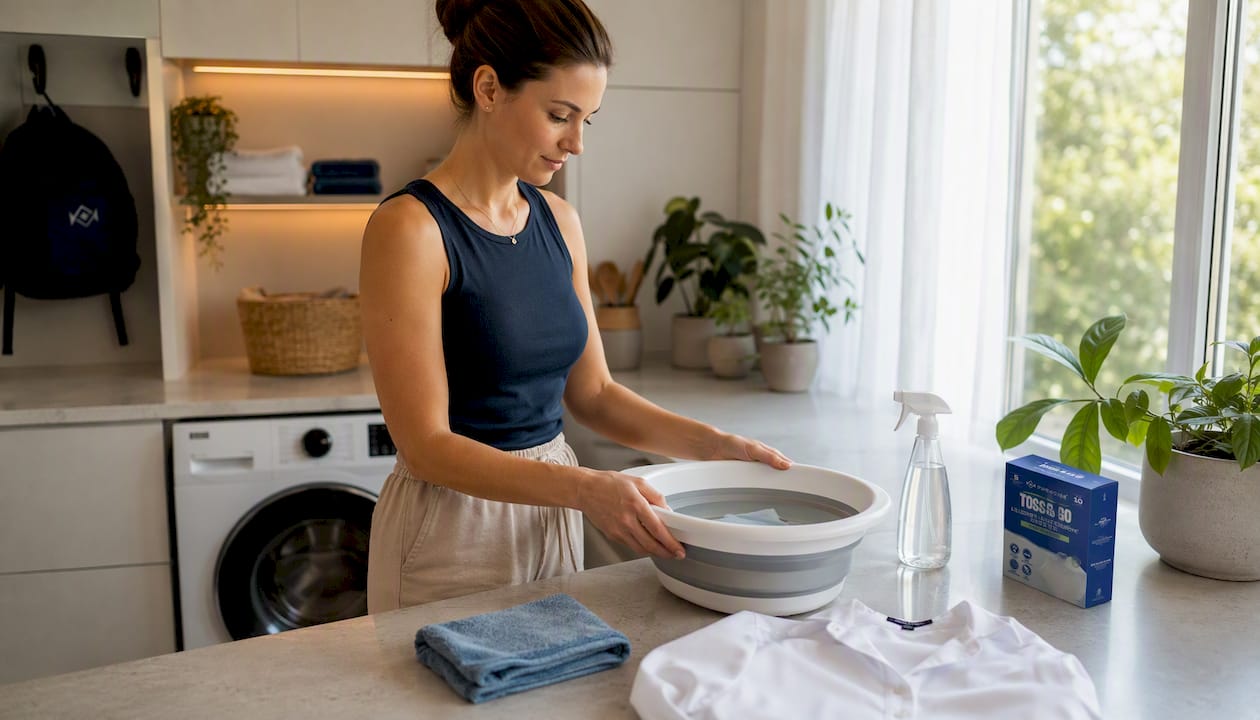
Pro Tip: Fill a small spray bottle with one part white vinegar and three parts water. Spritz it on armpits and collar areas before washing for a fast deodorizing pretreat that costs almost nothing.
How to hand-wash uniforms in a sink
Choose sink hand-washing when you have one or two items, light to moderate soil, and limited time. A single shirt takes roughly a quarter of an hour from start to wringing.
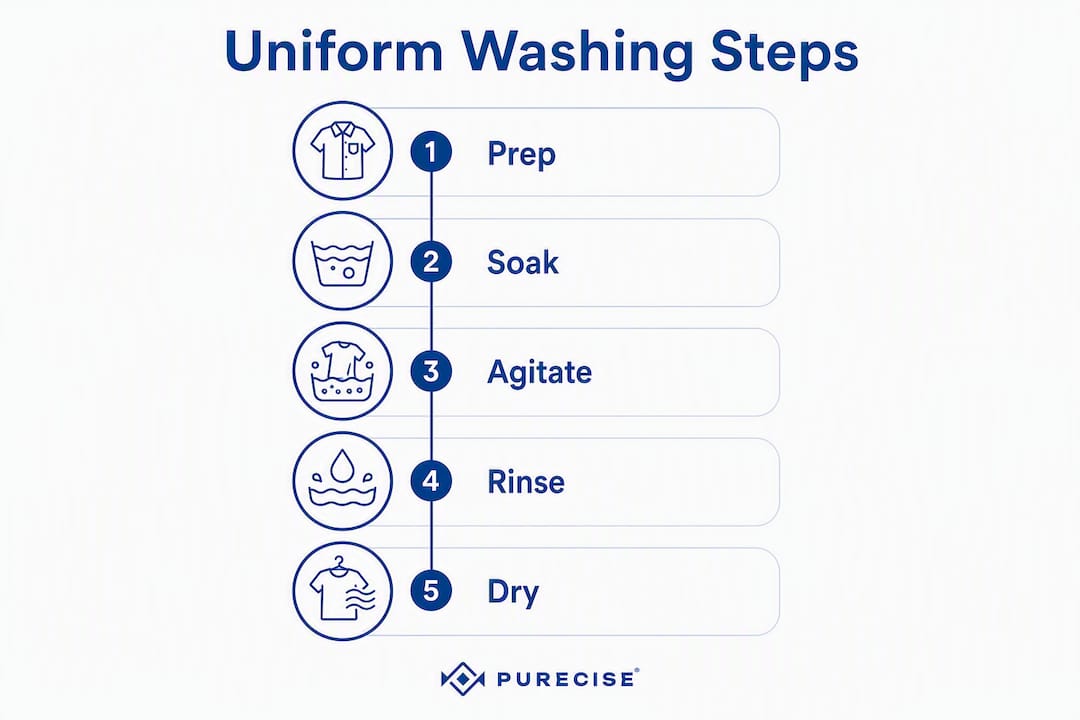
Step-by-step:
- Check the care label. Cold water is the safe default for most treated or synthetic uniform fabrics.
- Turn the garment inside out to protect patches, embroidery, and decorative trims.
- Fill the sink with cool or lukewarm water. Add half a detergent sheet (or a small squeeze of mild liquid) and swirl to dissolve.
- Submerge the garment and gently agitate by squeezing and pressing the fabric. Do not scrub aggressively.
- For stained areas, apply a small amount of detergent directly and let it sit for 3–5 minutes before working it in with a soft brush.
- Soak for 5–10 minutes.
- Drain and refill with clean water. Rinse by pressing and squeezing until the water runs completely clear. Repeat if needed.
- To remove excess water, lay the garment flat on a clean dry towel, roll the towel and garment together like a log, and press firmly. Unroll, reshape, and hang to dry.
Never wring or twist a uniform to remove water. Wringing stretches seams and distorts fabric. The towel-roll press extracts nearly as much moisture without any of the damage. Professional launderers who handle MLB uniforms rely on patience and controlled pressure, not force, for exactly this reason.
A pair of socks takes several minutes. A heavier work shirt may need two rinse cycles. The AP News guide to MLB laundry makes the same point: soak and patience beat scrubbing every time.
How to wash multiple uniform pieces in a bucket or tub
When you have three or more pieces, or a uniform that’s been through a full shift, a bucket or bathtub soak is more practical than repeated sink cycles.
Step-by-step:
- Fill your basin with enough cool water to fully submerge all items. For a standard bucket, one detergent sheet handles a few light garments.
- Dissolve the detergent fully before adding clothes.
- Submerge all items and agitate by hand for 2–3 minutes, pressing and lifting.
- Let soak. Light soil: short soak time. Moderate soil or sweat: longer soak up to around half an hour. Set-in stains: extended soaking recommended with pretreatment.
- Drain and refill with clean water. Agitate again, then drain. Repeat until the rinse water is clear.
- Remove each piece and use the towel-roll method to press out moisture before hanging.
| Soil level | Soak time | Rinse passes | Approx. total time |
|---|---|---|---|
| Light | 10 min | 1–2 | 15–20 minutes |
| Moderate | 20–30 min | 2–3 | 30–60 minutes |
| Heavy/set-in | 1–3 hours | 3–4 | 3–5 hours |
Multiple rinse passes matter more than longer soak times when detergent residue is the concern. In a low-water setup, a second rinse with a splash of white vinegar in the water helps strip any leftover soap from the fabric.
What compact tools speed up manual washing?
A few inexpensive tools make a real difference when you’re washing clothes without a machine regularly.
- Collapsible wash basin — folds flat, holds 3–5 gallons, and fits in a backpack. Costs around $10–$15. The go-to for travelers and van-lifers.
- Manual spin dryer — hand-cranked centrifuge that removes far more moisture than a towel-roll. Cuts air-dry time significantly. Bulkier than a basin but worth it for daily uniform use.
- Salad spinner — works surprisingly well for socks, underwear, and small items. Cheap, already in many kitchens, and gentle on fabric.
- Plunger-style agitator (bucket washer) — a clean toilet plunger or a purpose-built version creates agitation in a bucket without hand-scrubbing. Good for heavier fabrics.
- Portable hand-crank washer — small drum that fits on a countertop. Handles a few garments at a time and requires no electricity.
For the salad spinner method: wash the item first in soapy water, rinse it, then load it into the spinner and spin for 30–60 seconds. You’ll be surprised how much water comes out. Follow with a towel-roll press and hang immediately.
Avoid using any mechanical agitation tool on uniforms with heavy embroidery, sequins, or fragile trims. The friction can pull threads or crack embellishments. For those pieces, gentle hand-pressing in a basin is the only safe option.
Pro Tip: A portable laundry system built around a collapsible basin, a clothesline, and detergent sheets weighs under a pound and handles most uniform needs on the road.
How do you dry uniforms fast without a dryer?
The towel-roll technique plus air-drying in good airflow is the fastest safe method for nearly every uniform fabric.
Drying steps:
- After washing, lay the garment flat on a dry towel. Roll both together tightly and press along the length. This pulls moisture into the towel without stretching the fabric.
- Unroll, reshape collars and cuffs while the fabric is still damp, and hang immediately.
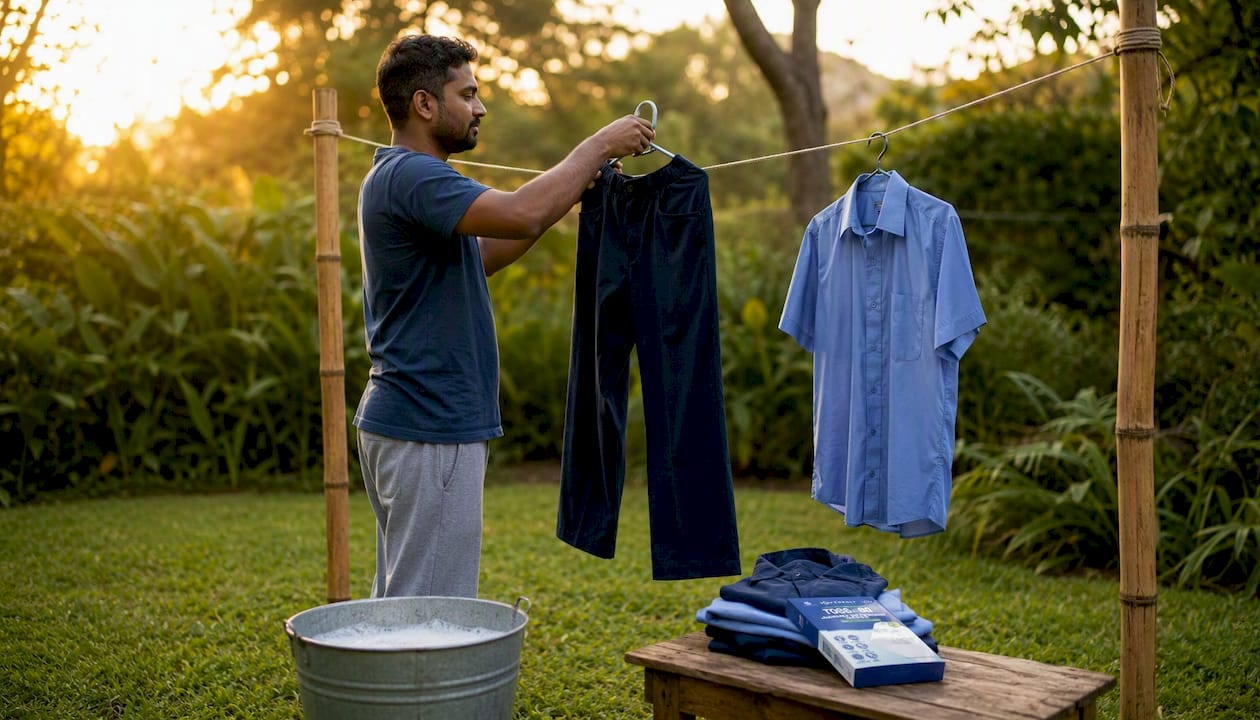
- Place on a rustproof hanger near an open window, a fan, or a vent. Moving air cuts drying time roughly in half compared to still indoor air.
- Avoid direct sunlight for colored uniforms. UV exposure fades dyes faster than almost anything else.
Timing by method:
- Towel-roll + fan airflow: 1–3 hours for a shirt, depending on fabric weight
- Indoor rack, no fan: 3–5 hours
- Clothesline in shade with breeze: 1–2 hours
For trousers, hang them by the waistband and smooth the legs flat to prevent creasing. For collared shirts, button the top button and hang on a shaped hanger so the collar dries in position.
Pro Tip: Rustproof hangers matter more than most people expect. A standard wire hanger leaves rust marks on damp fabric, especially on white or light-colored uniforms. Plastic or coated hangers cost almost nothing and eliminate that problem entirely.
If your employer allows low-heat dryer use and you have brief access to one, 10 minutes on the lowest setting after air-drying most of the way is far safer than a full dryer cycle from wet.
Stain pretreatment and fabric-care rules for uniforms
Pretreat first, then soak. That sequence beats aggressive scrubbing every time, and it’s especially important for uniforms with protective finishes.
Do:
- Read the care label before anything else. The American Cleaning Institute is clear: the label is the authority on water temperature and cycle type.
- Use cold water and mild detergent as your default.
- Apply detergent directly to stained areas and let it sit for 3–5 minutes before agitating.
- Use a soft brush or toothbrush for food, grease, and sweat stains. Work in small circles from the outside of the stain inward.
- Turn garments inside out before any spot cleaning to protect embroidery and patches.
Don’t:
- Use bleach on any treated uniform. Permethrin-treated fabrics, moisture-wicking finishes, and flame-resistant coatings all degrade with bleach exposure.
- Use fabric softener on treated uniforms. It coats fibers and reduces the effectiveness of protective treatments.
- Scrub aggressively on trims, sequins, or embroidered patches. For heavily trimmed garments, band uniform care guidance recommends inside-out washing with a gentle detergent, and dry-cleaning when trims are extensive.
The biggest mistake people make with uniforms is reaching for bleach. Mild detergent and cold water preserve protective finishes and trims far better. If a stain doesn’t lift after pretreating and soaking, repeat the treatment rather than escalating to harsher chemicals.
For fabric-specific stain removal by type, the Purecise stain removal guide covers food and grease stains across different fabric types in detail.
Pro Tip: Turn the garment inside out before spot-treating. Detergent applied directly to embroidery or printed patches can lift adhesive or loosen thread. Working from the inside pushes the stain out rather than driving it deeper.
When do you need to disinfect a uniform, and how?
Disinfect only when your employer requires it, when health codes apply (foodservice, healthcare), or after direct contamination. For most everyday use, thorough cleaning with mild detergent handles bacteria adequately.
Practical disinfecting options without a full washer:
- Diluted white vinegar spray — mix one part vinegar with three parts water. Spray on fabric, let sit for 5 minutes, then blot or rinse. Non-chlorinated, safe for most treated fabrics, and effective against common odor-causing bacteria.
- Handheld steamer — steam at close range kills surface bacteria and refreshes fabric without water immersion. Useful for items that can’t be submerged.
- Commercial non-chlorinated disinfectant wipes or sprays — check the label for fabric compatibility before use.
- Baking soda soak — add two tablespoons to your wash water to neutralize odors and assist with light sanitizing.
Before you disinfect, check these:
- Read your employer’s uniform policy. Some require specific approved products.
- Ask HR whether they require documentation of cleaning for compliance purposes.
- Confirm the disinfectant is compatible with your uniform’s fabric and any protective finishes.
Never use chlorine bleach on treated fabrics or near food-contact uniforms. Chlorine residue on food-service uniforms poses a contamination risk, and bleach destroys permethrin and other protective coatings permanently.
For items that can’t be submerged at all, spraying with diluted white vinegar and airing out in a well-ventilated space handles most odor and light-contamination situations. Always spray from the inside to protect trims and embroidery.
How long does each method take, and what does it cost?
Hand-washing costs almost nothing but takes more time. One small tool investment speeds things up considerably.
| Method | Wash + rinse time | Dry time | One-off cost | Detergent cost per load |
|---|---|---|---|---|
| Sink hand-wash | 15–20 min | 1–3 hrs | — | — |
| Bucket/tub soak | 30–90 min | 2–4 hrs | $10–$15 (basin) | — |
| Salad spinner assist | 20–30 min | 1–2 hrs | $10–$15 | — |
| Manual spin dryer | 20–30 min | 1–3 hours | $30–$60 | — |
Where to save and where to spend:
- Save on detergent by using pre-dosed sheets. They prevent overdosing, which wastes product and requires extra rinsing.
- Spend on a collapsible basin if you wash uniforms more than twice a week. At $10–$15, it pays back in convenience within a month.
- A manual spin dryer is worth the cost if drying time is your main constraint, particularly in humid climates where air-drying takes longer.
Detergent sheets are the single best cost-control move for small loads. A box stores in a drawer, travels in a pocket, and eliminates the half-bottle of liquid detergent that inevitably gets knocked over.
How Purecise detergent sheets simplify small-batch uniform washing
Pre-dosed detergent sheets solve the most common small-load problem: overdosing. When you’re washing one shirt in a sink, even a small pour of liquid detergent is usually too much, leaving residue that requires two or three extra rinse cycles.
Purecise laundry detergent sheets are plant-based, hypoallergenic, and dissolve fully in cold or warm water, which matters for treated uniforms where hot water is off the table. Each sheet is pre-dosed for a standard load; for a sink or small basin wash, half a sheet is enough for one or two light garments.
How to use them for hand-washing:
- Tear a sheet in half for a sink wash (one to two items) or use a full sheet for a bucket with three or more pieces.
- Hold the sheet under warm tap water for 10–15 seconds to start dissolving, then add to your wash water and swirl.
- Proceed with your normal hand-wash or soak routine.
- The formula is free from harsh chemicals, making it safe for sensitive skin and for fabrics with protective finishes.
Purecise backs every purchase with a 100% money-back guarantee, so there’s no risk in trying them for your uniform routine.
Pro Tip: For cold-water washes, dissolve the sheet in a small cup of warm water first, then pour that into your cold wash basin. It speeds full dissolution and distributes the detergent evenly before the garment goes in.
Key Takeaways
Hand-washing in a sink or soaking in a bucket, combined with a towel-roll spin and air-dry, is the most reliable way to clean uniforms when you lack a full washer or dryer.
| Point | Details |
|---|---|
| Pretreat before agitating | Apply detergent to stains and let it sit 3–5 minutes; soaking beats scrubbing every time. |
| Cold water is the safe default | Hot water shrinks fabric and degrades permethrin and other protective finishes. |
| Never wring or twist | Use the towel-roll press to remove moisture without stretching seams or distorting shape. |
| Avoid bleach on treated uniforms | Bleach permanently damages specialty coatings, flame resistance, and embroidery adhesives. |
| Purecise sheets for small loads | Half a pre-dosed sheet handles a sink wash with no measuring, no residue, and no overdosing. |
The case for gentle methods over frequent machine washing
Frequent machine washing is often the default, but it’s not always the best choice for uniforms. Aggressive cycles cause pilling, seam weakening, and gradual breakdown of protective finishes that a gentle hand-wash simply doesn’t. Controlled hand-washing is often the most fabric-preserving, cost-effective strategy for high-quality uniforms compared with frequent machine washes, particularly over a full season of use.
The cost math is straightforward: a uniform that lasts two seasons instead of one because it was hand-washed carefully is a uniform you didn’t have to replace. Protective finishes like permethrin last longer when exposed to mild detergent and cold water rather than hot cycles and spin agitation. That’s not a minor consideration for anyone whose employer requires specific uniform standards.
Purecise detergent sheets fit naturally into this approach. They’re gentle enough for treated fabrics, pre-dosed to prevent the residue buildup that accelerates fabric wear, and compact enough to keep in a locker, a travel bag, or a dorm room drawer.
Purecise makes small-load uniform washing simpler
Washing a uniform without a machine doesn’t have to mean hauling a bottle of detergent or guessing how much to use. Purecise Toss & Go detergent sheets are pre-dosed, plant-based, and dissolve fully in cold water, which means one sheet (or half a sheet for a sink wash) is all you need.
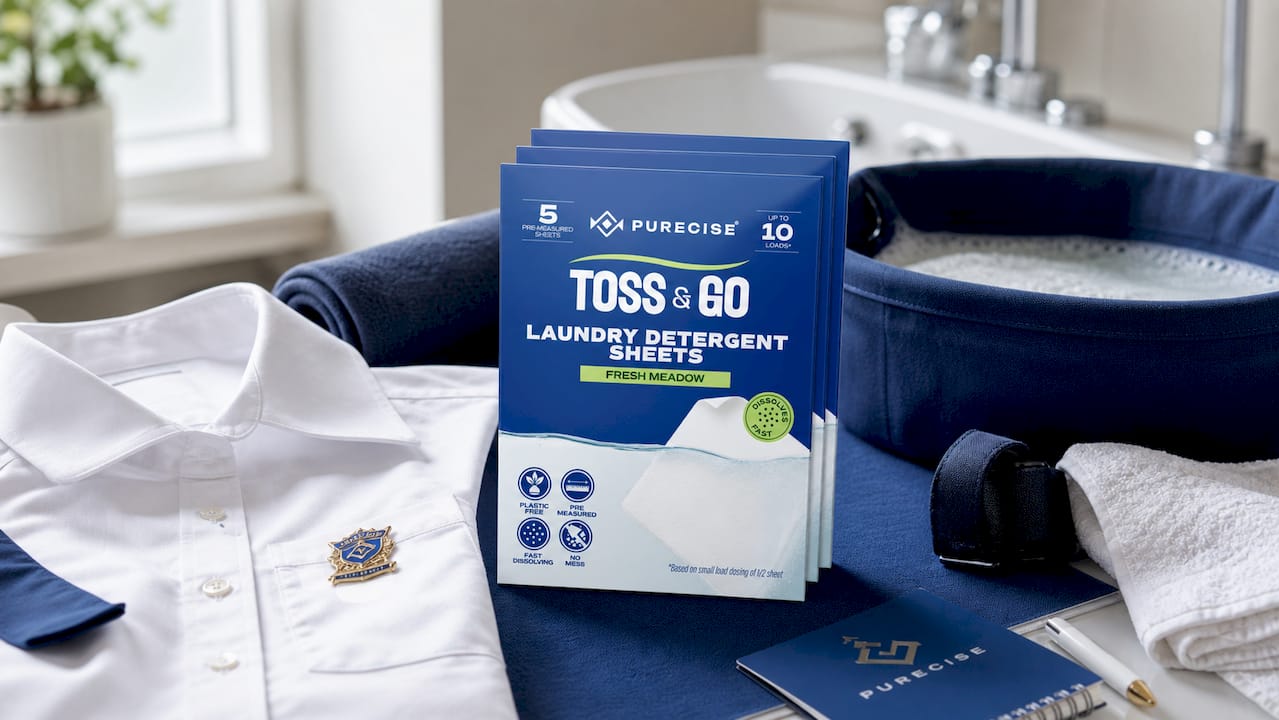
They’re hypoallergenic, free from harsh chemicals, and safe for the treated fabrics and sensitive skin that uniforms often demand. A full month’s supply fits in a pocket. For anyone washing uniforms in a sink, a bucket, or a hotel bathroom, that convenience is hard to beat.
Try Purecise laundry detergent sheets risk-free with a 100% money-back guarantee. Order directly from purecise.com and have them delivered to your door.
Useful sources and further reading
The claims in this article draw from the following authoritative sources. Each one is worth bookmarking if you care for uniforms regularly.
- American Cleaning Institute — Cleaning Uniforms: The industry standard for fabric care guidance, including care label interpretation and washing temperature recommendations.
- AP News — Laundry secrets from MLB uniform washers: Practical pretreating and soaking advice from professional launderers who handle high-performance fabrics daily.
- SASFT — 3 Simple Ways to Wash an Army Uniform: Specific guidance on avoiding bleach and fabric softener on treated military uniforms, with step-by-step washing methods.
- Bandmans — Cleaning and Caring for Custom Band Uniforms: Covers delicate trims, sequins, and embroidery care for specialty uniforms where standard agitation can cause damage.
- wikiHow — How to Wash an Army Uniform: Clear procedural steps for inside-out washing, cold water use, and the towel-roll moisture removal technique.
- Mozi Wash — 7 Ways to Refresh Clothes Without Washing: Practical non-wash refresh options including steam, baking soda, and fabric sprays for situations where a full wash isn’t possible.
- eazysupply.ca: A useful resource for maintaining fabric treatments and understanding best practices for cleaning functional uniforms.
A note on sourcing: Fabric-care rules for treated uniforms vary by manufacturer and employer. Always cross-reference the care label on your specific garment and confirm sanitizing requirements with your employer or HR department before applying any cleaning product.
Recommended
Lightweight Detergent Alternatives for Carry-On Travel
Common Greenwashing Laundry Product Mistakes to Avoid
Related Posts

Remove Berry Stains: Cold Water First, Detergent Sheets on the Go

Remove Makeup Stains on the Go With a 10–15 Minute Pretreat

Remove Lipstick Stains: The First 15 Minutes, Plus Detergent Sheets

How Often to Wash Towels: Bath Weekly, Hand Towels Every Few Days

Detergent Allergy Rash: Test a Low Residue Wash Without Fragrance

Save Clothes From Mud Stains in 1–2 Hours With Premeasured Sheets

Fabric First Sweat Stain Fixes: Measured DIY Recipes and Sheets


