

How to Prevent Color Fading in Your Laundry
You can slow color fading a lot, though you can’t stop it. The biggest levers are cooler water, a gentle cycle, washing garments inside out, sorting by color, not overloading the machine, and keeping dryer heat and direct sun to a minimum. Each habit is free, and together they add up over dozens of washes.
This guide covers why clothes fade, the wash routine that protects color, what to do about vinegar and salt (they don’t set dye), and how to handle bright and dark garments that need extra care.
TL;DR
- Wash in cool or cold water on a gentle cycle. Heat and long, rough cycles pull more dye out of fabric.
- Turn garments inside out, sort by color, and leave room in the drum so clothes don’t rub each other.
- Vinegar and salt do not fix dye, and tests show they can increase color loss.
- Dry on low heat or air-dry away from direct sun. Dryer heat and sunlight both fade color.
- Pre-measured sheets like our Toss & Go sheets take the guesswork out of dosing and are designed to dissolve in cold water.
Table of Contents
- Why clothes fade in the first place
- Start with the care label
- Sort the load so dye stays where it belongs
- The wash routine that protects color
- Does vinegar or salt keep colors from fading?
- Dry with care
- Special cases
- Perspective
- Make cold-water laundry simple with Toss & Go sheets
- A simple routine you can repeat
- FAQ
- Sources
Why clothes fade in the first place
Fading is the slow loss of dye from fibers. Some of it comes from the dye itself. Oregon State University explains that dyes for dark or bright shades are often applied in excess to reach the desired color, and that extra dye bleeds into the wash water. That is why a new red shirt turns the rinse pink.
Fiber matters too. Iowa State Extension notes that fading is more of a problem with cotton, wool and silk, while polyester, nylon and acrylic hold dye better. The same source says friction creates tiny breaks in fibers or yarns that release dye, and that hot water speeds the loss of the agent that anchors dye to the fabric.
Three other causes are worth knowing:
- Heat and bleach. A 2026 study in ACS Industrial & Engineering Chemistry Research found that temperature and bleaching agents, especially hypochlorite, speed up dye degradation.
- Sunlight and the dryer. One fabric brand’s care guide says sunlight and heat are the two biggest causes of fading, more than washing itself.
- Unstable dyes. The American Cleaning Institute says color loss is most common with neon and fluorescent colors, plus bright reds, greens, blues, purples, pinks, black and peach, and that loss from unstable dyes may be irreversible.
Why black clothes seem to fade fastest
Part of it is perception. The same brand’s guide points out that a black T-shirt losing ten percent of its dye looks clearly greyer, while a light grey shirt losing the same amount barely changes, because it has less color to lose. Dark clothes show every bit of wear, so they need the most careful routine.
Start with the care label
The care label is the first line of defense. Oregon State notes that care labeling is required on both domestic and imported apparel in the US, and that the importer or manufacturer is legally responsible for accurate care information. If the label says cold, wash cold. If it says wash inside out or dry flat, do that.
Labels are usually on a side seam, the back of the neck or the back waist. If the little symbols confuse you, our laundry symbols cheat sheet decodes them. Bedding has its own set of marks too, and this guide to bedding care label symbols explains what each one asks of you, which helps keep sheets and duvet covers colorful.
When a load mixes garments with different instructions, follow the most cautious one. That usually means cooler water and a gentler cycle.
Sort the load so dye stays where it belongs
Sorting prevents both fading and color transfer. The American Cleaning Institute recommends separating whites, pastels and medium colors, and brights and darks, and also sorting by soil level and fabric type.
A simple three-pile system works for most households:
| Pile | What goes in it | Why |
|---|---|---|
| Darks | Black, navy, deep red, brown, dark gray | These shed the most visible dye |
| Lights | White, cream, beige, pastels, light gray | These pick up stray dye most easily |
| Colors and brights | Pink, orange, yellow, light blue, neon and fluorescent | Brights are often less colorfast and do best washed alone |
The American Cleaning Institute also says fluorescent colors such as hot pink, bright green and electric blue are often much less colorfast than other fabrics, so wash them separately or test them first. For brand-new items, it advises washing them separately the first few times to remove excess dye.
Kansas State University adds a detail that catches people out: nylon is a “color scavenger” that readily picks up color from other clothes. Keep nylon items with similar colors.
A quick bleed test for new multicolor pieces
Good Housekeeping suggests a water-drop test on multicolored garments: dab a small spot with water and press it against a white cloth. If color transfers, wash the item alone until the water runs clear.
The wash routine that protects color
- Turn garments inside out. The Spruce says this prevents the abrasion that makes fabrics look worn and faded. Zip zippers and close hooks first.
- Pick cool or cold water. The same source says washable dark clothes are best washed in cool water between 60 and 80°F. Kansas State defines cold as 80°F or below and notes that many dark or bright colors need cooler water to prevent fading.
- Choose a gentle or short cycle. A University of Leeds and Procter & Gamble study, reported by Popular Mechanics, found significantly greater color loss from a 40°C, 85-minute cotton cycle than from a 30-minute cold cycle. Longer and hotter means more color loss.
- Leave space in the drum. The Spruce advises not overloading the washer. Packed drums mean more rubbing, and friction releases dye.
- Add detergent as the load needs, not by guess. More detergent is not better. Excess product can leave laundry feeling stiff and makes rinsing harder.
- Take clothes out promptly. Damp dark clothes sitting in a heap can transfer dye onto one another.
How much difference does temperature make?
A Leeds study of dye release found that going from 20°C to 40°C caused a significant increase in both the rate and the total amount of dye released. The jump from 40°C to 60°C was less dramatic. In other words, the move from cold to warm is where most of the extra loss happens, so the cold setting is a cheap, effective choice.

If you wonder whether cold water still gets clothes clean, we cover that in our cold-water guide. Time magazine’s laundry feature also notes that cold water is often just as effective at cleaning as warm or hot for everyday loads.
Does vinegar or salt keep colors from fading?
No. This is one of the most repeated laundry tips, and the research doesn’t back it. Oregon State states that today’s dyes cannot be set by home methods, and that vinegar or salt may actually cause more color loss.
Iowa State Extension calls it a myth that a vinegar or salt soak “fixes” color. If it seemed to work, the loose dye was simply rinsed away. A University of Nebraska-Lincoln publication reporting on lab research found that vinegar, salt, alum and Epsom salts were ineffective at reducing color loss in cotton, and some treatments increased it.
White vinegar still has a job in the laundry room, such as stain pretreating where the care label allows. Just don’t count on it to lock in color.

What about bleach?
Keep chlorine bleach away from colored clothes unless the care label allows it. The research above links hypochlorite to faster dye degradation. For a brightening soak on colored items, use an oxygen bleach labeled for colors and follow the package directions. Test on a hidden seam first, as the American Cleaning Institute advises for any pretreatment product.
Dry with care
Washing is only half the story. Time magazine notes that high dryer heat can shrink fabrics, fade colors and weaken elastic over time. Try this:
- Use low heat or a delicate setting, and stop while clothes are still slightly damp.
- Air-dry dark and bright pieces on a rack or hanger, away from direct sun. Sunlight is a leading cause of fading.
- Dry T-shirts and jeans inside out, too.
- Shake out wet items before drying so they don’t dry in creases that wear at the fold.
Shrinking and fading often travel together because both come from heat and agitation. Our guide to preventing clothes from shrinking covers the drying side in more detail.
Special cases
Dark jeans and black cotton
Jeans and black cotton tees are the classic fading complaints. Wash them less often, inside out, in cold water, and air-dry them. We have two step-by-step guides: how to wash jeans without fading them and how to wash jeans properly.
Bright and neon pieces
Wash these alone for the first few cycles, in cold water. If a bright piece keeps bleeding after several washes, keep it permanently separate. The American Cleaning Institute notes that color loss from unstable dyes may be irreversible, so prevention is the only real fix.
Dye fixatives
Iowa State Extension mentions that dye fixative products made for cotton can reduce color bleed, but they have limits: one type does not work in energy-efficient front-loaders and needs 140°F water. For most households, the cooler, gentler routine above is simpler.
Travel, dorms and shared laundry rooms
Coin-operated machines are often hot and heavily loaded, which is hard on color. Pick the cold or delicate setting, split a big pile into two loads, and pack a small amount of detergent so you aren’t tempted to use whatever is in the shared bin. If you wash clothes in a hotel sink, use half a sheet dissolved in a basin of cool water.
Perspective
Most of the color-saving advice for laundry comes down to being gentle: cool water, shorter cycles, lighter loads. The detergent step is where people quietly undo that, because pouring from a jug is imprecise. It is easy to overpour, and it is just as easy to skip the cold setting because the label on a jug says nothing about it.
That is why we built Toss & Go sheets as pre-measured doses. One sheet is a full dose for a regular load, two for a large or heavily soiled one, and half a sheet for a small load or hand washing in a sink. The sheet goes in the drum on top of the clothes, not in the dispenser drawer, and it is designed to dissolve in cold water. It works in HE and standard machines, front-load and top-load.
We can’t promise any detergent will stop dye from leaving a fabric, because the habits above do most of that work. What we can do is make the cold-water, right-dose routine easy to repeat on every load, with a short, published ingredient list for anyone who reads labels first.
Purecise
Make cold-water laundry simple with Toss & Go sheets
If you’re moving to a cold, gentle routine, a pre-measured sheet makes the dosing step automatic. The Box of 50 is $19.95 and covers up to 100 loads. The Travel 3-Pack is $15.95 and covers up to 30 loads, which suits dorm bags, gym bags and trips. Both come in plastic-free cardboard packaging. Choose Fresh Meadow, which is lightly scented, or Fragrance Free, which has no added fragrance or dyes.
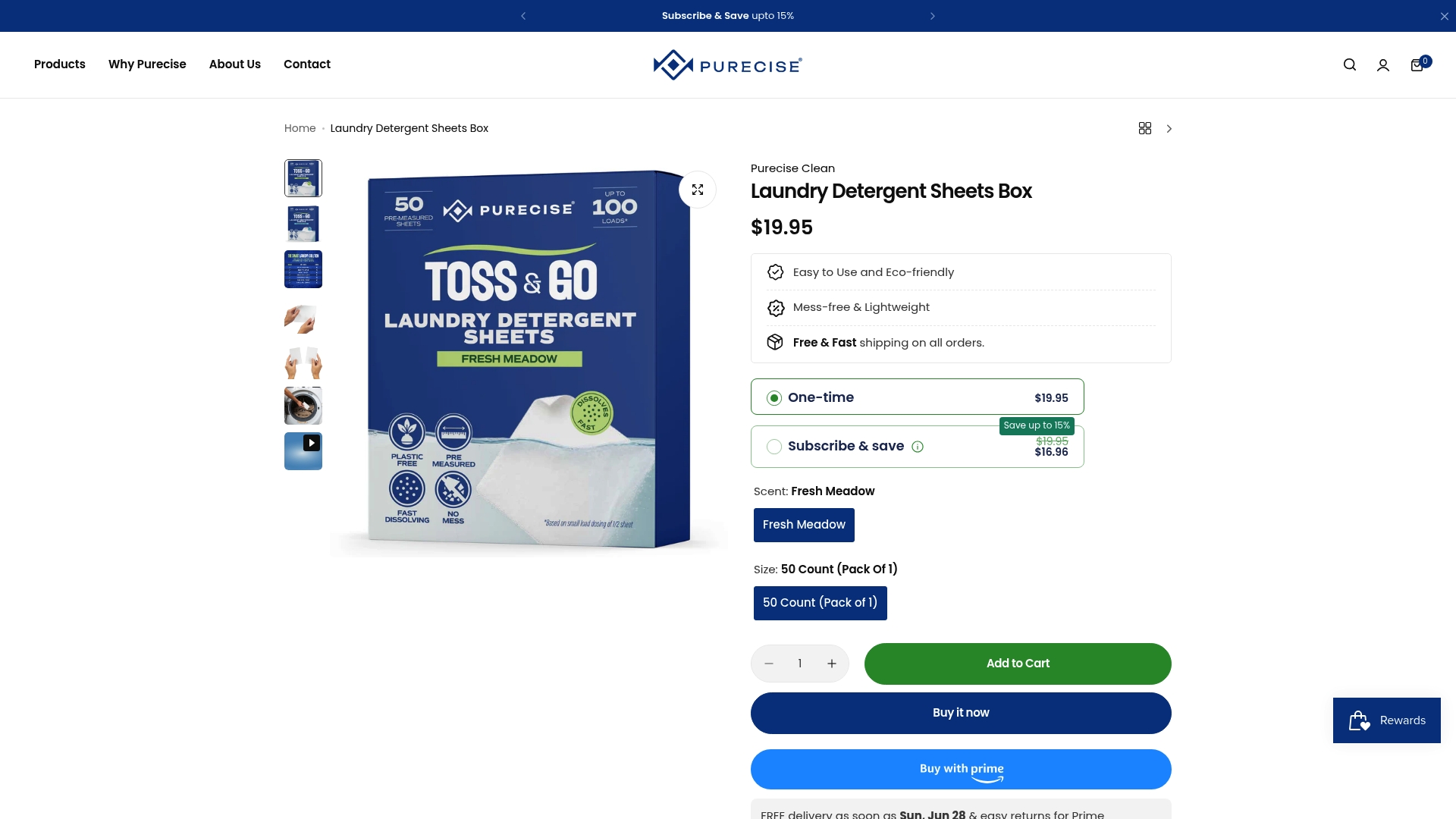
You can subscribe and save 15%, and every order is covered by our 30-day Keep It or Toss It Guarantee: a refund or a replacement, with nothing to send back. Every intentionally added ingredient is listed on our ingredients page. For more on reading labels, see our laundry ingredient checklist, or read how color-safe detergent works with pre-measured sheets.
A simple routine you can repeat
Here is the whole system on one page:
- Read the care label, and follow the most cautious one in a mixed load.
- Sort into darks, lights and brights. Wash new and neon pieces alone.
- Turn everything inside out and zip zippers.
- Load the drum loosely, add the detergent dose on top of the clothes, and choose cold with a gentle or short cycle.
- Move clothes to a rack or dry on low heat, out of direct sun.
- Wash less often when a garment isn’t dirty. Every wash takes a little dye with it.
If you’re new to laundry, our beginner’s guide to fabric care walks through the basics.
FAQ
What is the best detergent to prevent color fading?
No detergent can stop dye from leaving a fabric on its own. Water temperature, cycle length and friction matter more. Choose a detergent you can dose accurately, use it in cool or cold water, and avoid anything with bleach on colors unless the care label allows it. Our Toss & Go sheets are pre-measured, so you get the same dose every load.
Does vinegar keep colors from fading?
No. Oregon State University states that home methods cannot set today’s dyes and that vinegar or salt may increase color loss. If a soak seems to help, it is usually because loose dye was rinsed away. Use cold water and sort by color instead.
Does oxygen bleach prevent color bleeding?
Oxygen bleach is used for brightening and stain soaks, not for locking in dye. Use it only on items whose care label allows it, test a hidden seam first, and follow the package directions. To prevent bleeding, sort by color and wash new items separately.
Can I permanently restore faded clothes?
Usually not. The American Cleaning Institute says color loss from unstable dyes may be irreversible. The best approach is to slow further fading with cold water, gentle cycles, inside-out washing and low-heat or air drying.
Sources
- Colorfastness in Fabrics, Oregon State University
- Preventing Color Transfer by Bleeding or Crocking, Iowa State Extension
- Modeling the Fading Kinetics of Textile Dyes during Washing, ACS Industrial & Engineering Chemistry Research
- Laundering Problems & Solutions, American Cleaning Institute
- Laundry Basics, American Cleaning Institute
- Why some colours fade faster, Copenhagen Bamboo
- MF1014 Laundering guide, Kansas State University
- What Temperature Should You Wash Dark Clothes?, The Spruce
- Improved garment longevity and reduced microfibre release, University of Leeds
- Best Washing Machine Cycle, Popular Mechanics
- How to Do Laundry, Good Housekeeping
- How to Actually Do Laundry the Right Way, Time
- NF91-44 Ineffectiveness of Home Remedy Dye Setting, University of Nebraska-Lincoln
Recommended
Oxygen Bleach vs. Chlorine Bleach: Which to Use
How to Sort Laundry by Color: A Simple Guide
Related Posts

How to Wash Bedding to Reduce Dust Mites

How to Prevent Color Bleeding in the Wash

How to Sort Laundry by Color: A Simple Guide

Oxygen Bleach vs. Chlorine Bleach: Which to Use

How to Prevent Clothes From Shrinking: Wash, Dry, Store

How to Wash Jeans Without Fading Them


