

Wash Clothes with Limited Water on Deployment
You can keep socks and undergarments hygienic on deployment using as little as 1–3 gallons per item with a washboard friction method, or 5–8 gallons for a small bucket load. Prioritize skin-contact garments first: socks and underwear carry the highest infection risk when left unwashed. The three methods that work best under field constraints are washboard scrubbing, bucket-and-plunger agitation, and a soft-sided scrub bag. Here is how they compare at a glance:
- Washboard/friction scrub: 1–3 gallons (4–11 liters) per item, 30–60 minutes per item for heavy soil, lowest water use
- Bucket + plunger agitator: several gallons per small load, 20–30 minutes, handles multiple items at once
- Scrubba-style soft bag or hand-crank drum: a few gallons per cycle depending on design, fastest for light soil, most packable
Your next 15 minutes: Fill one basin or bucket with 1–2 gallons of water. Add one pre-dosed detergent sheet. Soak your socks and underwear for 5 minutes, scrub against a washboard or ridged surface, wring hard, do a quick rinse with a separate half-gallon, and hang to dry. That is a full wash cycle for your highest-priority items.
Table of Contents
- What gear do you need to wash clothes with limited water?
- How to use the washboard method to wash clothes with minimal water
- What are the best alternative hand-wash methods for deployment?
- When should you use a machine instead of hand-washing?
- Why do socks and underwear come first when water is scarce?
- How do you dry clothes fast and control odor in the field?
- Why pre-dosed detergent sheets work better for deployment laundry
- What is the most practical daily laundry schedule for deployment?
- How do you handle greywater and detergent safely in the field?
- Key Takeaways
- The real trade-off nobody talks about
- Purecise Toss & Go sheets for your deployment kit
- Useful sources and further reading
What gear do you need to wash clothes with limited water?
A compact kit covers almost every scenario. Pack or improvise these items before you need them:
Core gear:
- Two food-grade 5-gallon buckets (one wash, one rinse)
- Small washboard or folded rigid scrub pad
- Wash plunger or agitator lid
- Scrubba-style dry bag or any waterproof stuff sack
- Lightweight clothesline (paracord works) and a few clothespins or binder clips
- Hand-crank spin dryer or mop-bucket wringer if space allows
Consumables:
- Pre-dosed laundry detergent sheets (Purecise Laundry Detergent Sheets Envelopes for short patrols; Laundry Detergent Sheets Box for longer deployments)
- Travel soap bar as backup
- Baking soda or washing soda for hard water
Protection and extraction:
- Rubber gloves for handling soiled items or disinfectants
- A small towel for blotting before hang-drying
Pro Tip: A helmet liner or a dry-bag doubles as a soak basin in a pinch. A mop-bucket wringer mounted on one of your buckets acts as a makeshift press and removes far more water than hand-wringing alone, cutting drying time significantly.
How to use the washboard method to wash clothes with minimal water
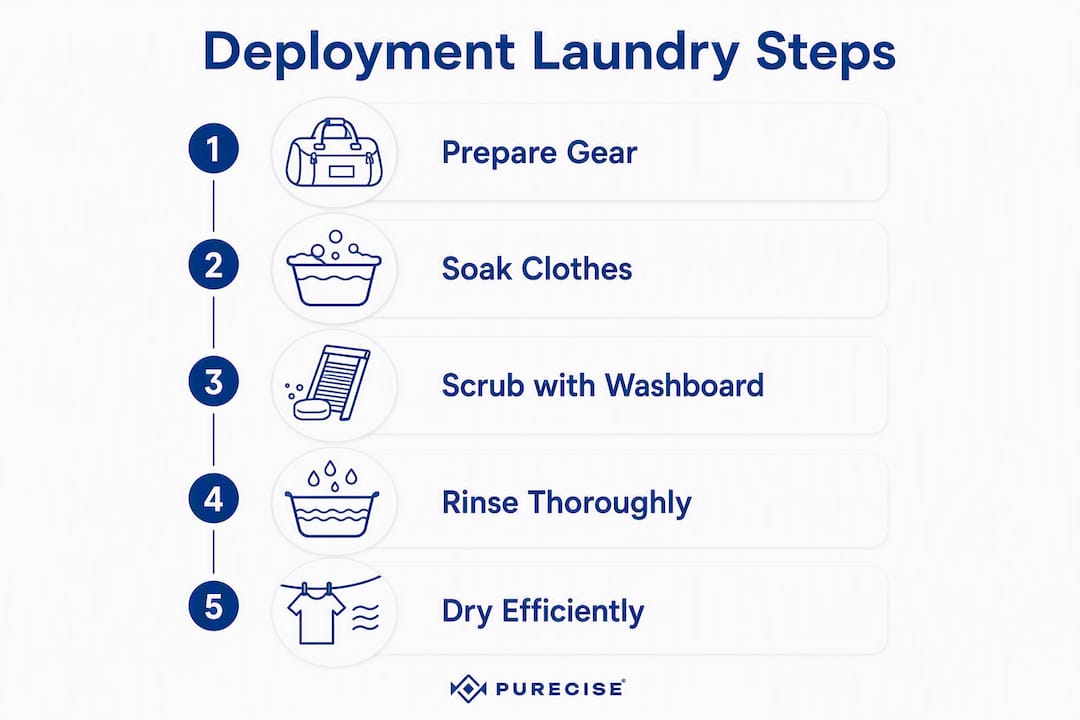
The washboard friction method uses the least water of any manual technique. You scrub fabric against a ridged surface to lift dirt mechanically, so you need less soaking and fewer rinses.
Step-by-step:
- Fill your wash basin with 1–1.5 gallons of warm or cold water.
- Add one Purecise detergent sheet and let it dissolve for 30 seconds.
- Submerge the item and soak for 3–5 minutes to loosen soil.
- Lift the item and scrub it firmly against the washboard in short downward strokes, focusing on cuffs, collars, and stained areas.
- For heavy stains, press a dampened half-sheet directly onto the stain and rub before the main scrub.
- Wring the item tightly by twisting, then fold and press against the bucket edge to extract more water.
- Rinse in a separate 0.5–1 gallon of clean water. One rinse is usually enough with a low-residue sheet detergent.
- Wring again, then hang or lay flat to dry.
Per-item estimates:
| Item | Water (gal / L) | Active time (min) | Drying note |
|---|---|---|---|
| Socks (pair) | 1–1.5 / 4–6 | 10–15 | Dry in 1–2 hrs in sun/wind |
| Underwear | 1–1.5 / 4–6 | 10–15 | Dry in 1–3 hrs depending on fabric |
| T-shirt | 2–3 / 8–10 | 20–30 | Dry in 2–4 hrs; hang from shoulders |
| Pants/BDUs | — | 30–60 | Dry in 4–8 hrs; turn inside out |
For cold-weather drying, hang items near any heat source and turn them once. Avoid leaving wet fabric in a sealed bag for more than an hour; mildew sets fast in cold, damp conditions.
What are the best alternative hand-wash methods for deployment?
Not every situation calls for a washboard. Here is how the other portable methods stack up:
Bucket + plunger agitator
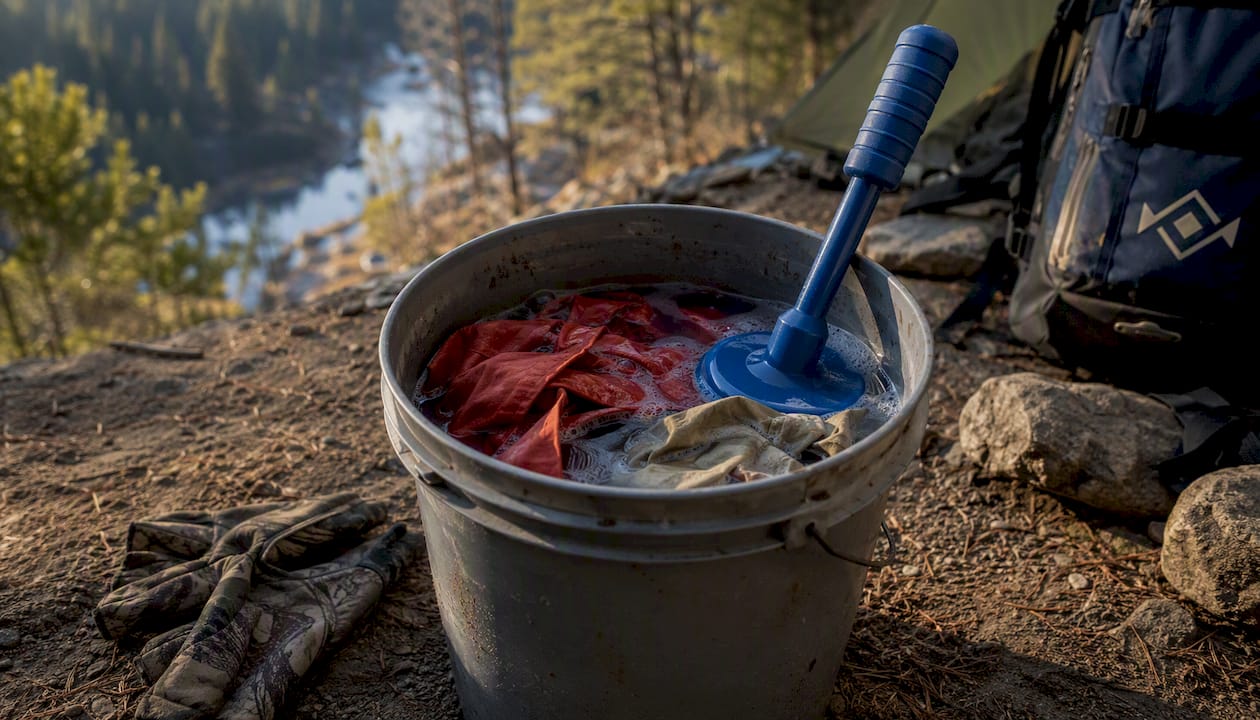
Fill one bucket with 5–8 gallons of water and one detergent sheet. Add up to six small items (socks, underwear, a T-shirt). Plunge vigorously for 10–15 minutes, then transfer items to a second bucket with 2–3 gallons of clean water for rinsing. Total active time: 20–30 minutes for a small load. This method suits a small squad where multiple people contribute items to a single load, spreading the water cost across more garments.
Scrubba-style soft bag or hand-crank drum
- Water use: under 3 gallons for a Scrubba-style bag (2–3 items); 5–10 gallons for a hand-crank drum with a larger load
- Cycle time: 3–5 minutes of rolling/kneading for a soft bag; 10–15 minutes for a hand-crank drum
- Best for: solo operators who need speed and packability; the bag folds flat and weighs almost nothing
- Limitation: throughput is low; you will wash 2–3 items per cycle, not a full load
Sink or small-basin wash
Fill a sink or small basin with 0.5–1 gallon of water, add a fraction of a detergent sheet, and agitate by hand for 5–10 minutes. This works for light-soil items only. It is not reliable for heavily soiled field gear or items with biological contamination.
Choosing the right method:
- Single soldier, light soil, speed priority: Scrubba-style bag
- Single soldier, heavy soil, lowest water: washboard
- Small squad (3–6 people), shared kit: bucket + plunger
- Immediate spot need, minimal gear: sink or basin wash
When should you use a machine instead of hand-washing?
HE front-load washers use relatively low water per load, compared with much higher water use for older top-load agitator machines. If you have access to a base laundry, a laundromat, or an HE machine at a forward operating base, that is almost always worth the trip for outer layers and bedding. Hand-washing is the right call when access is unavailable, time is short for a single item, or you need to wash socks and underwear daily without waiting for a full machine load.
Whirlpool’s guidance notes that ENERGY STAR-certified washers use relatively low water per load depending on model, while older machines often use significantly more water. That gap matters when base water supply is rationed.
Machine-use tips for limited-water contexts:
- Run loads at two-thirds capacity, not completely full; overstuffing reduces cleaning effectiveness and may require a rewash
- Use HE-compatible detergent or a pre-dosed sheet; liquid detergent overdosing in shared machines leaves residue and wastes water on extra rinses
- Skip the extra rinse cycle unless items are heavily soiled or you used too much detergent
- Choose a short, low-temperature cycle for lightly soiled items; low-temp washing maintains cleaning performance while reducing energy draw
Pro Tip: Before loading a shared base machine, check the drum for detergent buildup. If you see residue, wipe it out. Residue from overdosed liquid detergent traps soil and forces rewashes, wasting water you cannot afford to spare.
Why do socks and underwear come first when water is scarce?
Field hygiene guidance is direct on this: clean socks and undergarments prevent skin breakdown and infections. Trench foot, fungal infections, and contact dermatitis all start with prolonged moisture and microbial buildup against skin. Outer layers can be brushed, aired, and rotated for days. Socks and underwear cannot.
Water triage order when supply is critically low:
- Drinking water first, always
- Cooking and food prep second
- Medical wound care third
- Socks and underwear fourth
- Undershirts and base layers fifth
- Outer layers, BDUs, and bedding last
Sanitizing with minimal water:
- Hotter soaking (if fabric tolerates it) kills more pathogens per gallon than cold soaking
- A small amount of diluted bleach (1 tablespoon per gallon) works for white cotton items; avoid on synthetic or colored fabrics
- UV and air-drying in direct sunlight provides meaningful pathogen reduction as an adjunct, not a replacement for washing
- For contaminated or bloody items, bag them separately in a sealed plastic bag until you have enough water to wash them safely with gloves on
Safety callout: Always wear rubber gloves when handling items with blood, wound drainage, or fecal contamination. Rinse gloves before removing them. Never pour contaminated wash water near drinking sources, food prep areas, or camp wells.
How do you dry clothes fast and control odor in the field?
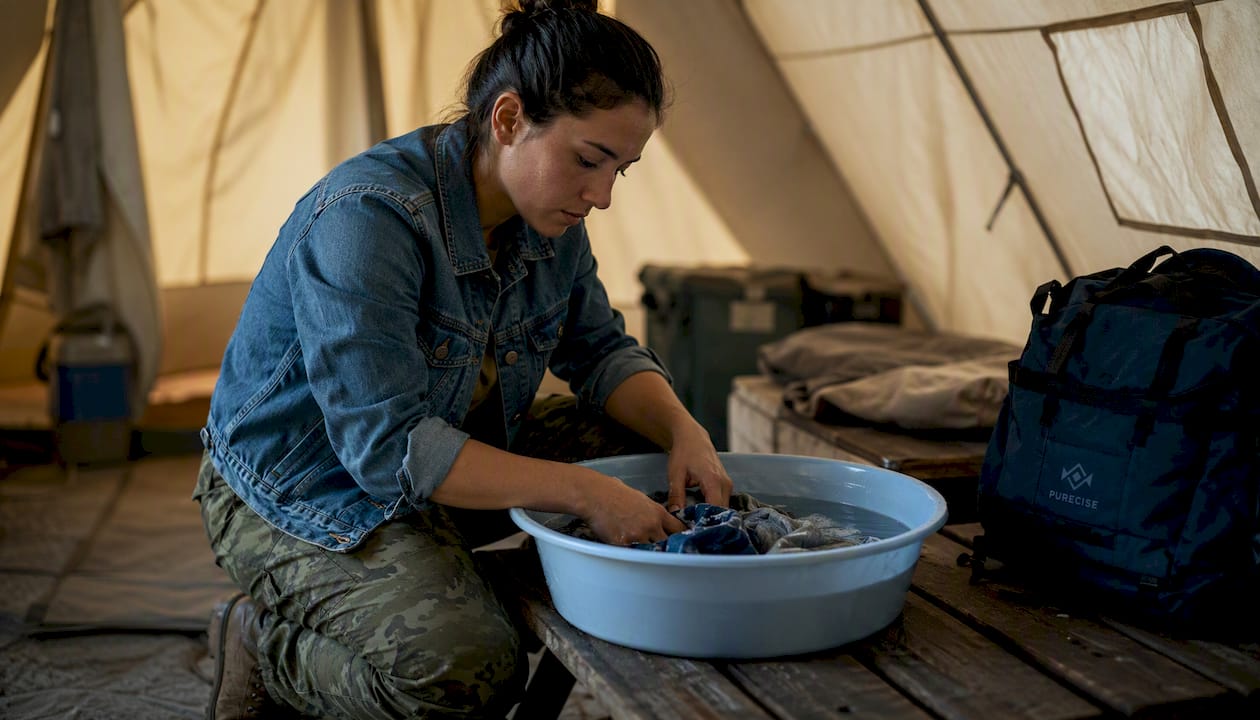
Getting water out before you hang is the highest-leverage step. A hand-crank spin dryer or mop-bucket wringer removes far more residual water than hand-twisting alone, and that translates directly to shorter drying time and lower mildew risk. Wring, then press the item against the bucket edge a second time before hanging.
Drying best practices:
- Hang on a tight clothesline; loose lines let items bunch and trap moisture
- Position for maximum wind exposure, not just sun
- Hang pants and shirts from the waist and shoulders respectively so air moves through the interior
- Turn items once halfway through drying
Odor control between washes:
- Air garments out for 30–60 minutes after wearing before storing
- Dust lightly with baking soda, shake out after 10 minutes; this neutralizes odor without water
- A diluted white vinegar spray (1 part vinegar to 3 parts water) is safe on most fabrics and kills odor-causing bacteria; let it air dry completely before wearing
- Spot-clean high-odor areas (underarms, collar) with a dampened detergent sheet fragment rather than running a full wash
For cold or humid climates, slow drying is the enemy. If you are indoors, hang items near any dehumidified airflow. A small battery-powered fan pointed at hanging clothes cuts drying time noticeably. Avoid sealing damp items in a stuff sack overnight.
Pro Tip: Rotate two sets of base layers and use a thin liner sock inside your main sock. The liner takes the sweat and friction; wash it daily while the outer sock goes every other day. You cut your water use for socks by roughly half without sacrificing hygiene.
Why pre-dosed detergent sheets work better for deployment laundry
Pre-dosed detergent sheets solve the three biggest field-laundry problems at once: accurate dosing, compact packing, and compatibility with low-water cycles. Pre-dosed formats reduce waste and dosing errors in low-water or shared-machine scenarios, which matters when every extra rinse costs water you may not have.
How to use them in the field:
- One sheet for a small hand-wash or scrub (1–3 items in 1–2 gallons of water)
- Two sheets for a small machine cycle or a full bucket load (5–8 gallons, 6–8 items)
- Half a sheet dampened directly on a stain as a pre-treat before scrubbing
- No measuring, no spills, no residue from overdosing
Packing options:
- Laundry Detergent Sheets Envelopes: single-serve pocket packets; ideal for patrols and short-duration missions where you carry only what you need for a day or two
- Laundry Detergent Sheets Box: boxed packs for week-long or longer deployments; fits in a side pocket of a ruck and covers a full rotation of washes
Purecise sheets are plant-based and hypoallergenic, which matters in field conditions where skin is already stressed by heat, friction, and limited bathing. They dissolve fully in cold water, so you do not need to heat water to activate them. The portable laundry supplies context applies directly here: compact format, no plastic jug, no measuring cup, no residue.
Pro Tip: Tear a single sheet in half for a quick spot-clean on a collar or cuff. Dampen the half-sheet, rub it directly on the stain, let it sit for two minutes, then rinse with a small pour of water. You use under a cup of water for a targeted clean.
What is the most practical daily laundry schedule for deployment?
Short, daily sessions beat weekly marathon washes on every metric: water reuse, physical effort, drying time, and hygiene consistency. The “30-minute laundry rule” is simple: spend 15–30 minutes each day on the highest-priority items rather than saving everything for one exhausting session.
Daily/weekly schedule:
- Daily: Socks and underwear. One basin, 1–2 gallons, one detergent sheet, 15–20 minutes total including hang time.
- Every 2–3 days: Undershirts and base layers. Same basin, slightly more water, 20–25 minutes.
- Weekly (when water allows): Outer layers, BDUs, and fleece. Bucket + plunger method, 5–8 gallons, 30 minutes.
- Bedding: When water supply permits, or when visibly soiled. Air and brush between washes.
15-minute daily routine:
- Fill basin with 1–1.5 gallons of water and one detergent sheet.
- Soak socks and underwear for 3–5 minutes.
- Scrub each item for 2–3 minutes against a washboard or ridged surface.
- Wring firmly, rinse in 0.5 gallons of clean water.
- Wring again and hang immediately.
Adjust frequency for climate. In humid environments, socks may need washing twice daily to prevent fungal growth. In dry desert conditions, outer layers can go longer between washes, but socks and underwear stay on the daily schedule regardless.
How do you handle greywater and detergent safely in the field?
Improper greywater disposal contaminates water sources and violates Leave No Trace principles on U.S. public lands and many base environments. Handle it deliberately.
Greywater basics:
- Disperse wash water at least 200 feet from any drinking water source, stream, or camp well
- Never pour greywater into trenches that drain toward water supplies
- Scatter greywater over a broad area of soil rather than concentrating it in one spot
- Use a simple sediment trap (a bandana or mesh bag over the bucket spout) to catch lint and solids before dispersal
Detergent selection:
- Choose biodegradable, phosphate-free, boron-free formulas; phosphates accelerate algae growth in waterways
- Avoid heavy-powder detergents in field conditions; they leave residue that requires extra rinse water to clear
- Pre-dosed sheets with plant-based surfactants dissolve fully and leave minimal residue, reducing the rinse water needed
Water reuse:
- Reuse rinse water from one wash cycle as the soak water for the next cycle’s pre-soak
- Use lightly soapy greywater to clean boots, gear, or tools before final dispersal
- A sediment trap lets you reuse water one extra cycle without carrying solid waste into the soil
Safety callout: Clothing contaminated with blood, wound drainage, or chemical exposure should be bagged in a sealed plastic bag and handled separately. Wash these items last, with gloves, in a dedicated bucket that is not reused for other laundry. Dispose of that wash water away from all living and food-prep areas.
Key Takeaways
The most water-efficient way to wash clothes on deployment is the washboard friction method using minimal water per item, with socks and underwear washed daily as the non-negotiable hygiene priority.
| Point | Details |
|---|---|
| Washboard uses the least water | Friction scrubbing uses 1–3 gallons (4–11 liters) per item, the lowest of any manual method. |
| Bucket + plunger for small loads | A two-bucket agitator setup handles 5–8 gallons per small load and suits a squad washing together. |
| Socks and underwear come first | Field hygiene triage puts undergarments above outer layers; skin infections start with dirty socks. |
| Daily short sessions beat weekly washes | A 15–30 minute daily routine uses less total water and keeps drying manageable in any climate. |
| Purecise sheets pack light and dose accurately | One sheet per hand-wash, two for a machine cycle; no measuring, no spills, dissolves in cold water. |
The real trade-off nobody talks about
Most field laundry guides focus on the water numbers. The harder problem is time and energy. Manual washing can consume up to 20 hours per week in low-resource settings, and that burden compounds fast when you are already running on limited sleep and high physical output.
The conventional wisdom says “just hand-wash daily.” That is correct in principle but incomplete in practice. What actually works is pairing a short daily routine with the right extraction step. Most people underestimate how much drying time drives the whole cycle. If items take 8 hours to dry because you did not wring them properly, you run out of clean gear before the next wash is ready. A mop-bucket wringer or a 2-minute hand-crank spin session is not optional equipment; it is the step that makes the rest of the routine viable.
Small, frequent washes also do something the weekly marathon cannot: they keep morale intact. There is a real psychological difference between wearing clean socks and wearing socks you have been in for four days. Hygiene is not just medical; it is a signal to yourself that you are maintaining standards under pressure. That matters more than most field manuals acknowledge.
Purecise Toss & Go sheets for your deployment kit
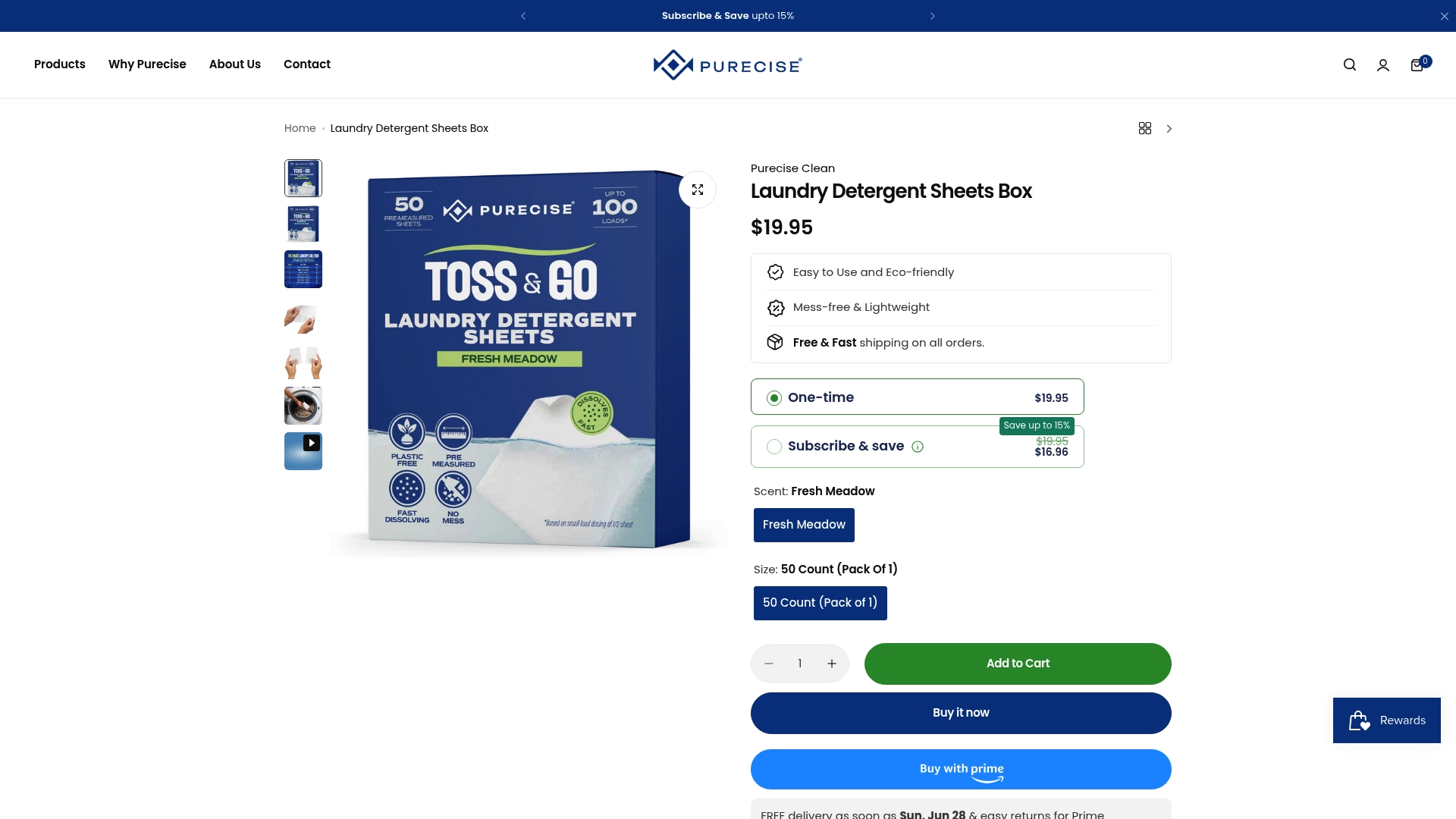
Skip the liquid jug and the measuring cup. Purecise Toss & Go laundry detergent sheets give you accurate, pre-dosed cleaning in a format that fits in a cargo pocket. One sheet handles a full hand-wash bucket; two sheets cover an HE machine cycle at two-thirds capacity. No residue, no overdosing, no extra rinse water wasted.
For short patrols or weekend missions, the Laundry Detergent Sheets Envelopes pack flat and weigh almost nothing.
For a week-long or extended deployment, the Laundry Detergent Sheets Box fits in a side pocket and covers a full rotation of daily sock-and-underwear washes plus outer layers. The plant-based, hypoallergenic formula dissolves completely in cold water, which means it works in a bucket, a scrub bag, or a base machine without leaving the residue that forces rewashes. Every order comes with a 100% money-back guarantee.
Useful sources and further reading
These are the core sources behind the water figures and hygiene guidance in this article:
- Off-grid laundry — Survipedia: covers washboard water estimates, bucket agitator methods, and water triage order for extreme scarcity; the most directly applicable source for deployment contexts.
- ENERGY STAR — Clothes washers product guidance: official U.S. government data on HE front-loader water use; use this to compare machine options when base access is available.
- The Washing Machine Project — partner sales: documents the time burden of manual washing and the impact of low-cost mechanical washers in low-resource settings.
- Optimizing laundry for sustainability — MDPI (Sustainability): peer-reviewed study on low-temperature, low-detergent washing conditions and their environmental trade-offs.
- Clothes Washer — Home Water Works: U.S. residential water-use data showing laundry’s share of household consumption and ENERGY STAR savings benchmarks.
For base-specific guidance, consult your installation’s civil engineering or facilities management office for local water-use protocols and greywater disposal rules.
Recommended
Common Greenwashing Laundry Product Mistakes to Avoid
Fabric Care for First-Time Laundry Doers: A Beginner's Guide
Related Posts

Remove Berry Stains: Cold Water First, Detergent Sheets on the Go

Remove Makeup Stains on the Go With a 10–15 Minute Pretreat

Remove Lipstick Stains: The First 15 Minutes, Plus Detergent Sheets

How Often to Wash Towels: Bath Weekly, Hand Towels Every Few Days

Detergent Allergy Rash: Test a Low Residue Wash Without Fragrance

Save Clothes From Mud Stains in 1–2 Hours With Premeasured Sheets

Fabric First Sweat Stain Fixes: Measured DIY Recipes and Sheets


