

Hypoallergenic Laundry Detergent Guide for Sensitive Skin
A hypoallergenic laundry detergent is a specially formulated product designed to minimize allergic reactions and skin irritation by excluding common triggers such as fragrances, dyes, and harsh synthetic chemicals. For the roughly one in three Americans who report skin sensitivity, choosing the wrong detergent means waking up to rashes, hives, or relentless itching. Trusted certifications like the National Eczema Association’s Seal of Acceptance and EWG Verified give you a reliable shortcut past misleading marketing. This hypoallergenic laundry detergent guide walks you through what labels actually mean, which ingredients to avoid, how to test a new formula, and how to find options that are gentle on skin and the planet.
What does “hypoallergenic” really mean on detergent labels?
The word “hypoallergenic” sounds clinical and reassuring. The reality is less comforting. The term is unregulated with no federal definition, meaning any manufacturer can print it on a bottle without testing, third-party review, or proof of any kind. That is not a minor footnote. It means a product loaded with fragrances and synthetic dyes can legally call itself hypoallergenic.
What the label cannot tell you
Because no government agency enforces the hypoallergenic claim, you cannot use it as a buying signal on its own. Two products sitting side by side on a shelf can both say “hypoallergenic” while having completely different ingredient profiles. One might be genuinely gentle. The other might contain isothiazolinone preservatives, which are among the most common causes of contact dermatitis in laundry products.
Certifications that actually mean something
Third-party certifications fill the gap that regulation leaves open. The National Eczema Association’s Seal of Acceptance requires products to meet strict transparency and clinical safety criteria, reviewed annually. Products carrying that seal have been validated for sensitive skin in a way that a self-applied label never can be. The EPA Safer Choice program and EWG Verified label similarly require ingredient-level screening before approval.
“Unscented” vs. “fragrance-free”: a critical difference
This distinction trips up even careful shoppers. “Unscented” products may contain masking fragrances added to neutralize chemical odors. Those masking agents are still fragrance compounds and can still trigger reactions. “Fragrance-free” means no fragrance compounds were added at all. If you have sensitive skin, fragrance-free is the only label worth trusting.
Pro Tip: Flip the bottle and read the ingredient list before the front label. If you see “parfum,” “fragrance,” or any essential oil listed, put it back regardless of what the front claims.
Which ingredients should you avoid in sensitive skin detergents?
Ingredient scrutiny is the single most reliable tool you have. Dermatologist Dr. Jessie Cheung recommends removing irritants like SLS and SLES and selecting fragrance-free detergents with the National Eczema Association’s Seal as the baseline standard for sensitive skin care.
The ingredients most likely to cause problems
- Fragrances and parfum: The leading cause of contact dermatitis from laundry products. Even “natural” fragrances from lavender or citrus can trigger reactions.
- Synthetic dyes: Added purely for appearance. They serve no cleaning function and are a common irritant.
- Sodium lauryl sulfate (SLS) and sodium laureth sulfate (SLES): These surfactants can dry skin and cause irritant dermatitis with repeated exposure through fabric contact.
- Isothiazolinone preservatives (MIT, CMIT): Potent sensitizers that increase irritation risk significantly. Widely used but poorly tolerated by sensitive skin.
- Optical brighteners: Chemical compounds that make whites appear whiter under UV light. They stay on fabric and sit against your skin all day.
- Enzymes (in some cases): Useful for stain removal but can irritate very reactive skin. Look for enzyme-free options if reactions persist.
Ingredients that work well for sensitive skin
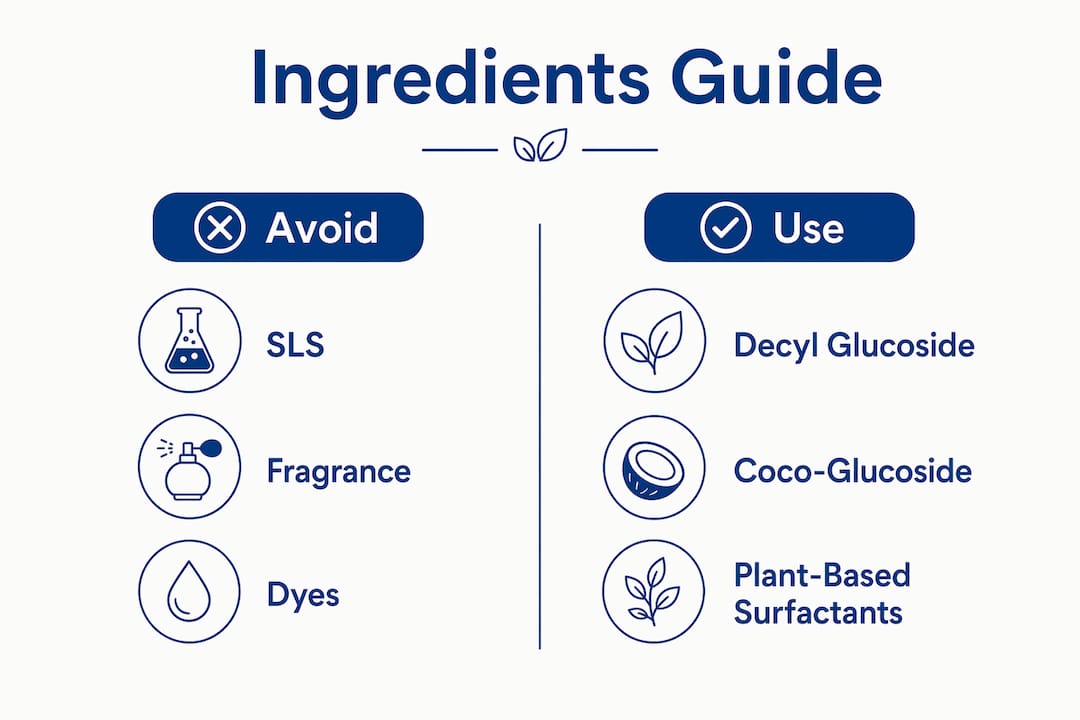
Plant-based surfactants like decyl glucoside and coco-glucoside clean effectively without the harshness of SLS. They are derived from coconut or corn and biodegrade readily. Shorter ingredient lists reduce your overall exposure risk. A detergent with eight ingredients is easier to evaluate than one with thirty.
| Ingredient | Avoid or Use | Reason |
|---|---|---|
| Sodium lauryl sulfate (SLS) | Avoid | Dries skin, causes irritant dermatitis |
| Isothiazolinone (MIT/CMIT) | Avoid | Common contact allergen, sensitizer |
| Optical brighteners | Avoid | Remain on fabric, irritate skin |
| Synthetic fragrances | Avoid | Leading cause of laundry-related dermatitis |
| Decyl glucoside | Use | Mild plant-based surfactant, well tolerated |
| Coco-glucoside | Use | Gentle, biodegradable, low irritation profile |
Pro Tip: Use the EWG’s Skin Deep database to look up any ingredient you do not recognize. It takes 30 seconds and removes all guesswork.
How do you select and test a hypoallergenic detergent?
Finding the right detergent is a process, not a single purchase. Start with products that are fragrance-free, dye-free, and carry at least one recognized certification. Then test systematically rather than switching back and forth every few days.
A step-by-step testing protocol
- Choose a certified starting point. Select a detergent with the National Eczema Association’s Seal of Acceptance or EWG Verified status. This eliminates the worst offenders before you begin.
- Wash a full load of everyday fabrics. Include the items that touch your skin most directly: underwear, t-shirts, bed sheets, and towels.
- Add an extra rinse cycle. Detergent residue on fabrics frequently triggers irritation even with gentle formulas. An extra rinse removes what the standard cycle leaves behind.
- Use less detergent than the label suggests. Most people overdose significantly. More detergent does not mean cleaner clothes. It means more residue.
- Track your skin over 10–14 days. A 10–14 day tracking period gives your skin enough time to respond or settle. Reactions that appear in the first two days may be from your previous detergent clearing out of fabrics.
- Patch test washed fabric. Press a freshly laundered cloth against the inside of your wrist or elbow for 30 minutes before wearing a full garment. This is especially useful for children or anyone with a history of contact dermatitis.
Detergent format comparison: liquid, powder, pods, and sheets
Liquid detergents rinse out cleanly and are easy to dose, but the bottles create plastic waste and can harbor preservatives to extend shelf life. Powder detergents often skip preservatives entirely since they are dry, but they can leave residue in cold water washes. Pods are pre-dosed and convenient, but many contain PVA plastic film and concentrated fragrance blends that are hard to avoid. Detergent sheets are a newer format that dissolves completely in any water temperature, require no measuring, and typically use shorter ingredient lists with no liquid preservatives needed.
Does eco-friendly always mean safe for sensitive skin?
The short answer is no. Eco-friendly and hypoallergenic are separate criteria. A detergent can be biodegradable and plant-based while still containing essential oils, botanical extracts, or natural fragrances that trigger reactions in sensitive individuals.
Not all eco-friendly detergents are safe for sensitive skin. Third-party verifications like EPA Safer Choice or EWG Verified screen formulas for both environmental impact and ingredient toxicity. Without that verification, “natural” or “green” claims carry no more weight than “hypoallergenic.”
What to look for in an eco-friendly detergent that also protects sensitive skin
- No synthetic dyes or optical brighteners
- No added fragrances, including essential oils
- Biodegradable surfactants verified by a recognized program
- Minimal or plastic-free packaging
- EPA Safer Choice or EWG Verified certification
Why “natural” fragrances are not a safe alternative
Lavender, eucalyptus, and tea tree oil are common in natural detergents and are also well-documented allergens. The American Contact Dermatitis Society has flagged lavender as a frequent sensitizer. A detergent that replaces synthetic fragrance with essential oils has not solved the problem for sensitive skin users. It has just changed the source of the irritant.
| Certification | Screens for Skin Safety | Screens for Eco Impact |
|---|---|---|
| National Eczema Association Seal | Yes | No |
| EWG Verified | Yes | Yes |
| EPA Safer Choice | Partial | Yes |
| USDA Organic | No | Partial |
Eco-friendly claims require third-party verification to confirm formulas are both sustainable and non-toxic. Without it, you are taking the brand’s word for both claims.
Key takeaways
The most reliable way to choose a detergent for sensitive skin is to ignore front-label claims entirely and focus on ingredient lists and third-party certifications.
| Point | Details |
|---|---|
| “Hypoallergenic” is unregulated | Any brand can use the term without testing; certifications like EWG Verified are the real standard. |
| Fragrance-free beats unscented | “Unscented” may contain masking fragrances; only “fragrance-free” guarantees no fragrance compounds. |
| Avoid SLS, SLES, and isothiazolinones | These ingredients cause dryness and contact dermatitis with repeated fabric exposure. |
| Test for 10–14 days with extra rinse cycles | Skin reactions need time to appear; residue removal is as important as formula choice. |
| Eco-friendly does not equal skin-safe | Natural fragrances like lavender are documented allergens; look for dual-certified products. |
What we’ve learned from watching people switch detergents
At Purecise, we have seen the same pattern repeat itself. Someone switches to a product labeled “natural” and “gentle,” their skin flares within a week, and they assume they are just too sensitive for any alternative. The real culprit is almost always one of three things: a masking fragrance hiding behind “unscented,” an essential oil added for scent, or detergent residue left in fabrics because the dose was too high.
Reading ingredient lists changed everything for the customers who came to us frustrated. The moment they stopped trusting front labels and started checking for isothiazolinones, optical brighteners, and any form of fragrance compound, their results improved. That shift in approach is more valuable than any single product recommendation.
The other thing worth saying plainly: eco-friendly and skin-safe are not the same goal, but they are not incompatible either. The products that do both well share a common trait. They use short, verifiable ingredient lists and carry certifications that required actual scrutiny. Purecise’s own plant-based detergent sheets were built around that exact standard because we found that most people with sensitive skin were not asking for a miracle formula. They were asking for honesty about what is in the product.
If you are still reacting to a detergent you believe is gentle, reduce your dose by half and add an extra rinse cycle before you switch products entirely. That single change resolves the problem for a significant number of people.
— Purecise
Try Purecise toss & go sheets: gentle, plastic-free, pre-dosed
Purecise was built for exactly the situation this guide describes. Each Toss & Go detergent sheet is fragrance-free, dye-free, and formulated without SLS, SLES, optical brighteners, or isothiazolinone preservatives. The plant-based formula dissolves completely in any wash temperature, leaving no residue on fabric. Pre-dosed sheets remove the overdosing problem entirely. There is no measuring, no plastic bottle, and no guessing. A full month’s supply fits in your pocket and generates zero plastic waste.
Purecise backs every order with a 100% money-back guarantee. If your skin does not agree with the formula, you pay nothing. Browse the full Purecise sheet collection and see why families with sensitive skin are making the switch.
FAQ
What does hypoallergenic mean on laundry detergent?
“Hypoallergenic” is an unregulated marketing term with no federal definition. Any manufacturer can use it without testing, so it does not guarantee allergy protection on its own.
Which certifications should i look for in a sensitive skin detergent?
The National Eczema Association’s Seal of Acceptance and EWG Verified are the most reliable certifications. Both require ingredient-level review and confirm the formula meets clinical or toxicological safety standards.
Is fragrance-free the same as unscented?
No. “Unscented” products may contain masking fragrances to cover chemical odors, while “fragrance-free” means no fragrance compounds were added at all. For sensitive skin, fragrance-free is the only reliable choice.
How long should i test a new detergent before judging it?
A 10–14 day period is recommended to accurately track skin reactions. Reactions in the first few days may reflect residue from your previous detergent rather than the new formula.
Can a natural or plant-based detergent still irritate sensitive skin?
Yes. Natural fragrances like lavender and eucalyptus are documented allergens. A plant-based formula is not automatically safe for sensitive skin unless it is also fragrance-free and certified by a recognized third-party program.
Recommended
Sensitive vs. Regular Detergent: What's the Difference?
Laundry Ingredients to Avoid for Sensitive Skin
Related Posts

Remove Lipstick Stains: The First 15 Minutes, Plus Detergent Sheets

How Often to Wash Towels: Bath Weekly, Hand Towels Every Few Days

Detergent Allergy Rash: Test a Low Residue Wash Without Fragrance

Save Clothes From Mud Stains in 1–2 Hours With Premeasured Sheets

Fabric First Sweat Stain Fixes: Measured DIY Recipes and Sheets

Whiten White Clothes, No Chlorine: 4–8 Hour Soak, Premeasured Sheets

Remove Blood Stains from Clothes: Cold Water, Enzyme Soak, No Dryer


