

Greenwashing in Cleaning Products: What to Know
Greenwashing in cleaning products is marketing that makes a product appear significantly safer or more sustainable than the evidence actually supports. Before you trust anything on the front panel, do one thing: flip the bottle and look for a full ingredient list by chemical name, or check for an EPA Safer Choice seal. Those two steps catch most greenwash before it costs you money or exposes your household to something you were trying to avoid.
Quick check before you buy:
- Label: Does it name every ingredient, or does it hide behind “fragrance” and “surfactant blend”?
- Third-party cert: Look for EPA Safer Choice, Green Seal, or EWG VERIFIED, not a logo the brand invented itself.
- Active claim: Is there a cited test standard or a specific certification number, or just a color and a leaf?
The FTC Green Guides set the rules for what environmental claims are supposed to mean in the U.S. Most brands know those rules exist. Many still push right up to the edge.
Pro Tip: Purecise publishes a full ingredients disclosure page. Use that as a benchmark for what real transparency looks like when comparing other brands.
Key Takeaways
Greenwashing in cleaning products thrives on vague language and missing ingredient lists; the fastest way to cut through it is to demand named ingredients and a verified third-party certification.
| Point | Details |
|---|---|
| Check ingredients first | Named chemicals on the label beat any front-panel claim; no list means no transparency. |
| Prefer verified seals | EPA Safer Choice reviews every ingredient before certification; invented logos do not. |
| Vague claims are unverifiable | “Natural,” “eco-friendly,” and “non-toxic” have no legal definition in U.S. cleaning products. |
| Verify biodegradability claims | Ask which test standard applies; no cited standard means the claim cannot be checked. |
| Purecise sheets meet the checklist | Plant-based formula, public ingredient disclosure, plastic-free packaging, and pre-dosed format. |
Table of Contents
- What does greenwashing in cleaning products actually look like?
- Common green claims and what they usually mean
- How to verify whether a cleaning product is actually greener
- Which U.S. certifications actually mean something?
- What health and environmental risks does greenwashing hide?
- Real greenwashing patterns: three anonymized examples
- Practical choices that reduce your exposure to greenwashing
- How U.S. regulation handles greenwashing in cleaning products
- Why ingredient transparency is the only claim that holds up
- Purecise sheets: full disclosure, no plastic jug required
- Sources
What does greenwashing in cleaning products actually look like?
The packaging is usually the first tell. Brands use soft green coloring, forest imagery, and earth-tone fonts to signal “natural” before you read a single word. That visual language carries no regulatory weight whatsoever, and experts note that brands routinely overcommunicate minor sustainability wins while downplaying larger impacts.
The most common verbal tactics:
- Vague adjectives: “Natural,” “eco,” “planet-friendly,” and “non-toxic” appear on thousands of products with no legal definition behind them.
- Partial truths: A brand highlights that its bottle uses recycled plastic while the formula inside contains synthetic fragrances and petroleum-derived surfactants.
- Invented seals: A green circle with a leaf that the brand designed in-house. No third party reviewed it.
- Unsupported offsets: “Carbon neutral” printed on the label with no link to a verified program, no scope defined, and no audit trail.
Website and social media claims follow the same pattern. A brand posts a “sustainability commitment” with aspirational language and no measurable targets, no timeline, and no independent verification. The United Nations has cataloged these tactics as part of a broader pattern where unsubstantiated net-zero claims and minor improvements get amplified while bigger impacts stay quiet.
Pro Tip: Search the brand name plus “SDS” (Safety Data Sheet) in Google. If the company won’t publish one, that tells you something about how much they want you to know.
Common green claims and what they usually mean
Most front-panel language in cleaning products lacks any standardized legal definition. That is not an accident. Here is what the most common claims actually signal, and the follow-up question worth asking each time.
- “Natural”: No federal definition. A product can contain synthetic preservatives and still call itself natural. Ask: natural compared to what?
- “Plant-based”: Could mean one plant-derived ingredient among many synthetic ones. Ask: what percentage of the formula is plant-derived, and which ingredients are not?
- “Biodegradable”: Technically almost everything biodegrades eventually. Ask: biodegradable according to which test standard, and in what timeframe?
- “Non-toxic”: No legal threshold. Ask: non-toxic at what dose, for whom, and verified by which body?
- “Eco-friendly”: Entirely self-defined. Ask: which lifecycle stage does this cover?
- “Carbon neutral”: Often relies on purchased offsets whose quality varies widely. Carbon offsets may not cover the full product lifecycle, and verification standards differ significantly across programs.
- “Fragrance-free”: Usually reliable, but check that it doesn’t say “unscented” instead, which can mean masking agents were added.
The single most reliable red flag: no ingredient list. If a cleaning product won’t name its ingredients, the front-panel claims are the only story you’re getting, and that story is incomplete by design.
Hidden trade-offs are the subtler version of this problem. A brand emphasizes one genuine positive, like a recycled bottle, while the formula contains problematic actives that the packaging never mentions. The positive is real. The omission is the greenwash.
Pro Tip: The NRDC recommends treating vague marketing language as a prompt to verify, not a reason to trust. Specific, testable claims are the ones worth your attention.
How to verify whether a cleaning product is actually greener
One-minute check
- Find the full ingredient list. Named chemicals, not category labels.
- Look for a recognized third-party certification logo (see the next section for which ones count).
- Check whether any specific claim cites a test standard or certification number.
Deeper verification steps
- Search the EPA Safer Choice product database by product name. If it’s there, every ingredient has been reviewed.
- If you’re in California or buying a product sold there, California’s SB 258 (the Cleaning Product Right to Know Act) requires ingredient disclosure on labels and online. Use that disclosure to cross-reference ingredients.
- Run individual ingredients through the EWG Healthy Cleaning database or EWG’s Skin Deep database for hazard scores.
- For any product claiming biodegradability, look for a cited standard such as OECD 301B or EPA biodegradability guidelines. No standard cited means the claim is unverifiable.
When a product lists “fragrance” as a single ingredient, that one word can legally cover dozens of undisclosed chemicals, including potential allergens and endocrine disruptors. Ask the manufacturer for full fragrance disclosure. If they won’t provide it, that product fails the transparency test.
For comparison shopping, look at active ingredient concentrations (a more concentrated formula means less packaging per wash), whether the brand offers refills, and what the packaging lifecycle looks like from production to disposal.
Pro Tip: Use the clean laundry ingredient checklist as a reference when reading any detergent label, not just laundry products.
Which U.S. certifications actually mean something?
Not all seals carry the same weight. Here is what the most credible U.S. labels actually verify, and where each one stops.
| Certification | What it reviews | Key limit |
|---|---|---|
| EPA Safer Choice | Every ingredient for human health and environmental endpoints before certification | Does not cover greenhouse gas emissions or supply-chain labor |
| EPA Design for the Environment (DfE) | Ingredient safety using a tiered hazard framework | Older program; some products carry it without recent re-review |
| Green Seal | Ingredient safety, packaging, and some lifecycle criteria | Scope varies by product category standard |
| EWG VERIFIED | Ingredient transparency and hazard scoring against EWG database | Based on EWG’s own criteria, not a government standard |
| MADE SAFE | Screens against a list of known and suspected harmful chemicals | Does not assess environmental persistence or aquatic toxicity independently |
| Cradle to Cradle | Material health, recyclability, and supply-chain transparency | Full certification is multi-level; lower tiers cover less |
The most practical advice: combine a recognized seal with your own ingredient check. A seal tells you the product passed a review at a point in time. Your ingredient check tells you whether the formula has changed or whether the seal’s scope covers what you care about most.
For verification of what “non-toxic certified” actually means on a label, the Purecise guide to certification claims walks through the process clearly.
Pro Tip: An invented seal, one you can’t find on the certifying body’s own website, is a red flag, not a trust signal. Always verify the seal at the source.
What health and environmental risks does greenwashing hide?
The stakes here go beyond marketing ethics. When a product misrepresents its safety profile, real exposures follow.
Peer-reviewed research documents that cleaning product ingredients and VOC exposures have measurable effects on respiratory health, including airway irritation and, with chronic exposure, more serious outcomes. The EPA notes that VOCs from cleaning products contribute to indoor air quality problems, and indoor air can be two to five times more polluted than outdoor air in some settings.
Beyond VOCs, specific ingredient categories raise documented concerns:
- Phthalates: Often hidden inside “fragrance,” linked to endocrine disruption in toxicology literature.
- PFAS: Some cleaning products use PFAS-based surfactants or stain-repellent coatings; these compounds are persistent in the environment and in human tissue.
- Certain surfactants: Some are acutely toxic to aquatic organisms and don’t fully break down before reaching waterways.
- Microplastics: Plastic packaging that degrades into microplastic particles adds to a documented pollution problem in marine and freshwater systems.
The core problem with greenwashing and health risk: a product that claims to be “non-toxic” or “safe for families” without disclosing its full ingredient list gives you no way to assess the actual exposure. The claim substitutes for the information you actually need.
Sensitive populations, including infants, people with asthma, and those with chemical sensitivities, face higher risk from undisclosed irritants. A product that markets itself as “gentle” while containing synthetic fragrance compounds is not gentle for everyone.
Real greenwashing patterns: three anonymized examples
These are composite patterns drawn from documented greenwashing tactics, not specific brand accusations.
Product A: heavy nature imagery, “plant-based” claim, no ingredient list
The front panel shows a forest, uses the word “plant-based,” and carries a green leaf the brand designed itself. The back panel lists “surfactant blend” and “preservative system” with no chemical names.
- What to check: Search the product name in the EPA Safer Choice database. If it’s absent, request the SDS from the manufacturer.
- Why it’s likely greenwash: “Plant-based” with no ingredient disclosure and a self-made seal meets none of the verification criteria that matter.
Product B: “biodegradable” with no test standard
The label says “biodegradable formula” in large type. No standard is cited. No timeframe is given.
- Ask: biodegradable under which test? OECD 301B is the most common rigorous standard.
- Search the ingredient list against the EWG Healthy Cleaning database.
- If the brand can’t point to a test, the claim is unverifiable and should be treated as marketing language.
Product C: recycled bottle, problematic formula
The packaging highlights “made from 100% recycled plastic.” The formula contains synthetic fragrance and a surfactant with documented aquatic toxicity.
This is a classic hidden trade-off: one genuine positive attribute amplified while a more impactful negative stays invisible. The recycled bottle is real. The formula risk is also real.
Pro Tip: When a brand leads with packaging sustainability, that’s your cue to look harder at the formula. The two are separate questions.
Practical choices that reduce your exposure to greenwashing
The most reliable way to avoid greenwashed cleaning products is to change what you look for, not just what you avoid.
- Prefer full ingredient disclosure. If the brand won’t name every ingredient, move on.
- Choose products with recognized third-party seals and verify the seal at the certifying body’s website.
- Favor concentrated formats. Concentrated products use less packaging per use and often have a lower lifecycle footprint. Concentrated detergent sheets reduce both plastic waste and transport emissions compared with liquid jugs.
- Look for refill programs or packaging that is genuinely recyclable in your local system, not just labeled “recyclable” in theory.
- Go fragrance-free for households with sensitive skin, asthma, or young children. It removes an entire category of undisclosed chemical exposure.
- Make simple DIY cleaners for low-risk tasks. Diluted white vinegar handles many surface cleaning jobs with zero ingredient ambiguity.
For laundry specifically, pre-dosed formats like Purecise’s Laundry Detergent Sheets Envelopes and Laundry Detergent Sheets Box address several greenwashing risk factors at once: the formula is plant-based and hypoallergenic, the packaging is plastic-free, and the ingredient list is publicly disclosed. That combination is exactly what the checklist above asks for.
Pro Tip: Check whether a brand publishes its plant-based formulation rationale alongside its ingredient list. Brands with nothing to hide tend to explain their choices.
How U.S. regulation handles greenwashing in cleaning products
The honest answer is: imperfectly, and largely after the fact.
The FTC Green Guides define what environmental marketing claims are supposed to mean and set expectations for substantiation. They are guidance, not a pre-market approval system. A brand can put “eco-friendly” on a label today without asking anyone’s permission. The FTC acts when it receives complaints and decides to investigate.
The EPA’s Safer Choice and Design for the Environment programs are the closest thing to pre-market ingredient review for cleaning products, but participation is voluntary. A brand that doesn’t apply for certification faces no penalty for skipping it.
California’s SB 258 is the most consumer-friendly disclosure law currently in effect in the U.S. It requires cleaning product manufacturers to list ingredients on the label and on a public website, including fragrance ingredients above a certain threshold. If a product is sold in California, that disclosure is legally required.
How to report a greenwashing claim:
- File a complaint with the FTC at ftc.gov/complaint.
- Contact your state attorney general’s consumer protection office, particularly in states with active enforcement like California, New York, and Massachusetts.
- Report to NGO watchdogs like the NRDC or Earthjustice, which track and publicize deceptive environmental claims.
Enforcement reality:
- Most enforcement is reactive, not proactive.
- State attorneys general have been more aggressive than federal agencies on greenwashing in recent years.
- Class-action litigation has become a meaningful deterrent for brands making specific, falsifiable claims.
Why ingredient transparency is the only claim that holds up
At Purecise, we built our product around a simple premise: if you have to hide what’s in your cleaner, you probably shouldn’t be selling it as safe or green. The cleaning industry’s greenwashing problem is not primarily a regulatory failure. It’s a transparency failure, and it persists because most consumers don’t yet know to demand the ingredient list before the front-panel story.
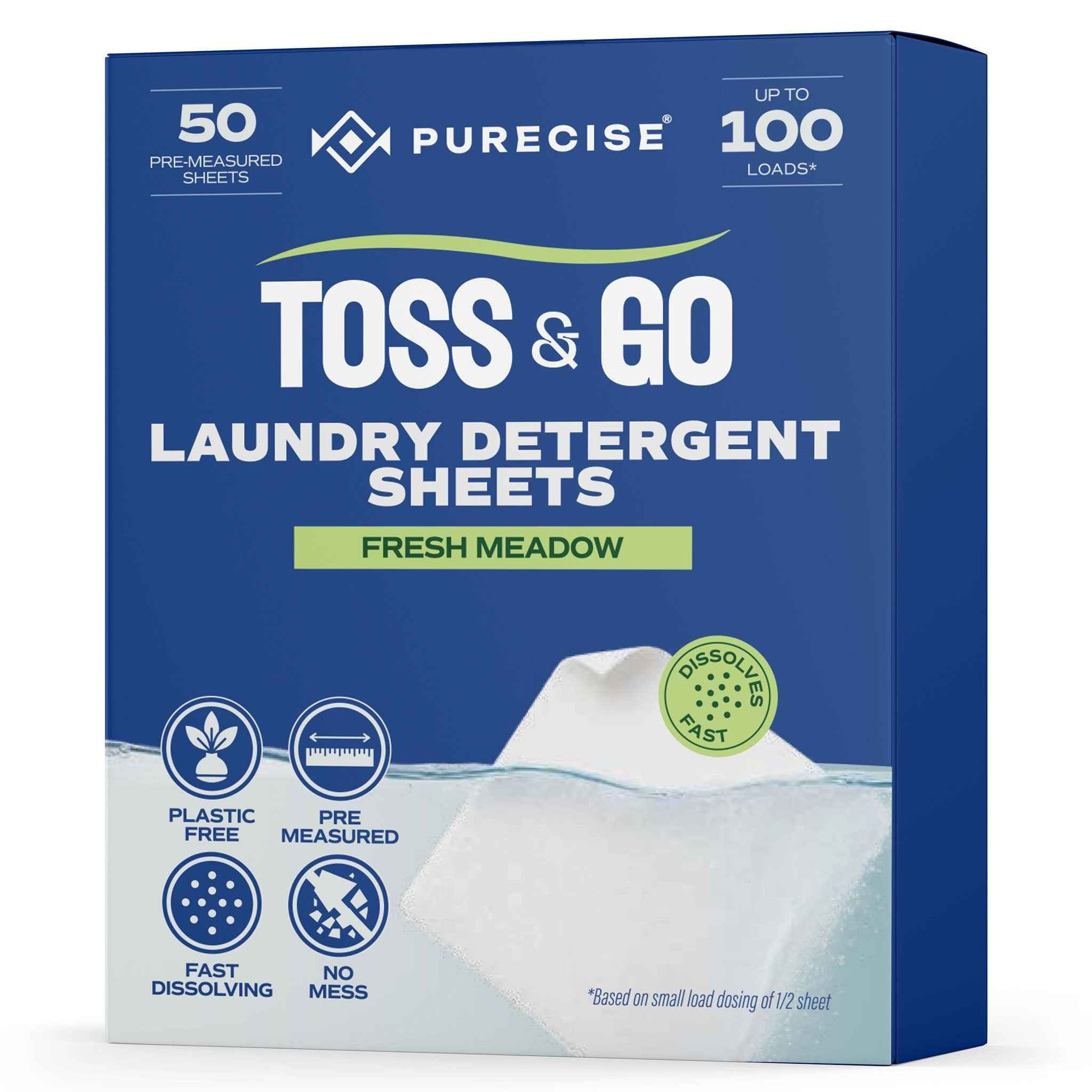
Purecise’s Toss & Go laundry sheets are pre-dosed, dissolve fully in any wash temperature, and are formulated without harsh chemicals, with a hypoallergenic formula designed for sensitive skin. The full ingredient list is public. The packaging is plastic-free. Those are verifiable facts, not adjectives. That’s the standard we think every cleaning product should meet, and it’s the standard this article’s checklist is designed to help you apply to every brand you consider.
Purecise sheets: full disclosure, no plastic jug required
Shoppers who’ve read this far know exactly what to look for: named ingredients, a recognized certification or transparent formulation rationale, plastic-free packaging, and a format that doesn’t waste product or generate unnecessary waste. Purecise’s laundry detergent sheets check every one of those boxes.
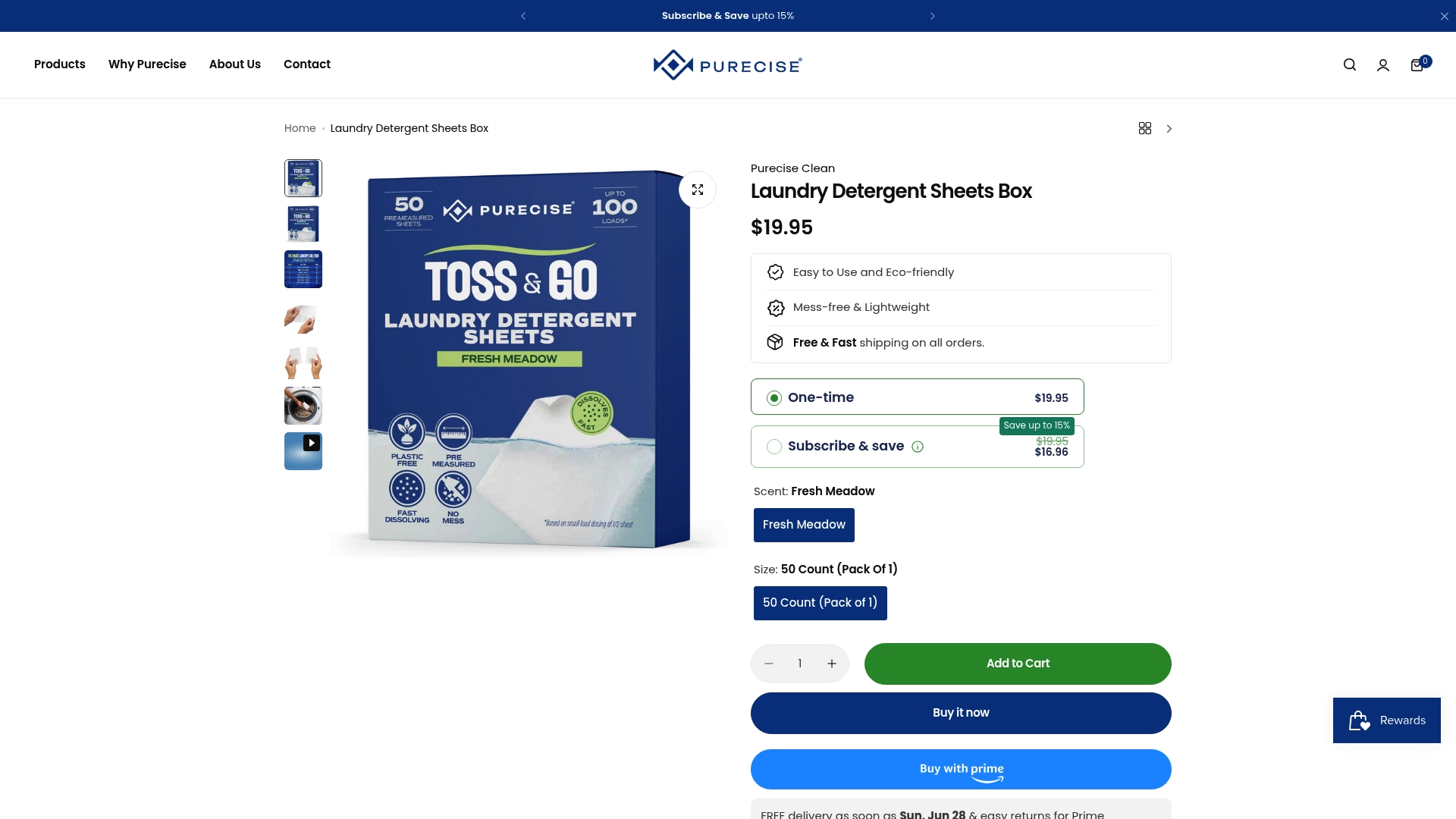
Each sheet is pre-dosed and plant-based, with a hypoallergenic formula that works in cold and hot water, standard and HE machines. No measuring, no plastic jug, no mystery “fragrance blend.” The Laundry Detergent Sheets Box holds a full month’s supply in cardboard packaging that’s genuinely recyclable. If you travel or want a smaller commitment first, the Laundry Detergent Sheets Envelopes fit in a carry-on. Every order comes with a 100% money-back guarantee. Browse the full line and see the ingredient list at Purecise Clean.
Sources
Use these directly when you want to go beyond the label.
- FTC issues revised Green Guides (green guides PDF)
- Identifying Greener Cleaning Products | US EPA
- How to spot greenwashing and buy actual green products | CNN
- Greenwashing: The 9 Words That Mean Almost Nothing on a Cleaning Product Label (Ecolosophy blog)
- Learn to Spot Greenwashing | NRDC
- Pubmed
- Carbon offsets explainer | MIT Climate
Recommended
Fabric Care for First-Time Laundry Doers: A Beginner's Guide
Optical Brighteners in Detergent: What They Do and Why It Matters
Related Posts

Remove Berry Stains: Cold Water First, Detergent Sheets on the Go

Remove Makeup Stains on the Go With a 10–15 Minute Pretreat

Remove Lipstick Stains: The First 15 Minutes, Plus Detergent Sheets

How Often to Wash Towels: Bath Weekly, Hand Towels Every Few Days

Detergent Allergy Rash: Test a Low Residue Wash Without Fragrance

Save Clothes From Mud Stains in 1–2 Hours With Premeasured Sheets

Fabric First Sweat Stain Fixes: Measured DIY Recipes and Sheets


