

Laundry Sheet Weight vs Liquid Bottle: Which Wins?
Laundry detergent sheets beat liquid bottles on weight, shipping carbon, and everyday convenience. A 60-sheet pack weighs less than a quarter of a kilogram while an equivalent liquid jug is several times heavier, and that gap is almost entirely water. Liquid formulations contain a majority of water by weight, meaning you are paying to ship something your tap already provides. The trade-off is cleaning muscle: Consumer Reports finds sheets handle routine laundry well but recommends liquids or powders for heavily soiled items. Wirecutter echoes that position. For most households, the answer is a hybrid: sheets for daily loads, liquid reserved for the weekend’s grass-stained jeans.
Key trade-offs at a glance:
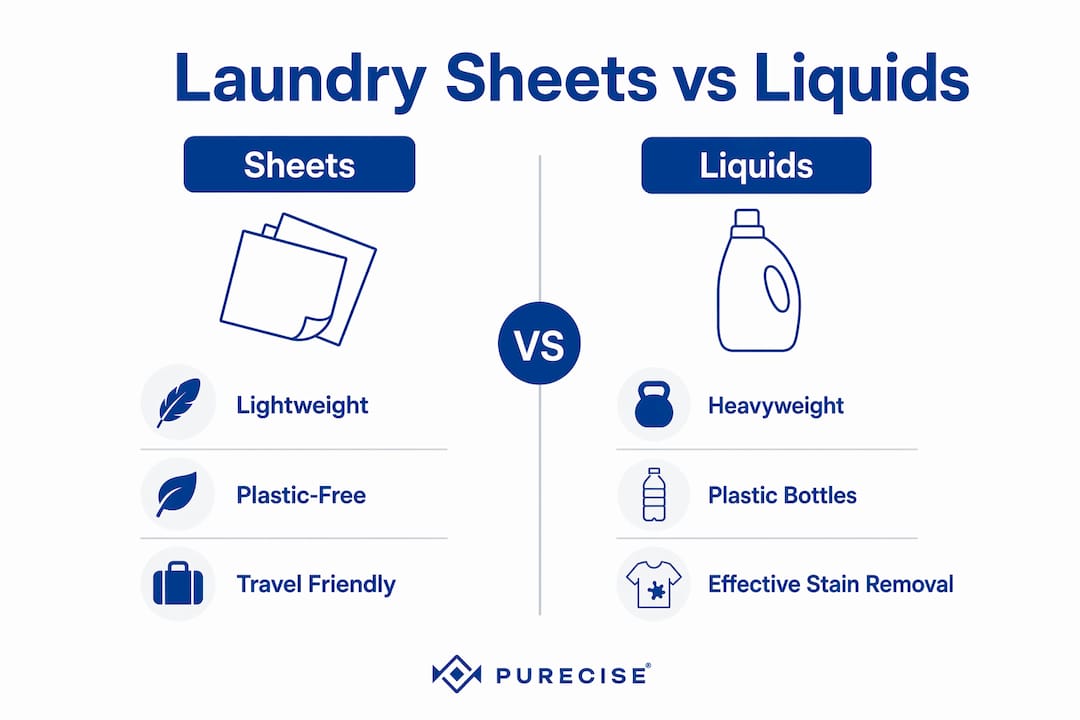
- Weight and shipping: Sheets are 10–15× lighter per equivalent dose, cutting transport fuel and plastic waste.
- Cleaning power: Sheets match liquids on everyday loads; liquids pull ahead on grease, wine, and set-in stains.
- Convenience: Sheets are pre-dosed, spill-proof, and travel-ready. Liquid requires measuring and a jug.
- Cost: Sheets can run higher per load on premium brands; mainstream options close the gap.
- Environment: Sheets win on packaging and shipping; PVA binder biodegradability is still debated.
Purecise’s Toss & Go sheets are one concrete example of the sheet format done with a hypoallergenic, plastic-free approach. The sections below unpack every dimension so you can decide which format fits your laundry routine.
Table of Contents
- How do sheets and liquid detergents compare side by side?
- How laundry sheets and liquid detergents actually work
- Weight, packaging, and what the shipping difference actually means
- What do independent tests say about cleaning performance?
- Cost per load: what you actually pay per wash
- Environmental concerns beyond the shipping weight
- Machine compatibility, travel, and practical edge cases
- What dermatologists say about sensitive skin and safety
- Which format should you choose? A quick decision guide
- How Purecise illustrates the sheet format in practice
- Final recommendation and next steps
- Key Takeaways
- The case for living with both formats
- Try Purecise sheets with no risk
- Useful sources
How do sheets and liquid detergents compare side by side?
| Dimension | Laundry Sheets | Liquid Detergent | Edge |
|---|---|---|---|
| Weight per 60 washes | under 200 g | multiple kilograms | Sheets — significantly lighter |
| Everyday cleaning | Good | Good | Tie — comparable on light soils |
| Heavy stain removal | Moderate | Strong | Liquid — more enzymes, more volume |
| Cost per load | — | — | Liquid — cheaper at mass-market end |
| Packaging waste | Cardboard/paper | Plastic jug | Sheets — minimal plastic |
| Transport CO2 | Low (light, compact) | Higher (water weight) | Sheets — lower shipping footprint |
| Convenience | Pre-dosed, no spills | Measuring required | Sheets — simpler handling |
| Travel / portability | Excellent | Poor | Sheets — pocket-sized |
| Machine compatibility | HE, standard, cold | HE, standard, cold | Tie — both work across machine types |
| Sensitive skin options | Many fragrance-free | Some fragrance-free | Tie — depends on formulation |
How laundry sheets and liquid detergents actually work
A liquid detergent is a ready-to-use solution: surfactants, enzymes, and other actives suspended in water. You pour a measured dose into the drum or dispenser, and the formula gets to work immediately on contact with the wash water. The water in the bottle is a carrier, not a cleaner.
A laundry sheet is the same chemistry compressed into a thin film, typically bound with polyvinyl alcohol (PVA) or a cellulose-based binder. Drop one in the drum, and it dissolves as the wash cycle fills. The active ingredients release just as they would from a liquid dose.
The critical difference is volume. A single sheet often weighs 1–3 grams, while a standard liquid dose runs around 37 grams. Fitting enough surfactants and enzymes into that smaller mass is genuinely difficult, which is why sheets tend to underperform on heavy soils. It is not a formulation failure; it is a physics constraint.
- Dosing flexibility: Liquid lets you scale up for a filthy load. Most sheets come perforated so you can use half for a small load or two for a large one, but the range is narrower.
- Dissolution speed: Sheets dissolve well in warm water; cold water may need a bit more agitation, especially in a front-loader with a low-water cycle.
- Active ingredients: Both formats can carry enzymes (proteases for protein stains, lipases for grease). Sheets increasingly include them, though at lower concentrations than premium liquids.
Pro Tip: If you use sheets in a cold-water cycle, toss the sheet directly into the drum before adding clothes rather than placing it in the dispenser drawer. Direct water contact speeds dissolution.
Weight, packaging, and what the shipping difference actually means
The weight gap between formats is not subtle. A Tide 80 fl oz liquid bottle covers 64 loads and weighs 5.8 pounds (about 2.6 kg). A 60-sheet pack covers a comparable number of washes and weighs under 200 g. That is roughly a 13× weight difference per equivalent wash count.
| Format | Pack weight | Washes covered | Weight per wash |
|---|---|---|---|
| Liquid (standard jug) | ~2.6 kg (5.8 lbs) | 64 | 37 grams |
| Laundry sheets | under 200 g | 60 | 1–3 grams |
Because liquid jugs contain a large proportion of water, a delivery truck carrying liquid detergent is largely hauling tap water. A truck loaded with sheet packs moves much less weight and volume for the same number of wash doses. That translates directly into fewer truck miles per unit, lower fuel burn, and reduced CO2 per load delivered.
Shipping weight matters: A pallet of liquid jugs covering 10,000 wash loads weighs roughly 400 kg in product alone. The same 10,000 wash doses in sheet form weigh under 30 kg. That difference compounds across a supply chain.
The plastic jug itself adds to the footprint. Most liquid detergent bottles are HDPE plastic, and while technically recyclable, recycling rates for plastic containers remain low in practice. Sheet packaging is typically cardboard or a paper envelope, both with cleaner end-of-life options.
What do independent tests say about cleaning performance?
Sheets are real detergent. They dissolve, they lift stains, and on a normal load of lightly to moderately soiled clothes, most perform comparably to mainstream liquids. The gap opens on the tough stuff.
Consumer Reports finds sheets suitable for routine laundry but recommends liquids or powders when the load is heavily soiled. Independent testing at Goods Discovered found sheets underperform liquid detergents by roughly 10–11% on average across standardized stain tests. The reason is volume: a 3–5 gram sheet simply carries fewer surfactants and enzymes than a 37-gram liquid dose, and that matters when you are fighting grease, coffee, or set-in wine.
Good Housekeeping’s lab testing found that sheets have improved as more brands add enzymes to their formulas, though overall they still trail the best liquid and pod detergents on heavy-soil cycles.
One practical caution from Wirecutter: users who find sheets underperform on a tough stain often re-wash the load, which adds water and energy use that can erase the shipping savings entirely. Choosing the right format for the right load prevents that outcome.
Pro Tip: Reserve sheets for everyday maintenance loads: work clothes, bedding, and lightly worn items. Keep a small bottle of liquid or a pre-treatment spray for grass stains, grease, and anything that sat in the hamper for a week.
Cost per load: what you actually pay per wash
Sticker price on a sheet pack can look expensive until you divide by the number of washes. Published per-load estimates suggest mainstream sheets tend to cost more per wash than mainstream liquid detergents at standard retail pricing. Premium sheets close the gap with premium liquids; budget sheets can match mid-range liquids.
The overdosing problem: Studies on consumer behavior consistently show people pour more liquid detergent than the label recommends. If you routinely use 20% more liquid than directed, your real cost per load rises by the same amount, and your environmental footprint grows with it. Pre-dosed sheets eliminate that variable entirely.
Pods and concentrated liquids narrow the weight advantage of sheets but do not close it. Even a concentrated liquid pod still ships in a plastic tub with significant water content compared to a paper-packaged sheet. The per-load cost of pods often sits above mainstream liquid, putting sheets and pods in a similar price tier.
The honest cost comparison: if you buy mainstream liquid in bulk and measure accurately, liquid wins on price. If you factor in the cost of overdosing (which most people do), the gap shrinks. Sheets offer cost predictability that liquid does not.
Environmental concerns beyond the shipping weight
Shipping weight is the clearest win for sheets, but the full environmental picture is more complicated.
PVA binders and biodegradability. Most sheets use polyvinyl alcohol (PVA or PVOH) as the binding film. PVA is water-soluble, which sounds clean, but Wirecutter notes that whether PVA fully biodegrades in all wastewater treatment systems is actively debated. Some treatment plants handle it well; others may pass it through partially intact, raising microplastic-adjacent concerns.
Manufacturing water use. Sheets are marketed as water-free, but industry experts note that manufacturing still requires significant water during formulation and production. A full lifecycle assessment can reduce the apparent carbon advantage of sheets compared to what shipping-only comparisons suggest.
- Packaging: Cardboard and paper envelopes are genuinely better than HDPE plastic jugs on recyclability and material weight.
- Plastic jugs: Most are technically recyclable but depend on local collection infrastructure. Many end up in landfill.
- Manufacturing location: Good Housekeeping flags that where sheets are made matters. Domestic production generally carries a smaller transport footprint than overseas manufacturing.
- Re-washing risk: If sheets underperform and you re-wash a load, the water and energy cost of that second cycle can offset the shipping savings. Format choice and load matching matter.
For a deeper look at sustainable laundry packaging, the trade-offs between cardboard, compostable pouches, and refillable systems are worth understanding before making a permanent switch.
Machine compatibility, travel, and practical edge cases
Both formats work in HE and standard machines. Both handle cold-water cycles, though sheets benefit from direct drum placement in cold or low-water washes. Neither format requires a special machine setting.

Where sheets genuinely pull ahead is portability. A month’s supply fits in a jacket pocket. There is no spill risk, no measuring cup to rinse, and no jug to lug up three flights of stairs. For apartment dwellers, frequent travelers, or anyone with limited storage, that is a real practical advantage.
Situations where liquid still makes sense:
- Very large or commercial loads where dose scaling matters
- Heavily soiled work clothes that need enzyme-heavy formulations
- Loads requiring color-safe bleach or fabric softener additives (most sheets do not include these)
- Hand-washing delicates, where controlling the exact amount of detergent is easier with liquid
Safety note: Both concentrated sheets and liquid detergents should be stored out of reach of children and pets. Sheets can look like candy or wipes to a small child. Keep them in a latched cabinet and follow label guidance on first-aid steps if ingested.
Pro Tip: When traveling, pack a small envelope of sheets in your carry-on. They pass through TSA without the liquid-volume restrictions that apply to detergent bottles, and they weigh almost nothing.
What dermatologists say about sensitive skin and safety
Skin safety comes down to formulation, not format. That is the consistent message from dermatologists who have weighed in on the sheet-versus-liquid debate.
“A detergent’s safety for sensitive skin rests on being fragrance-free and dye-free rather than whether it is a sheet or liquid.” — Dr. Peter Lio, as cited by CNN Underscored
The delivery mechanism, whether a thin film or a poured liquid, does not determine whether a product will irritate skin. What matters is what is in it. Fragrance is the most common laundry-related skin irritant. Optical brighteners and certain preservatives are secondary concerns.
For households with sensitive skin or allergies, here is what to check on any label, sheet or liquid:
- Fragrance-free (not just “unscented,” which can still contain masking fragrance)
- Dye-free and free of optical brighteners
- Enzyme content: proteases and lipases are generally well-tolerated but can trigger reactions in some people; patch-test a new product on a small load first
- Hypoallergenic labeling: not regulated by the FDA, so look for third-party certifications or ingredient transparency alongside the claim
- EPA Safer Choice certification: a meaningful signal that ingredients meet safety and environmental standards
For a full breakdown of ingredients to avoid for sensitive skin, Purecise’s ingredient guidance covers the most common offenders by category.
Which format should you choose? A quick decision guide
Choose sheets if you:
- Do mostly light-to-moderate loads (work clothes, bedding, everyday wear)
- Travel frequently or live in a small space
- Want to cut plastic packaging from your routine
- Have children or pets and want pre-dosed simplicity with no measuring errors
Choose liquid if you:
- Regularly wash heavily soiled items (sports gear, work uniforms, kids’ clothes after outdoor play)
- Need enzyme-heavy or bleach-containing formulations
- Want the lowest possible cost per load at mass-market pricing
- Wash very large loads where dose flexibility matters
Common household profiles:
- Single traveler: Sheets, no question. Pack an envelope and forget the jug.
- Family with young kids and heavy soils: Liquid for the muddy loads, sheets for school clothes and bedding.
- Eco-focused shopper: Sheets win on packaging and shipping; verify PVA and manufacturing claims before committing.
- Apartment dweller: Sheets for storage and spill reasons alone.
Pro Tip: Run a controlled test before fully switching. Wash the same type of load with sheets for two weeks, then compare results and cost against your usual liquid. Most people find sheets handle 80% of their laundry without issue, which is enough to justify keeping liquid only for the tough 20%.
How Purecise illustrates the sheet format in practice
Purecise’s Toss & Go sheets are a concrete example of the format’s potential. The following points are brand claims, clearly labeled as such.
- Pre-dosed and plastic-free: Each sheet is a single dose in cardboard or paper packaging, no plastic jug involved (brand claim).
- Hypoallergenic formulation: Purecise states the formula is free from harsh chemicals and suitable for sensitive skin, including families with children (brand claim).
- HE and cold-water compatible: Sheets are designed to dissolve completely in any wash type, including cold cycles (brand claim).
- Money-back guarantee: Purecise backs the product with a 100% money-back guarantee, which is a meaningful signal of confidence in performance (brand claim).
- Storage: A full month’s supply fits in a pocket, which addresses the storage and portability advantages discussed throughout this article.
You can try the Purecise sheet box for a full supply or start with the envelope option for a lower-commitment first test.
Pro Tip: Before fully switching to any sheet brand, run a home stain test. Apply a small amount of your most common tough stain (coffee, grease, or grass) to a fabric swatch, wash with the sheet, and compare the result to your usual liquid. One load tells you more than any review.
Final recommendation and next steps
Sheets win on weight, shipping carbon, convenience, and packaging. Liquids win on raw cleaning power for heavy soils and cost at the mass-market end. Neither format is universally superior, and the most practical approach for most households is to use both.
Three steps to find your right balance:
- Run a stain test. Wash your typical weekly load with sheets for two weeks. Note any loads that needed re-washing. That tells you exactly where you need liquid backup.
- Compare cost per load, not pack price. Divide the total price by the number of washes. Factor in how accurately you measure liquid, since overdosing is common and raises your real per-load cost.
- Adopt a hybrid if needed. Keep a small bottle of enzyme-heavy liquid for the 20% of loads that need it. Use sheets for everything else. You cut plastic waste, reduce shipping weight, and still get the cleaning power where it counts.
If environmental impact is your priority, sheets are the clearer choice on packaging and transport. If budget is the primary driver, mainstream liquid in bulk is hard to beat on price per load. Most people land somewhere in between, and the hybrid approach handles that well.
Key Takeaways
Laundry sheets win on weight and shipping carbon, but liquid detergents still lead on heavy-stain removal, making a hybrid approach the most practical solution for most households.
| Point | Details |
|---|---|
| Weight gap is significant | A 60-sheet pack weighs under 200 g versus ~2.6 kg for an equivalent liquid jug. |
| Liquid is 60–80% water | That water fraction drives higher shipping weight and transport CO2, not cleaning performance. |
| Sheets underperform on tough stains | Independent testing shows sheets average 10–11% below liquids on standardized stain tests. |
| Skin safety is about ingredients | Fragrance-free and dye-free formulation matters more than whether the product is a sheet or liquid. |
| Purecise sheets offer a plastic-free option | Pre-dosed, hypoallergenic, and backed by a money-back guarantee for households ready to try the format. |
The case for living with both formats
The conventional framing of this debate, sheets versus liquid as a permanent either/or choice, misses the point. Most households have two or three distinct laundry categories: the easy weekly rotation, the occasional heavy-soil load, and the delicates. No single format handles all three optimally.
Sheets make the most sense for the majority of loads most people run. A week’s worth of work clothes, bedding, and everyday wear does not need the enzyme firepower of a premium liquid. Sheets handle it cleanly, with no measuring, no spills, and a fraction of the plastic waste. Where the format genuinely disappoints is on the kind of load that has been sitting in the hamper since last Tuesday with a grease stain that has had time to set. That is where liquid earns its place.
The environmental argument for sheets is real but not absolute. Shipping weight and plastic packaging are genuine wins. The PVA biodegradability question and manufacturing water use are genuine unknowns. Treating sheets as a perfect sustainability solution overstates the case; treating them as a meaningful step in the right direction is accurate.
Try Purecise sheets with no risk
Switching detergent formats is a low-stakes decision when there is a money-back guarantee behind it. Purecise Toss & Go sheets are pre-dosed, plastic-free, and formulated without harsh chemicals, making them a practical starting point for anyone who wants to cut plastic jug waste without sacrificing clean laundry.
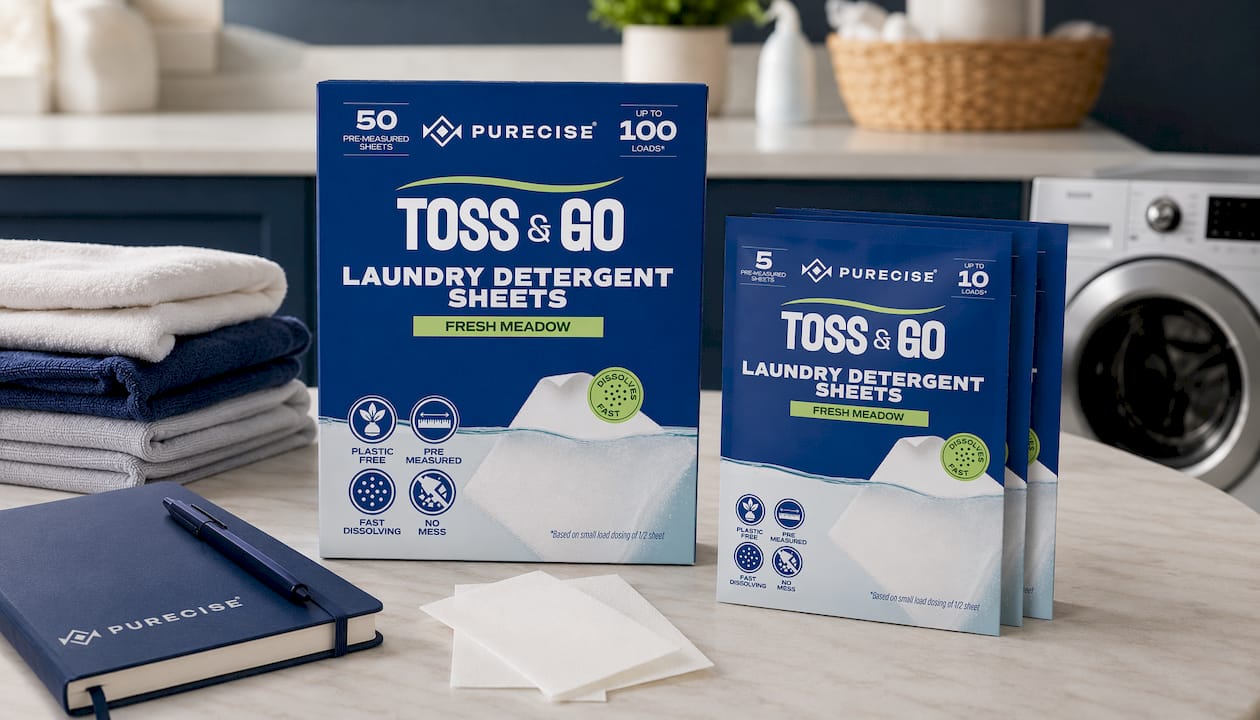
Start with the sheet envelope for a travel-sized trial, or go straight to the full box if you are ready to replace your jug. If the sheets do not perform to your standard, the money-back guarantee covers you. Product performance claims above are brand-provided; independent test results vary by load type and soil level, as covered throughout this article.
This article is general consumer information, not professional advice. Verify ingredient safety for your specific health needs with a dermatologist or healthcare provider.
Useful sources
- Consumer Reports: Laundry Detergent Sheets Review — primary source for cleaning effectiveness findings and the recommendation to use liquids for heavily soiled loads.
- Wirecutter: Laundry Detergent Sheets Sustainability Review — covers PVA biodegradability concerns, manufacturing water use, and the re-washing risk.
- CNN Underscored: Best Laundry Detergent Sheets — includes Dr. Peter Lio’s dermatologist commentary on sensitive skin and formulation.
- Green Llama: Carbon Footprint of Cleaning Products — explains the water-shipping problem and why liquid detergent weight drives transport emissions.
- Speed Queen Laundries: Laundry Sheets Review — concrete weight-per-dose figures and the 10–15× shipping weight comparison.
- Goods Discovered: Do Laundry Sheets Actually Work? — standardized stain testing showing sheets average 10–11% below liquids, with dose-weight comparison data.
- Good Housekeeping: Best Laundry Detergent Sheets — lab testing methodology and per-load cost range data ($0.20–$1.00).
- EPA Safer Choice Program — ingredient safety standards referenced in the sensitive-skin section.
- How concentrated detergent sheets reduce emissions — Purecise brand content on the logistics and emissions argument for water-free formats.
Recommended
Detergent Quantity Control Saves Money: Here's How
What "Non-Toxic Certified" Detergent Means and How to Verify It
Related Posts

Remove Berry Stains: Cold Water First, Detergent Sheets on the Go

Remove Makeup Stains on the Go With a 10–15 Minute Pretreat

Remove Lipstick Stains: The First 15 Minutes, Plus Detergent Sheets

How Often to Wash Towels: Bath Weekly, Hand Towels Every Few Days

Detergent Allergy Rash: Test a Low Residue Wash Without Fragrance

Save Clothes From Mud Stains in 1–2 Hours With Premeasured Sheets

Fabric First Sweat Stain Fixes: Measured DIY Recipes and Sheets


