

What "Non-Toxic Certified" Detergent Means and How to Verify It
A “non-toxic certified” laundry detergent has passed an independent, ingredient-level review by a recognized third-party program such as EPA Safer Choice or EWG VERIFIED®. That distinction matters because “non-toxic” alone is an unregulated marketing term in the United States. Any brand can print it on a bottle without a single independent test. Certification changes that equation entirely.
Here is what separates a certified product from a self-declared one:
- “Non-toxic” (uncertified): A front-of-bottle claim with no federal legal definition, no required testing, and no independent review. The FTC Green Guides provide advertising guidance, but they do not require pre-approval or verification before a brand uses the term.
- “Non-toxic certified”: The formula has been submitted to a recognized program, every ingredient has been reviewed against toxicological and environmental criteria, and the brand must disclose the full formula to the certifying body.
- EPA Safer Choice: Evaluates each ingredient individually, maintains a searchable product database, and explicitly screens for hazardous byproducts including 1,4-dioxane formation pathways.
- EWG VERIFIED®: Applies strict fragrance-disclosure rules and rates every ingredient against EWG’s hazard database.
Purecise publishes this guide to help you tell the difference between a label and a guarantee.
Table of Contents
- How “non-toxic,” “eco-friendly,” and “natural” actually differ
- Why “non-toxic” on the bottle isn’t legally reliable in the United States
- Common detergent ingredients to avoid if you want genuinely safer results
- Which third-party certifications actually mean something
- How to verify whether a detergent is truly non-toxic
- Does “non-toxic” mean “safe”? What you should realistically expect
- What to buy and how to use detergents for genuinely safer laundry
- Key Takeaways
- The verification gap most shoppers never close
- Purecise Toss & Go sheets: a format built for the checklist
- Authoritative sources to bookmark
How “non-toxic,” “eco-friendly,” and “natural” actually differ
These three terms answer completely different questions, and confusing them is how people end up with a “natural” detergent that still triggers a skin reaction.
- “Non-toxic” is a human-health claim. It signals the formula is unlikely to cause harm at typical exposure levels. Without certification, it is self-declared and unverifiable.
- “Non-toxic certified” means a third party reviewed the ingredients for health hazards. The brand had to disclose what is actually in the bottle.
- “Eco-friendly” addresses environmental impact: biodegradability, aquatic toxicity, packaging. A product can be eco-friendly and still leave irritating residues on fabric.
- “Natural” refers to ingredient origin, not safety. A plant-derived ingredient can still cause sensitization or contain hazardous processing byproducts. As one comparison of these terms puts it, the strongest choice combines verified health screening, environmental performance, and clean ingredient origins.
Which label to prioritize based on your goal:
- Sensitive skin or allergies → look for “non-toxic certified” or “fragrance-free” with an EPA Safer Choice or EWG VERIFIED® logo
- Environmental priority → EPA Safer Choice or USDA BioPreferred
- Ingredient origin matters to you → “natural” or plant-based, but always cross-check with a cert
- All three matter → choose a product that holds at least one health-screening cert and discloses a full ingredient list
Why “non-toxic” on the bottle isn’t legally reliable in the United States
The U.S. regulatory gap here is real and worth understanding before you spend money on a product based on front-label language alone.
Neither the FDA nor the EPA defines or enforces “non-toxic” for household cleaning products. The FTC’s Green Guides (16 CFR Part 260) set standards for environmental marketing claims and can be used to challenge deceptive advertising after the fact, but they do not require any pre-market review or independent testing before a brand uses the term. That means a company can launch a product tomorrow, call it “non-toxic,” and face no regulatory hurdle unless a complaint is filed and investigated.
The practical result: “Non-toxic” on a detergent label is a marketing decision, not a safety finding. Certification is the only reliable independent assurance that someone outside the company reviewed the formula.
What you can use as reliable signals:
- A recognized certification logo (EPA Safer Choice, EWG VERIFIED®, MADE SAFE)
- A full ingredient list, not just “surfactants” or “cleaning agents”
- A Safety Data Sheet (SDS) with hazard statements and ingredient concentrations
- Verification in the certifying body’s online directory
Common detergent ingredients to avoid if you want genuinely safer results
Knowing which ingredients to flag lets you scan a label in under two minutes. These are the ones that show up most often in products that claim “non-toxic” without earning it.
- Synthetic fragrance (“fragrance” or “parfum”): A single fragrance entry can represent dozens of undisclosed chemicals. Health departments recommend fragrance-free products for people with allergies or respiratory sensitivities because the blend is rarely disclosed. Note: “unscented” is not the same as “fragrance-free.” Unscented products sometimes contain masking fragrances.
- Optical brighteners: These UV-reactive compounds stay on fabric after washing and can cause skin irritation and photosensitivity. They do not rinse out.
- Phosphates: Effective at softening water, but they cause nutrient pollution in waterways, fueling algae blooms. Most U.S. states have restricted or banned them in laundry detergents.
- Ethoxylated surfactants (potential 1,4-dioxane source): Surfactants like sodium laureth sulfate are produced through ethoxylation, a process that can leave 1,4-dioxane as a manufacturing byproduct. The EPA has assessed 1,4-dioxane as a likely human carcinogen. New York State has set limits on 1,4-dioxane in cleaning products.
- Nonylphenol ethoxylates (NPEs): Hormone-disrupting surfactants that break down into compounds toxic to aquatic life. Largely phased out in Europe but still found in some U.S. products.
- Methylisothiazolinone (MI) and methylchloroisothiazolinone (MCI): Preservatives linked to skin sensitization and allergic contact dermatitis, particularly in leave-on or rinse-off products used frequently.
- Artificial dyes: No cleaning function. Added for appearance and associated with skin reactions in sensitive individuals.
- Unnecessary bleaching agents (sodium hypochlorite): Effective disinfectants but harsh on skin, reactive with other chemicals, and a respiratory irritant at higher concentrations.
For a deeper look at toxic chemicals in conventional detergents, Purecise covers the full breakdown with sourced explanations.
A note on format: Powder detergents often require fewer preservatives than liquids, which simplifies the ingredient review. That said, powders can still contain optical brighteners and problematic surfactants, so checking the list remains necessary. Detergent sheets vary widely by brand. Some use PVA (polyvinyl alcohol) as a dissolvable film, which is under ongoing environmental review. Always check the full ingredient list regardless of format.
Which third-party certifications actually mean something
Not all certification logos carry the same weight. Here is what the major programs actually require and where each one has limits.
| Certification | What It Screens | Key Requirement | Limitation |
|---|---|---|---|
| EPA Safer Choice | Human health + environmental endpoints, ingredient-by-ingredient | Full formula disclosure to EPA; safer ingredients list compliance | May not cover manufacturing byproducts in all cases |
| EWG VERIFIED® | Health-hazard screening, full fragrance disclosure | Ingredient transparency; rated against EWG hazard database | Focuses on hazard, not always exposure context |
| MADE SAFE | Broad hazardous-chemical screen (human health + ecosystem) | Independent review by scientists; full ingredient disclosure required | Does not certify environmental performance separately |
| USDA BioPreferred | Biobased content (ingredient origin) | Minimum percentage of biobased ingredients | Not a safety certification; does not screen for toxicity |
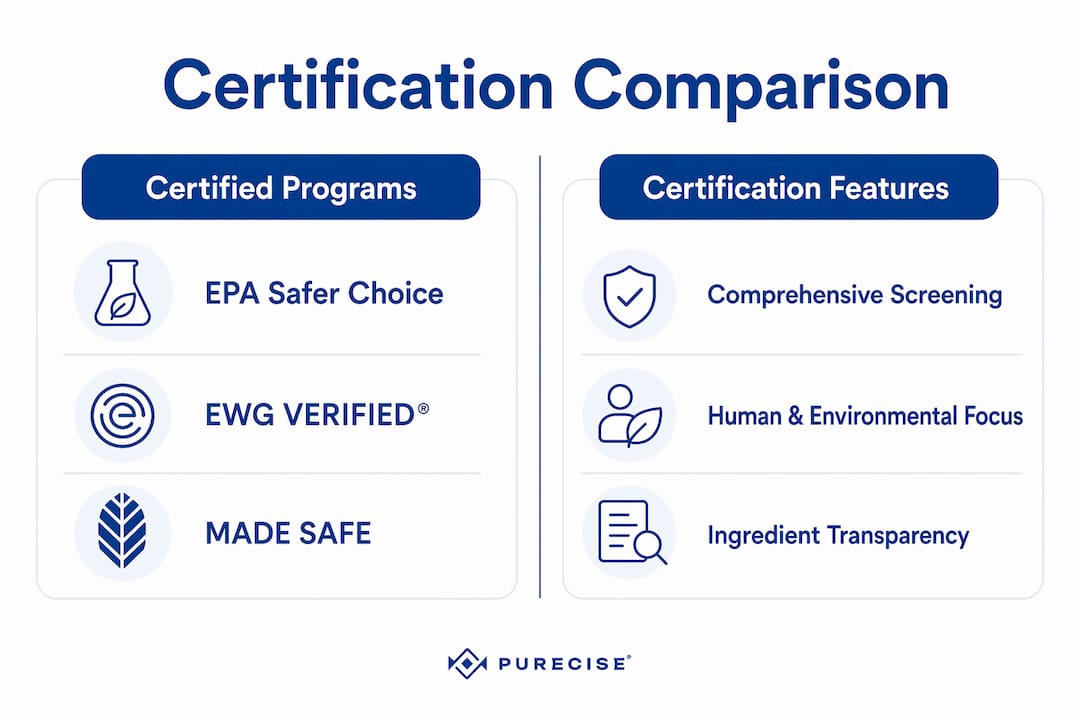
EPA Safer Choice is the most rigorous for health and environmental endpoints combined. It explicitly evaluates for 1,4-dioxane formation pathways and requires ongoing compliance monitoring, not just a one-time review. EWG VERIFIED® is particularly strong on fragrance transparency, which matters most if you have skin sensitivities or respiratory concerns. MADE SAFE screens against a broad list of hazardous chemicals and is worth looking for on products that do not hold a Safer Choice cert. USDA BioPreferred tells you about ingredient origin, not safety. It is useful context but should never be read as a health certification on its own.
One honest limitation applies to all programs: certification scope may not cover every manufacturing byproduct, every exposure scenario, or every environmental endpoint. Combining a cert check with a full ingredient-list review gives you the strongest picture.
Pro Tip: The EPA Safer Choice product database and the EWG Guide to Healthy Cleaning are both free and searchable by product name. Bookmark both before your next shopping trip.
Understanding how clean-label manufacturing works at the production level can also clarify why some brands earn certs more easily than others.
How to verify whether a detergent is truly non-toxic
Run this checklist before you buy, whether you are in a store aisle or scrolling a product page.
- Look for a recognized certification logo. EPA Safer Choice, EWG VERIFIED®, or MADE SAFE are the ones worth trusting. Then verify the product in the certifying body’s online directory. A logo on packaging can be outdated or misused; the database confirms current status.
- Read the full ingredient list. Look for INCI (International Nomenclature of Cosmetic Ingredients) names. Flag any entry that just says “fragrance” or “parfum” without component disclosure. Look up unfamiliar surfactant or preservative names in the EWG database. Purecise’s guide to reading detergent ingredient labels walks through exactly what to look for line by line.
- Check the Safety Data Sheet (SDS). Most brands are required to make SDS documents available. Search “[brand name] + laundry detergent + SDS” to find it. Look at Section 2 (hazard identification) and Section 3 (composition/ingredient information) for concentration ranges and any listed hazard statements.
- Search the cert database and brand transparency pages. If a brand refuses to disclose ingredients or does not appear in any cert directory, treat the “non-toxic” claim skeptically. Lack of disclosure is a reliable red flag. The clean laundry ingredient checklist from Purecise gives you a printable reference for this step.
Pro Tip: Type the product name directly into the EPA Safer Choice product search at epa.gov/saferchoice/products and the EWG Guide to Healthy Cleaning at ewg.org/guides/cleaners. If the product does not appear in either database, the certification claim is unverified.

Does “non-toxic” mean “safe”? What you should realistically expect
Certification reduces meaningful chemical-hazard risk. It does not make a product risk-free in every context.
A certified, fragrance-free detergent genuinely lowers the risk of skin sensitization, respiratory irritation from fragrance chemicals, and residue-related reactions. For people with eczema or contact dermatitis, fragrance is the single biggest risk factor in laundry-related flareups. Switching to a certified, fragrance-free formula and running an extra rinse cycle addresses the most common trigger.
Where certification has limits:
- Accidental ingestion: No laundry detergent is safe to ingest. “Non-toxic” does not change that. Keep all detergents out of reach of children regardless of certification status.
- Occupational or high-volume exposure: Workers handling large quantities of any detergent face different exposure levels than a household user. Cert standards are calibrated for typical consumer use.
- Individual sensitivities: Even certified products can cause reactions in people with specific ingredient sensitivities. A reaction to a certified product does not mean the cert is wrong; it means individual biology varies.
Simple mitigation steps that work for most people: use the recommended dose (overdosing leaves more residue on fabric), run an extra rinse cycle if you have sensitive skin, wash new clothes before wearing them, and do a patch test on a small skin area if you have a history of reactions. Do not interpret “non-toxic” as a legal safety guarantee for any specific use case. For guidance on ingredients to avoid for sensitive skin, Purecise has a dedicated resource.
What to buy and how to use detergents for genuinely safer laundry
Buying rules:
- Prefer products certified by EPA Safer Choice, EWG VERIFIED®, or MADE SAFE over self-declared “non-toxic” claims.
- Choose fragrance-free over “unscented” when sensitivity is a concern. Fragrance-free means no fragrance ingredients were added. Unscented may still contain masking agents.
- Check the full ingredient list before purchasing, not just the front label.
- For people with multiple sensitivities, powders or sheets with minimal preservatives are worth prioritizing. Liquids often require more preservatives to maintain stability.
Usage tips:
- Use the recommended dose. More detergent does not mean cleaner clothes; it means more residue.
- Run an extra rinse cycle if you or a family member has sensitive skin or a history of reactions.
- Wash new clothing before wearing it. Manufacturing residues and finishes can be irritating even when the detergent you use is certified.
- If you are switching formats (liquid to sheets, for example), give your skin a week or two to adjust before concluding whether the new product works for you.
Format comparison:
- Sheets: Pre-dosed, low packaging waste, easy to store. Ingredient transparency varies by brand, so always check the list. The format tradeoffs across sheets, pods, and liquids are covered in detail by Purecise.
- Liquids: Easy to pre-treat stains but require preservatives and often come in single-use plastic. Dosing errors are common.
- Powders: Fewer preservatives needed, often lower cost per load, but can include optical brighteners. Check the ingredient list the same way you would for any format.
Key Takeaways
“Non-toxic certified” means a recognized third party reviewed every ingredient in the formula. A front-label “non-toxic” claim without certification is unverified marketing language under U.S. rules.
| Point | Details |
|---|---|
| Certification beats label claims | EPA Safer Choice, EWG VERIFIED®, and MADE SAFE require independent ingredient review; “non-toxic” alone does not. |
| “Non-toxic” is unregulated in the U.S. | No federal agency defines or pre-approves the term for household detergents; any brand can use it freely. |
| Fragrance-free is the safer default | “Fragrance” on a label can represent dozens of undisclosed chemicals; fragrance-free is not the same as unscented. |
| Verify before you buy | Check the EPA Safer Choice database, EWG Guide to Healthy Cleaning, and the full ingredient list before purchasing. |
| Purecise Toss & Go sheets | Purecise offers pre-dosed, hypoallergenic detergent sheets with an ingredient disclosure page you can check against this guide’s criteria. |
The verification gap most shoppers never close
The conversation around non-toxic cleaning products has improved significantly, but one gap persists: most people stop at the front label. They see “non-toxic,” “plant-based,” or “gentle formula” and assume someone checked. Nobody did.
What strikes me about the certification programs covered here is how much they demand from brands that actually pursue them. Full formula disclosure to an independent reviewer is not a small ask. Brands that go through that process are making a verifiable commitment, while brands that do not are making a marketing decision.
The verification steps in this article take about five minutes per product. That is not a burden. It is the difference between trusting a claim and confirming one. The EPA Safer Choice database and EWG’s Guide to Healthy Cleaning exist precisely so consumers do not have to take a brand’s word for it.
Purecise believes ingredient transparency is not optional. It is the baseline. If a brand will not show you what is in the bottle, that tells you something.
Purecise Toss & Go sheets: a format built for the checklist
If you have worked through the verification steps above and want a starting point that already checks several boxes, Purecise Toss & Go detergent sheets are worth a look.
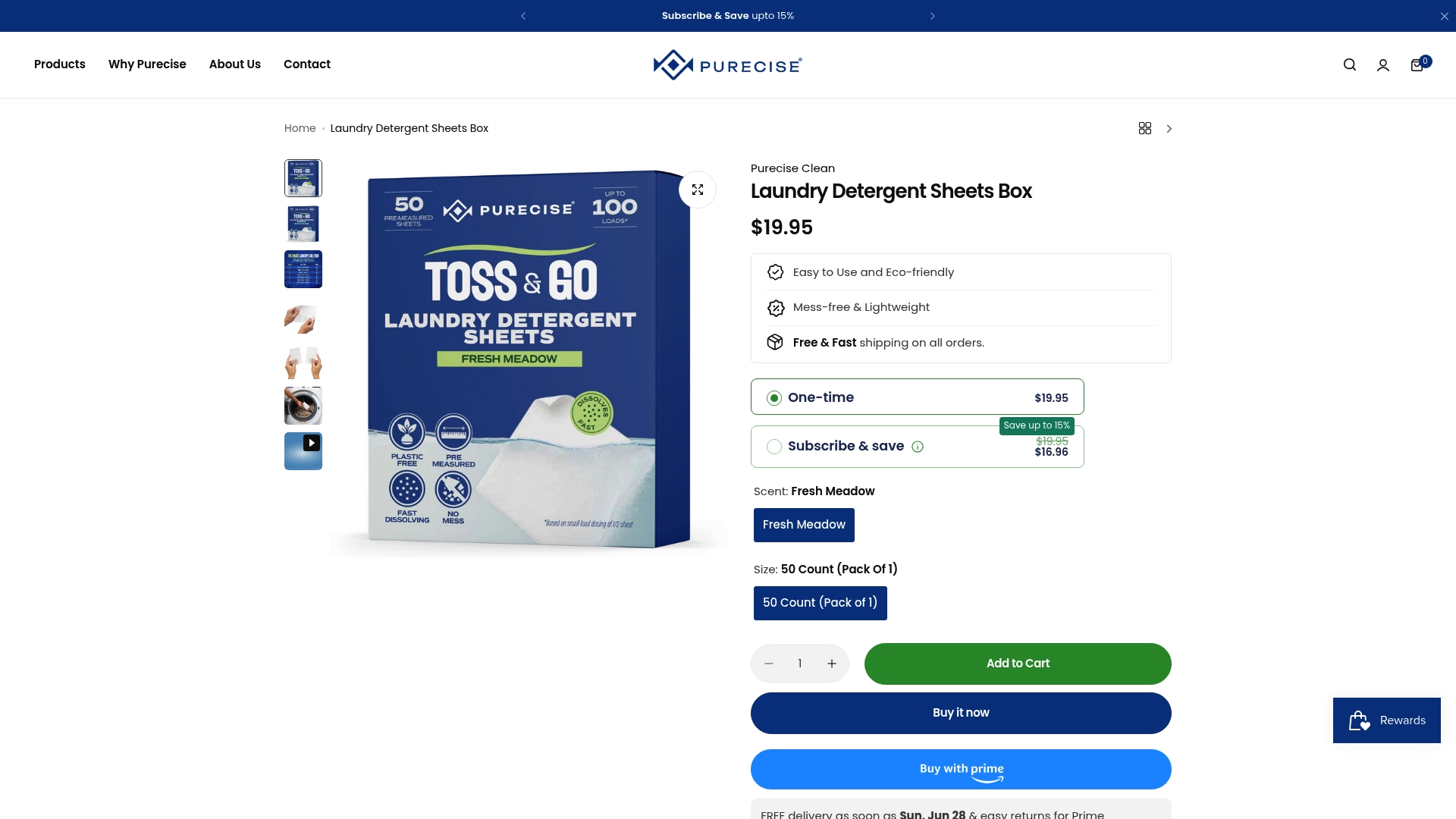
Each sheet is pre-dosed, which eliminates the overdosing that leaves residue on fabric. The formula is hypoallergenic and free from optical brighteners, synthetic fragrances, and phosphates. Purecise publishes a full ingredient disclosure page so you can run the verification steps from this article directly against the product. No guessing required.
The sheets come in a compact box that replaces a bulky plastic jug, and a full month’s supply fits in a drawer or a travel bag. Purecise often backs every order with a money-back guarantee. Check the Laundry Detergent Sheets Box or the Laundry Detergent Sheets Envelopes for the format that fits your household. Before purchasing, verify the current ingredient list and any applicable certifications on the product page.
Authoritative sources to bookmark
These are the primary resources for verifying certifications and checking ingredient safety independently.
- EPA Safer Choice Product Database: Search by product name or category to confirm current certification status. The most reliable first stop.
- EPA Safer Ingredients List: Explains the criteria ingredients must meet to qualify for Safer Choice certification.
- FTC Green Guides (16 CFR Part 260): The FTC’s advertising guidance for environmental claims, including “non-toxic.” Useful for understanding what the law does and does not require.
- USDA BioPreferred Program: Verify biobased content claims. Remember: biobased is an origin certification, not a safety certification.
- MADE SAFE Certified Products: Background on what MADE SAFE screens for in laundry detergents specifically.
- NYC Department of Health: Safe and Green Cleaning: Public health guidance on fragrance-free choices and safer cleaning product selection.
- Purecise Ingredient Disclosure Page: Full ingredient list for Purecise products, formatted for the verification steps in this article.
Recommended
Laundry Sheet Weight vs Liquid Bottle: Which Wins?
Pre-Portioned Detergent Saves Your Trips Downstairs
Related Posts

Remove Berry Stains: Cold Water First, Detergent Sheets on the Go

Remove Makeup Stains on the Go With a 10–15 Minute Pretreat

Remove Lipstick Stains: The First 15 Minutes, Plus Detergent Sheets

How Often to Wash Towels: Bath Weekly, Hand Towels Every Few Days

Detergent Allergy Rash: Test a Low Residue Wash Without Fragrance

Save Clothes From Mud Stains in 1–2 Hours With Premeasured Sheets

Fabric First Sweat Stain Fixes: Measured DIY Recipes and Sheets


