

Safe Detergent for Eczema-Prone Skin: 2026 Guide
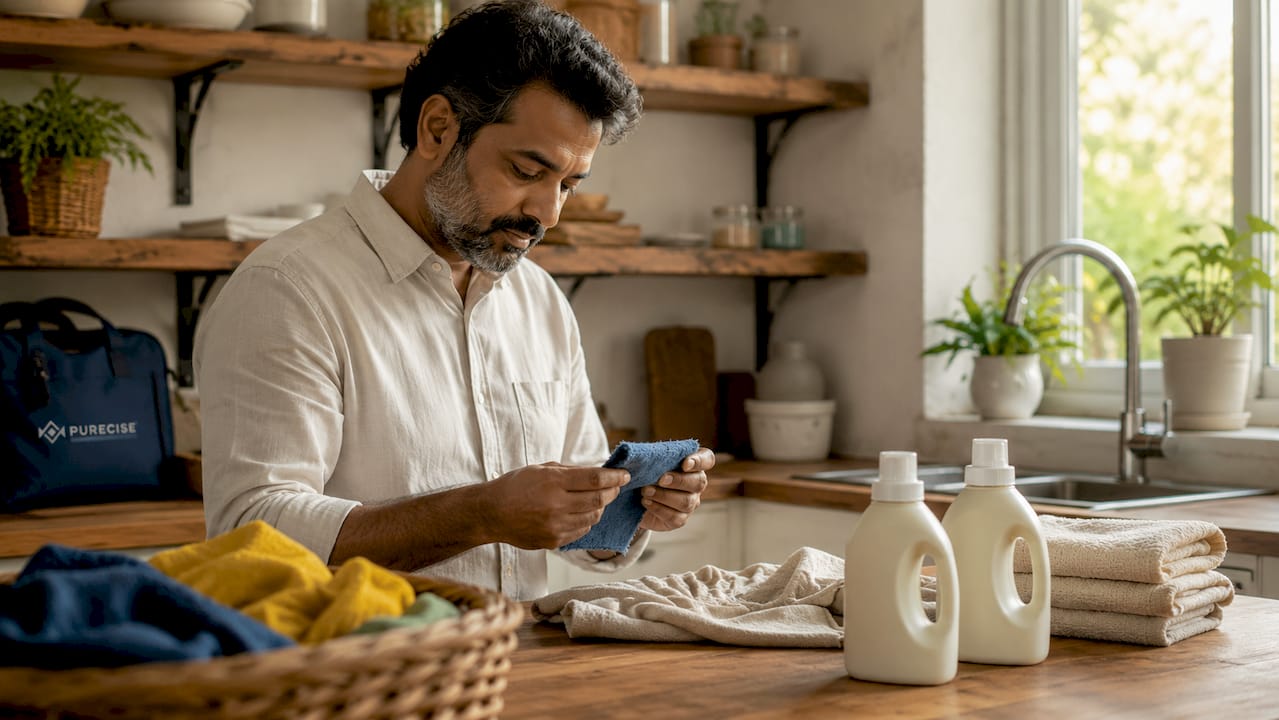
A safe detergent for eczema-prone skin is a laundry formula made without fragrances, synthetic dyes, or harsh surfactants that strip the skin’s protective barrier and trigger flares. Eczema affects millions of Americans, and the clothes touching your skin all day are a direct exposure route for chemical irritants. Choosing the wrong detergent does not just cause itching. It can break down the acid mantle, the thin protective film at pH 5.5 that defends skin against pathogens and moisture loss. The right hypoallergenic laundry soap removes allergens without leaving reactive residues behind, and the difference shows up on your skin within days.
What makes a safe detergent for eczema-prone skin?
A detergent is genuinely safe for eczema when it removes allergens without depositing new ones. The National Eczema Association and dermatologists consistently point to three non-negotiable criteria: no added fragrance, no synthetic dyes, and no preservatives linked to contact dermatitis. Free and clear formulas meeting these criteria remove up to 99% of common allergens including pet dander, dust mite matter, and pollen. That level of allergen removal matters because eczema flares are often triggered by environmental proteins, not just chemical residues.
The term “hypoallergenic” is not regulated by the FDA, so it functions as a marketing claim rather than a safety standard. Reading the ingredient list yourself is the only reliable method. Look for short ingredient lists, no “fragrance” or “parfum” entries, and surfactants derived from plant sources rather than petroleum.
Daily contact with detergents can disrupt skin protein and barrier integrity, increasing inflammation for people with eczema. This means even a “gentle” detergent causes cumulative harm if the laundry routine itself is flawed.
How do detergent ingredients affect eczema-prone skin?
Surfactants are the cleaning agents in every detergent, and their chemistry determines how much damage they do to sensitive skin.
Anionic vs. nonionic surfactants
Anionic surfactants are the primary irritants in most conventional detergents. They carry a negative electrical charge that bonds aggressively to dirt and oils, but that same charge strips skin lipids and leaves residues on fabric. Nonionic surfactants carry no charge. They clean effectively at lower concentrations and rinse out more completely. Blending anionic and nonionic surfactants reduces harshness while maintaining cleaning power. A detergent for sensitive skin should list nonionic surfactants prominently or use them as the primary cleaning agent.
Fragrances, dyes, and preservatives
Fragrance is the single most common contact allergen in laundry products. A product labeled “unscented” may still contain masking fragrances. Only “fragrance-free” guarantees none are present. Synthetic dyes serve no cleaning function and exist purely for appearance. They bind to fabric fibers and transfer to skin with heat and sweat.
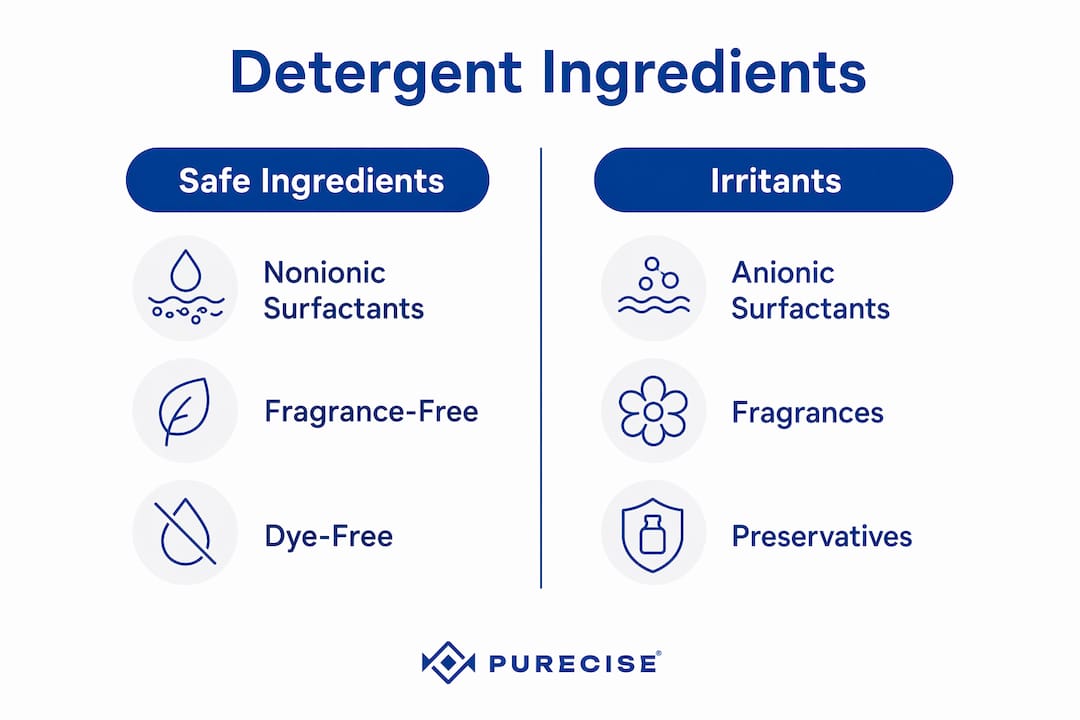
Liquid detergents often contain methylisothiazolinone (MI), a preservative that prevents bacterial growth in water-based formulas. MI is a known allergen that causes severe eczema-like rashes. Powder detergents typically avoid MI entirely because bacteria cannot survive in dry formulations. If you use liquid detergent and experience unexplained flares, MI is a strong suspect.
pH and the skin’s acid mantle
Detergents with a pH of 9–11 weaken the skin’s acid mantle, which sits at pH 5.5 and acts as the first line of immune defense. Residual high-pH detergent on fabric raises the local pH of skin on contact. pH-neutral detergents or thorough rinsing restores this balance. Check the product label for pH information, or contact the manufacturer directly.
Pro Tip: If a detergent does not list its pH and the manufacturer does not respond to inquiries, treat it as a high-pH formula and add an extra rinse cycle to compensate.
For a full breakdown of which ingredients to avoid, the laundry ingredients guide from Purecise covers the most common offenders by chemical name.
What laundry routine habits reduce eczema flares?
The detergent you choose matters less than how you use it. Residue is the real enemy.
-
Add an extra rinse cycle. Extra rinse cycles increase chemical removal from about 80% to nearly 98%. That improvement adds roughly 20 minutes per load but dramatically reduces the irritants left on fabric. Water-saving cycles do the opposite. They leave higher detergent concentrations behind, and heat, moisture, and friction reactivate those surfactants against your skin.
-
Use the right water temperature. Wash bedding and towels at 140°F (60°C) to kill dust mites without relying on chemical sanitizers. For clothing, 86–104°F (30–40°C) is sufficient and gentler on both fabric and detergent residue levels.
-
Address hard water. Hard water increases detergent residue on fabrics by binding with detergent ingredients before they can rinse away. Hard water areas show higher childhood eczema rates linked directly to this residue problem. A water softener or a small amount of washing soda added to the drum reduces mineral interference and lets detergent rinse cleanly.
-
Use less detergent than the label says. Most people use two to three times more detergent than necessary. Excess detergent does not rinse out fully regardless of cycle length. Start with half the recommended dose and increase only if cleaning results are poor.
-
Choose powder over liquid when possible. Powder formulas skip the preservatives that liquid formulas require. They also tend to rinse more completely because they dissolve fully rather than leaving a surfactant film.
Approximately 2.5% detergent residue remains on fabric after a standard machine wash cycle. That residue reactivates with body heat and sweat, causing delayed itching hours after dressing. An extra rinse cycle is the single most effective step you can take regardless of which detergent you use.
Which fabrics work best for eczema-prone skin?
Fabric choice and laundry care work together. The cleanest detergent still causes problems if the fabric itself is rough or retains residue.
- High-thread-count cotton is the gold standard. Tightly woven fibers create a smooth surface that minimizes friction against inflamed skin. Look for 200 thread count or higher in bedding and clothing worn directly against the body.
- Bamboo viscose is a strong alternative. It is naturally soft, moisture-wicking, and less likely to trap heat that triggers itching. Bamboo fabric also rinses cleanly because its fibers are smooth rather than textured.
- Avoid wool and coarse synthetics. Wool and rough synthetic fibers physically irritate eczema-prone skin. The mechanical friction alone triggers inflammation, independent of any detergent residue. Polyester fleece and acrylic blends fall into the same category.
- Test new fabrics before committing. Wear a new garment for two hours on a small skin area before washing and wearing it fully. Texture reactions appear quickly and save you from a full-load mistake.
- Avoid fabric softeners and dryer sheets. Both deposit a coating of fragrance and conditioning chemicals directly onto fabric. That coating sits between the fabric and your skin all day. Air drying or using wool dryer balls achieves softness without chemical transfer.
Residual detergent interacts differently with different fabric types. Synthetic fibers hold surfactant residue longer than natural fibers because their smooth, non-porous surface does not absorb and release water as efficiently. This is another reason to prioritize natural fabrics even when using a gentle detergent.
How do you spot hidden irritants in detergent labels?
Label reading is a skill, and the marketing on the front of a bottle is designed to distract from the ingredient list on the back.
- “Free and clear” is meaningful. It signals no added fragrance and no dyes. Verify by checking the ingredient list for “fragrance,” “parfum,” or color additives like FD&C Blue 1.
- Watch for coconut-derived surfactants. Coconut-derived surfactants cause reactions in people with coconut sensitivities. Many “natural” detergents use these as their primary surfactant. Tallow-based soap formulas offer a coconut-free alternative for people with this specific sensitivity.
- “Natural” does not mean safe. Essential oils, botanical extracts, and plant-based preservatives are all natural and all capable of triggering eczema. The ingredient source is irrelevant. The reaction potential is what matters.
- Avoid optical brighteners. These UV-reactive chemicals make white fabric appear brighter under light. They stay on fabric permanently and transfer to skin. They serve no cleaning function and are a common hidden irritant.
- Check for enzymes. Protease and amylase enzymes break down protein and starch stains effectively. Some people with eczema react to enzyme residues. If you suspect enzyme sensitivity, look for enzyme-free formulas.
Some people with severe sensitivities must avoid even coconut-derived surfactants common in natural detergents. This requires reading ingredient lists at the chemical level, not just trusting front-label claims. Understanding what free and clear detergent means for sensitive skin is a practical starting point for building that skill.
Pro Tip: Photograph the ingredient list of every detergent you try and keep a simple log of flare dates. Patterns emerge within 4–6 weeks and point directly to the specific trigger.
Key Takeaways
Consistent laundry habits and ingredient awareness protect eczema-prone skin more reliably than any single product switch.
| Point | Details |
|---|---|
| Choose fragrance-free and dye-free | Free and clear formulas remove up to 99% of common allergens without adding new irritants. |
| Add an extra rinse cycle | Extra rinsing raises chemical removal from 80% to nearly 98%, cutting residue that triggers delayed itching. |
| Prefer powder over liquid | Powder detergents skip preservatives like methylisothiazolinone that cause eczema-like rashes in liquid formulas. |
| Address hard water | Water softeners prevent mineral-detergent binding that leaves higher residue on fabric in hard water areas. |
| Read ingredient lists critically | “Natural” and “hypoallergenic” are unregulated claims; only the ingredient list confirms what touches your skin. |
What I’ve learned about laundry and eczema after years of testing
The most common mistake people make is treating eczema flares as a detergent brand problem. They switch products every few weeks, never giving their skin or their routine enough time to stabilize. Consistent gentle laundry routines are more effective than frequent detergent switching. Many flares come from residual chemicals and mechanical fabric friction, not from the detergent brand itself.
What actually works is boring. Use less detergent. Add a rinse cycle. Wash bedding weekly at 140°F. Stop using fabric softener. Do those four things consistently for six weeks before evaluating whether your detergent needs to change. Most people who follow that routine see significant improvement without changing products at all.
The ingredient awareness piece takes patience. Reading labels feels tedious until you find your specific trigger. Once you identify it, whether that is MI, a coconut-derived surfactant, or an enzyme, you can filter products quickly and stop the cycle of trial and error. That knowledge is more valuable than any single product recommendation.
At Purecise, we designed our detergent sheets specifically around this reality. Pre-dosed sheets eliminate the overuse problem entirely. No measuring means no excess residue. The formula is free from fragrances, dyes, and harsh preservatives because we know those are the ingredients that matter most to people managing sensitive skin every day.
— Purecise
Purecise detergent sheets for sensitive skin
People with eczema-prone skin need a detergent that does not require a chemistry degree to evaluate.
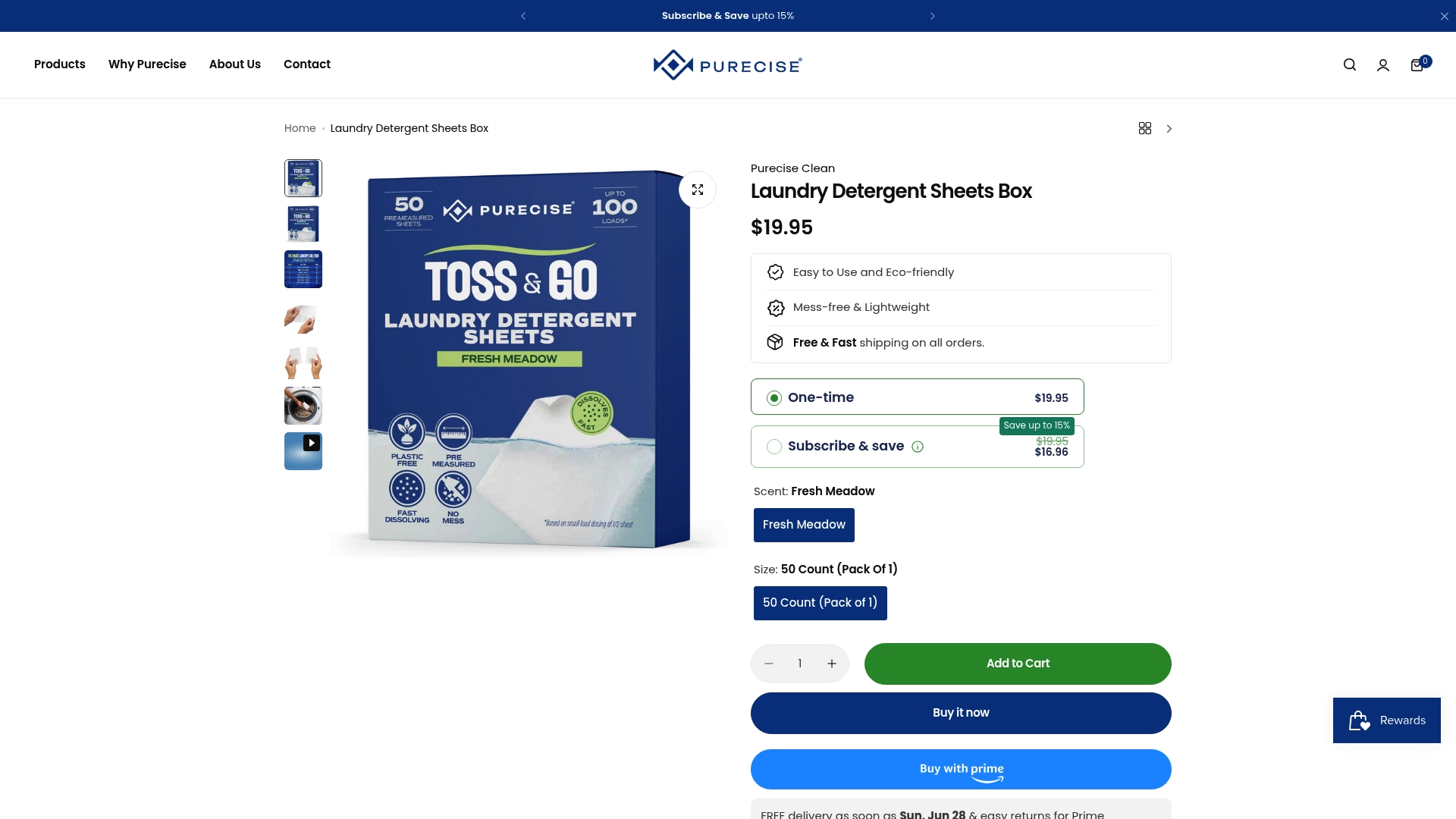
Purecise Toss & Go laundry detergent sheets are pre-dosed, fragrance-free, and dye-free. Each sheet dissolves completely in any wash temperature, leaving no surfactant film behind. The hypoallergenic formula skips the preservatives and optical brighteners that trigger most contact reactions. You can try the detergent sheets envelopes for a starter supply, or pick up the detergent sheets box for a full month’s worth. Every order comes with a 100% money-back guarantee, so the risk of trying something new is zero.
FAQ
What ingredients should eczema-prone skin avoid in detergent?
Avoid fragrances, synthetic dyes, methylisothiazolinone, optical brighteners, and high-pH surfactants. These are the most common contact allergens and barrier disruptors in standard laundry formulas.
Is powder or liquid detergent better for eczema?
Powder detergent is generally safer because it does not require preservatives like methylisothiazolinone that liquid formulas need to prevent bacterial growth.
How does hard water affect eczema and laundry?
Hard water binds with detergent ingredients before they rinse away, leaving higher residue on fabric. Adding a water softener or washing soda reduces this effect and lowers irritant exposure.
Does extra rinsing actually help eczema-prone skin?
Extra rinse cycles raise detergent removal from about 80% to nearly 98%. That reduction in residue directly lowers the risk of delayed itching and flare-ups triggered by reactivated surfactants.
Are “natural” or “plant-based” detergents safe for eczema?
Not automatically. Natural detergents can contain coconut-derived surfactants, essential oils, and botanical preservatives that trigger reactions in sensitive skin. Always read the full ingredient list regardless of front-label claims.
Recommended
What Does HE Compatible Detergent Mean for Your Laundry?
Types of Off-Grid Laundry Methods for Sustainable Living
Related Posts

Remove Lipstick Stains: The First 15 Minutes, Plus Detergent Sheets

How Often to Wash Towels: Bath Weekly, Hand Towels Every Few Days

Detergent Allergy Rash: Test a Low Residue Wash Without Fragrance

Save Clothes From Mud Stains in 1–2 Hours With Premeasured Sheets

Fabric First Sweat Stain Fixes: Measured DIY Recipes and Sheets

Whiten White Clothes, No Chlorine: 4–8 Hour Soak, Premeasured Sheets

Remove Blood Stains from Clothes: Cold Water, Enzyme Soak, No Dryer


