

Optical Brighteners in Detergent: What They Do and Why It Matters
Optical brighteners are chemical additives in most mainstream laundry detergents that absorb invisible ultraviolet and violet light and re-emit it as visible blue light, making fabrics appear whiter and brighter than they actually are. They do not remove a single particle of soil. The bottom line: if you have sensitive skin, care for infants, or want to reduce chemical accumulation on your clothes and in waterways, an OBA-free detergent is the smarter pick.
A few terms you’ll see used interchangeably:
- OBAs (optical brightening agents)
- FBAs (fluorescent brightening agents)
- FWAs (fluorescent whitening agents)
All three names describe the same class of compounds. They absorb UV/violet light in the 340–370 nm range and re-emit blue light around 420–470 nm, a shift known as the Stokes shift. The two most common chemical families are stilbene derivatives and benzoxazolyl compounds.
Pro Tip: If you want to know whether your current detergent contains OBAs, shine a UV blacklight on a freshly washed white shirt in a dark room. A blue-white glow means brighteners are present.
Key Takeaways
Optical brighteners make fabrics look cleaner by converting UV light into visible blue light, but they do not remove soil and can accumulate on fabric and in waterways with repeated use.
| Point | Details |
|---|---|
| Appearance vs. cleaning | OBAs modify how fabric reflects light; surfactants and enzymes do the actual cleaning. |
| Buildup is cumulative | Brightener deposits increase across washes, causing haze on dark fabrics over time. |
| Health and environment | Residues can irritate sensitive skin; OBAs often pass through wastewater treatment intact. |
| How to identify them | Check labels for “FWA,” “FBA,” or “Tinopal”; confirm with a UV blacklight test at home. |
| Purecise sheets | OBA-free, plant-based, pre-dosed sheets that clean without optical masking or plastic waste. |
Table of Contents
- How do optical brighteners actually work in your laundry?
- What chemical classes are used as optical brighteners in detergents?
- What do OBAs do to fabric appearance, and does buildup change that over time?
- What do health and environmental studies say about optical brighteners?
- How can you tell if a detergent contains optical brighteners?
- What are your options if you want to avoid optical brighteners?
- Laundry practices that reduce buildup or preserve brightness
- Why optical brighteners are a shortcut worth skipping
- Clean laundry without the optical illusion
- Sources
How do optical brighteners actually work in your laundry?
The fluorescence mechanism is straightforward once you see it in plain terms. Sunlight and indoor lighting both carry ultraviolet energy your eyes cannot see. OBA molecules deposited on fabric fibers capture that invisible UV energy and convert it into blue visible light, adding to the light already reflected off the fabric. The result is a fabric that appears to emit more light than it receives, which reads to your eye as brilliant white.
This is why brighteners are so effective at masking yellowing. Aged cotton and synthetic fibers absorb blue light, which shifts their appearance toward yellow. OBAs counteract that shift by flooding the reflected spectrum with blue, essentially canceling the yellow cast. The fabric looks cleaner and newer without any soil having been removed.
The X-Rite color science team describes a related problem called metamerism: two fabrics with different brightener loads can appear identical under one light source but look noticeably mismatched under UV-rich daylight or a blacklight. This is why garment manufacturers and textile suppliers must test for brightener consistency across production batches.
| Light condition | What you see on brightened fabric |
|---|---|
| Natural daylight (UV-rich) | Strong blue-white glow, maximum brightness |
| Indoor fluorescent light | Moderate brightening effect |
| UV blacklight | Vivid blue fluorescence, clearly visible |
| Incandescent/warm light | Minimal brightening, yellowing more apparent |
According to Texcare (Messe Frankfurt), even doses as low as 0.01–0.05% relative to textile weight produce a visible brightening effect, and the molecules adsorb substantively to fibers, meaning rinsing alone will not remove them.
What chemical classes are used as optical brighteners in detergents?
Most OBAs in consumer detergents belong to a handful of well-characterized compound families:
- Stilbene derivatives are the most widely used. Distyrylbiphenyl disulfonic acid compounds (DSBP types) are a common example. Their extended conjugated structure is what enables efficient UV absorption and blue-light emission, and their sulfonate groups give them strong affinity for cotton fibers.
- Benzoxazolyl compounds (including bis-benzoxazoles) are used on synthetic fibers like polyester and nylon. Their heterocyclic ring structure produces a slightly different emission profile but the same whitening effect.
- Coumarins and naphthalimides appear in some specialty formulations, though less commonly in household detergents.
The reason these compounds stay on fabric after rinsing comes down to substantivity: their molecular structure allows them to bind to cellulose (cotton) or hydrophobic synthetic fibers through hydrogen bonding or van der Waals forces. Once deposited, they are difficult to remove, which is why avoidance is more effective than trying to strip them out after the fact.
What do OBAs do to fabric appearance, and does buildup change that over time?
The immediate effect on white fabrics is striking: a single wash with an OBA-containing detergent can produce a noticeably brighter, crisper appearance. That “fresh from the store” look is largely OBAs at work, not superior cleaning.
On dark garments, the picture is different. Brighteners deposit on dark fibers just as readily as on white ones, but instead of producing a pleasing white glow, they create a gray or chalky haze. A black shirt washed repeatedly in a brightener-heavy detergent will gradually look faded even if the dye itself is intact.
- White and light fabrics: cumulative brightener deposits increase the blue-white effect across washes, so clothes can actually look brighter after several cycles than after the first.
- Dark and colored fabrics: buildup creates visible haze and reduces color depth over time.
- Cotton: highly susceptible to OBA accumulation due to cellulose affinity.
- Synthetics (polyester, nylon): also retain brighteners, particularly benzoxazolyl types.
- Hospitality and healthcare textiles: professional laundries use OBAs at controlled doses precisely because white linens and uniforms must look consistently bright under institutional lighting.
Pro Tip: Separate your dark garments from whites and wash them with a brightener-free detergent. Even one wash with an OBA-containing product can start the haze cycle on black or navy fabrics.
There is also a practical note for anyone washing tactical or military gear: modern night-vision and near-infrared imaging can detect the spectral flaring caused by OBAs, which is why military garments must be laundered with brightener-free products.
What do health and environmental studies say about optical brighteners?
The health picture is nuanced. OBAs are not acutely toxic at typical exposure levels, but research on textile chemicals and skin contact identifies them as a potential source of contact irritation, particularly for populations whose skin barrier is already compromised. Infants, people with eczema, and those with contact dermatitis are at higher risk because brightener residues remain in direct contact with skin through clothing and bedding throughout the day.
The mechanism is physical and chemical: OBA molecules deposited on fabric fibers transfer to skin during wear, and repeated low-level exposure can trigger sensitization in susceptible individuals. The evidence is not uniform across all studies, and dose and frequency matter considerably. Someone washing one load a week in a low-OBA detergent faces a different exposure profile than a parent washing daily loads of infant clothing.
On the environmental side, the concern is persistence. ScienceDirect’s topic overview on optical brighteners documents that OBAs frequently pass through municipal wastewater treatment systems without full degradation, binding to sediments and being taken up by aquatic organisms. Their photostability, the same property that makes them effective on fabric, also makes them resistant to breakdown in water.
Key risk factors to weigh:
- Skin contact duration (clothing worn all day vs. occasional use)
- Wash frequency and detergent concentration
- Wastewater treatment capacity in your area
- Presence of vulnerable household members (infants, eczema sufferers)
| Concern | Evidence level | Who is most affected |
|---|---|---|
| Contact skin irritation | Moderate; mechanism established | Infants, eczema sufferers |
| Aquatic persistence | Documented; wastewater passage confirmed | Aquatic ecosystems downstream |
| Sensitization over time | Plausible; limited long-term human data | Frequent-contact users |
How can you tell if a detergent contains optical brighteners?
Reading the label is the first step, but OBAs are not always listed prominently. Look for any of these terms:
- “Optical brightener” or “optical brightening agent”
- “Fluorescent whitening agent” (FWA)
- “Fluorescent brightening agent” (FBA)
- “Stilbene derivative” or “distyrylbiphenyl”
- “Tinopal” (a widely used commercial OBA trade name)
If the label is vague, check the product’s Safety Data Sheet (SDS), formerly called the MSDS. Section 3 (Composition/Information on Ingredients) will list OBAs if they are present above threshold concentrations. Many brands post SDS documents on their websites or through the EPA’s ChemView database.
The quickest home test requires nothing more than a UV blacklight (widely available for under $15):
- Wash a white cloth with the detergent in question.
- Let it dry completely.
- Hold it under the UV light in a darkened room.
- A bright blue-white glow confirms OBAs are present. No glow means none detected.
Pro Tip: Run the same UV test on your current laundry detergent’s packaging foam or residue on the drum. If the drum itself glows, OBAs have been depositing there and transferring to every load.
What are your options if you want to avoid optical brighteners?
Avoiding OBAs does not mean accepting duller clothes. The actual cleaning work in any detergent is done by surfactants, enzymes, builders, and oxygen bleach. Those ingredients remove soil; OBAs only change how the result looks under light. A well-formulated OBA-free detergent cleans just as effectively.
When shopping, look for these signals:
- “OBA-free,” “brightener-free,” or “free and clear” on the label
- “Hypoallergenic” combined with a full ingredient list
- “Dye-free” (dyes and brighteners often travel together in conventional formulas)
- Plant-based formulations, which tend to exclude synthetic optical agents by design
- Certifications like EPA Safer Choice, which restricts certain OBAs
Some commercial laundries and hospitality operations are also moving away from OBAs, replacing them with oxygen bleach and enzymatic action for whitening, a trend driven by ecological awareness and tighter sustainability standards.
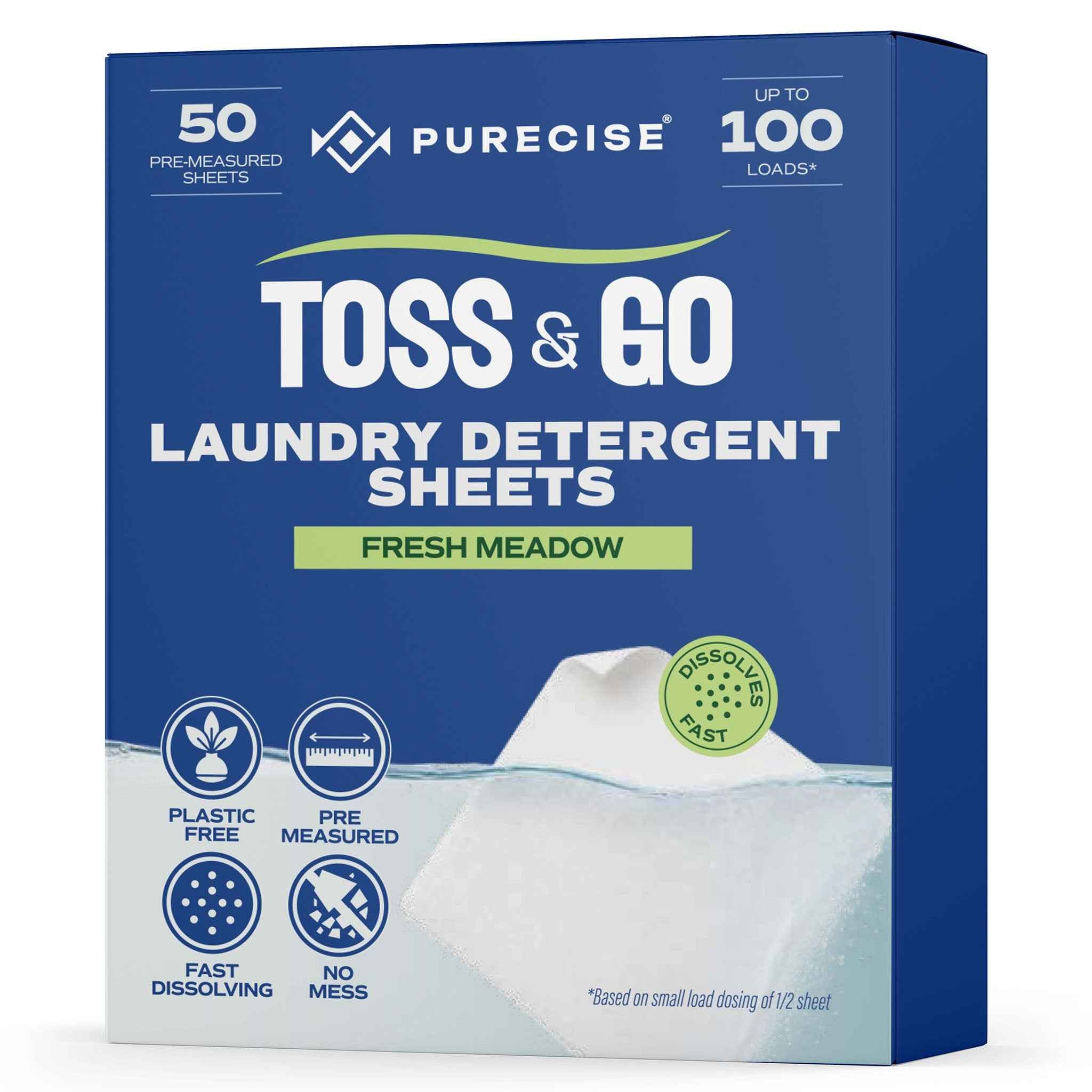
Purecise Laundry Detergent Sheets are formulated without optical brighteners, using a plant-based, hypoallergenic formula in pre-dosed sheets. The Laundry Detergent Sheets Box is the standard home option; the Laundry Detergent Sheets Envelopes work for travel and smaller households. Both dissolve fully in any machine type and temperature.
Laundry practices that reduce buildup or preserve brightness
Your wash habits matter as much as your detergent choice.
If you want to reduce brightener buildup:
- Switch to a brightener-free detergent immediately for dark garments and baby clothes.
- Avoid long soak cycles, which increase contact time and deposition.
- Rinse with an extra cycle when washing items worn directly against skin.
- Rotate detergents only if you are comfortable with some OBA exposure on whites; for sensitive-skin households, commit to one OBA-free formula.
If you want to preserve or maximize the brightening effect:
- Wash whites in cooler water. OBAs are retained more effectively at lower temperatures because high heat can degrade some fluorescent compounds.
- Cumulative washes increase the effect, so consistency with the same brightener-containing detergent builds up the optical deposit over time.
- Dry whites in sunlight, which activates the fluorescence and produces the most visible brightening.
Pro Tip: If you are switching from a conventional detergent to an OBA-free formula, run two or three wash cycles on your whites before judging the results. The OBA deposit from previous washes will fade gradually, and the true fabric color will re-emerge.
For dark garments, always wash inside-out and avoid mixing them with whites in the same load when one load uses an OBA detergent and the other does not. Cross-contamination from residue in the drum is enough to start the haze cycle on dark fabrics.
Why optical brighteners are a shortcut worth skipping
The laundry industry has leaned on optical brighteners for decades because they produce an immediate, visible result that consumers associate with cleanliness. That association is the point. A shirt that glows blue-white under daylight reads as “just cleaned” even if the detergent barely touched the actual soil. It is a perception trick built into the formula.
The problem is that the trick has costs. For families with infants or anyone managing eczema, residual OBAs on clothing and bedding represent a daily skin-contact exposure that serves no cleaning purpose. For the environment, compounds that pass through wastewater treatment and accumulate in aquatic sediments are a liability that compounds with every wash cycle. And for dark garments, the cumulative deposit is simply destructive.
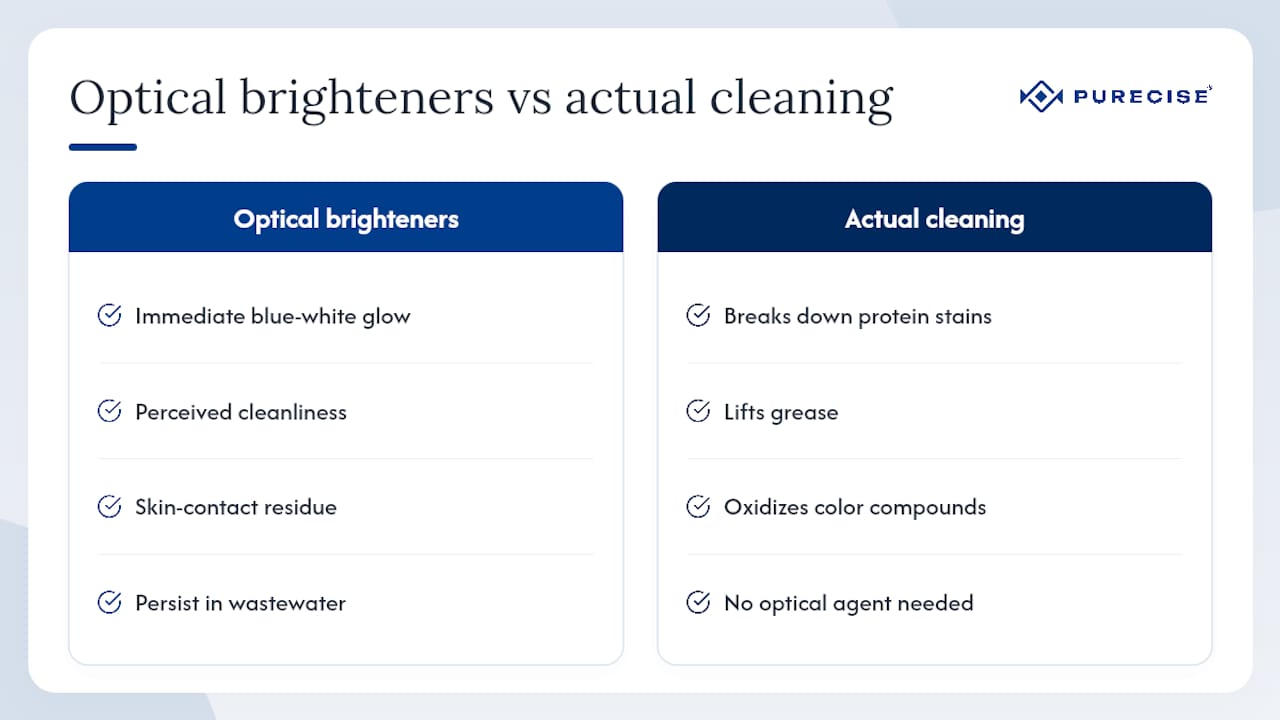
The more useful question is not “does this detergent make my clothes look bright?” but “does it actually remove what I need removed?” Enzymes break down protein stains. Surfactants lift grease. Oxygen bleach oxidizes color compounds. None of those mechanisms need an optical agent alongside them. The brightness follows from clean fabric, not from a fluorescent coating on top of it.
Clean laundry without the optical illusion
Purecise detergent sheets skip the brighteners entirely and put the formula where it counts: plant-based surfactants and enzymes that actually lift soil, in a pre-dosed sheet that dissolves completely in any machine at any temperature. No plastic jug, no measuring, no residue on your drum or your skin.
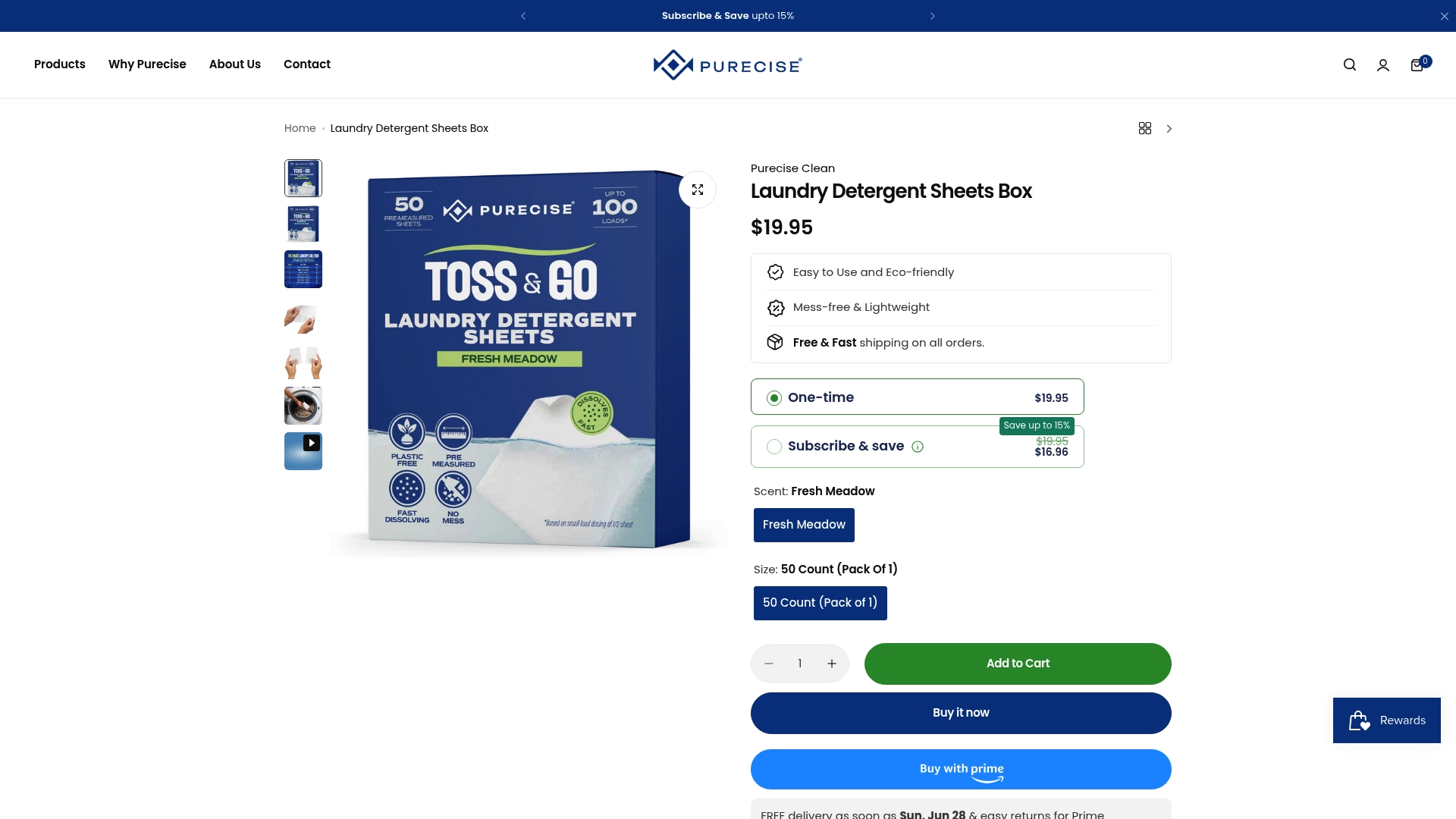
For home use, the Laundry Detergent Sheets Box gives you a full month’s supply in recyclable packaging. Traveling or living in a smaller space? The Laundry Detergent Sheets Envelopes fit in a carry-on pocket. Try a box and see what clean looks like without the glow.
Sources
- NCBI / PMC article on textile chemicals and skin exposure
- Optical brighteners in textile care — Texcare (Messe Frankfurt)
- Optical brightener - Wikipedia
- Optical Brightener — ScienceDirect topic overview
- Do You Know How Optical Brighteners Work — X-Rite Blog
Recommended
Greenwashing in Cleaning Products: What to Know
How Enzyme Cleaners Work for Natural Stain Removal
Related Posts

Whiten White Clothes, No Chlorine: 4–8 Hour Soak, Premeasured Sheets

Remove Blood Stains from Clothes: Cold Water, Enzyme Soak, No Dryer

Pet Owners: Remove Hair from 5 Surfaces with a Washer and Dryer Trick

Wash Sheets Weekly, Dry Them Fully, and Stop Dosing Guesswork

6 Quick Steps to Remove Oil Stains at Home Without Ruining Clothes

Save Space: 50 Sheets Cover 50–100 Loads for Airbnb Hosts

Cut Detergent 25–50%: Use Premeasured Sheets for Soft Water


