

Why Measuring Laundry Detergent Wastes Your Time
Measuring laundry detergent precisely is unnecessary, and skipping it won’t hurt your clothes. Modern detergents are highly concentrated, and washing machines tolerate a reasonable range of dosage without any drop in cleaning performance. The real problem is that most people measure too much, not too little, and that excess detergent actively works against them.
Here’s what actually happens when you stand over the washer trying to read those tiny cap lines:
- You guess anyway, because the fill lines are nearly impossible to read
- You pour more than needed, because the cap design encourages it
- The extra detergent leaves residue on fabrics and inside the drum
- You waste money and add unnecessary chemicals to the water supply
- Pre-measured formats, like detergent sheets, eliminate all of this instantly
Why measuring laundry detergent wastes time and effort
The cap on your detergent bottle is not your friend. Inaccurate measuring caps with illegible lines cause consumer guessing, making precise measuring ineffective and a consistent time drain. Every brand uses a different cap design, so there’s no muscle memory to build. You start fresh every time you switch products.
Laundry expert Patric Richardson, known as The Laundry Evangelist, puts it plainly: one tablespoon is right for a standard 8-pound load, and two tablespoons is the maximum for large (12+ pound) loads, in any machine, with any detergent. That’s a ballpark, not a laboratory measurement. You don’t need a measuring spoon. You need a rough sense of proportion.
Pro Tip: Mark the one-tablespoon line for standard loads and two-tablespoon line for large loads on your cap with a permanent marker once, and you’ll never need to squint at the fill lines again.
How much detergent does a typical load actually need?
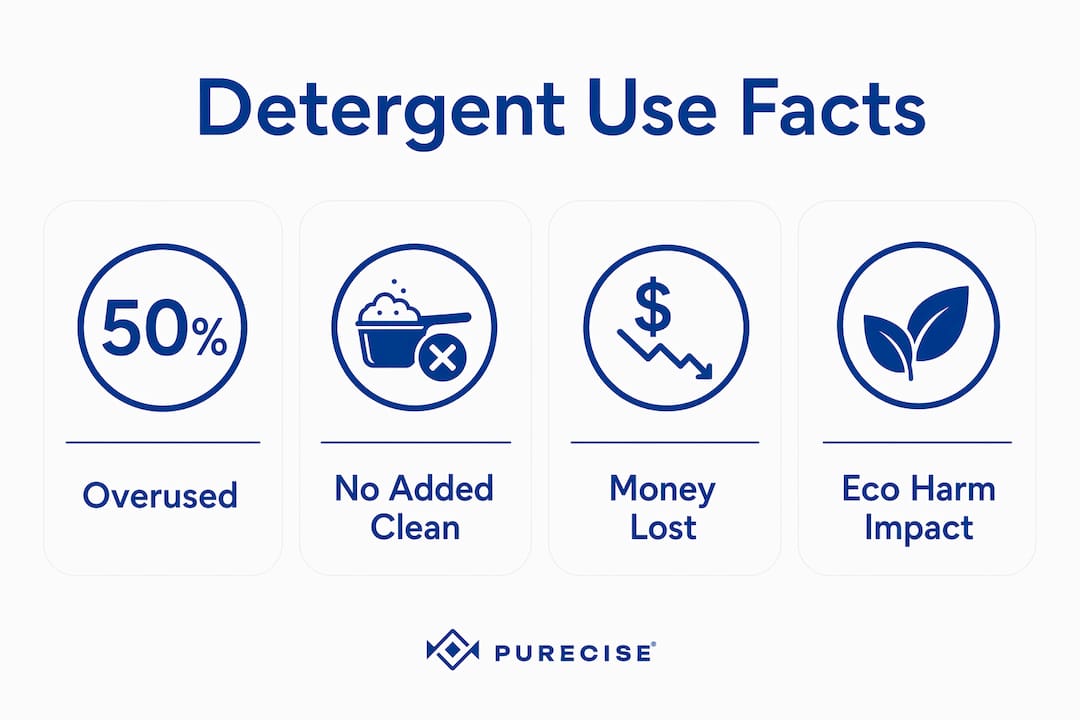
Less than you think. A standard 8-pound load needs a moderate amount of detergent, and even a large load requires only a small additional amount. Traditional detergent caps hold 2 ounces, which is several times that amount, so the cap itself nudges you toward overuse.
Practical dosing by load size:
- Small or half load: 1 tablespoon or less
- Standard load (around 8 lbs): 1 tablespoon
- Large load (12 lbs or more): 2 tablespoons maximum
- HE machines: Use the lower end of any range; these machines use less water, so heavy dosing creates excess suds with nowhere to go
- Hard water or heavily soiled clothes: Add a booster like Borax instead of more detergent
Water hardness used to matter more than it does now. Richardson notes that today’s machines and detergent formulas have narrowed the adjustment to roughly a quarter tablespoon either way, making it barely worth calculating.
What happens when you use too much laundry detergent
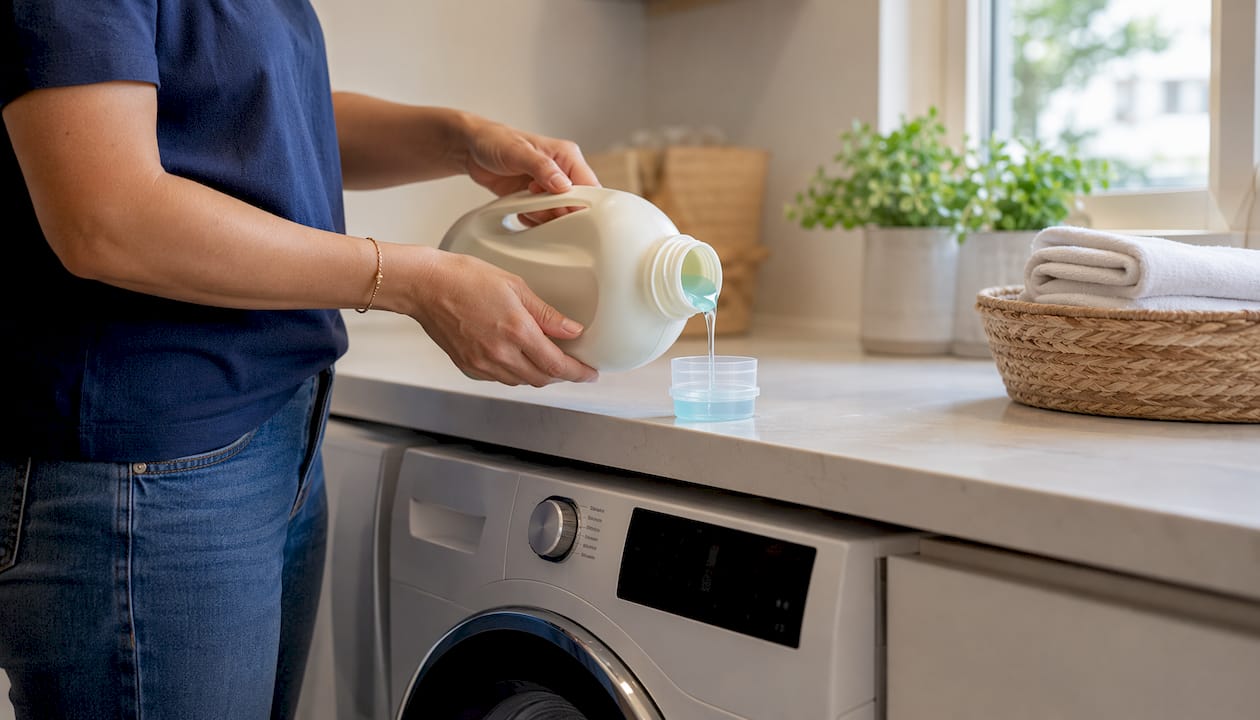
Too much detergent doesn’t clean better. It cleans worse. Excess suds reduce fabric rubbing, which is the mechanical action that actually lifts dirt from fibers. Past a certain point, more detergent means dirtier clothes.
The downstream effects compound quickly:
- Residue trapped in fabric hardens in the dryer, leaving clothes stiff and scratchy
- Towels lose absorbency; workout gear stops breathing properly
- Sensitive skin reacts to chemical residue left behind after rinsing
- The washing machine drum develops a haze of buildup and a mildewy odor
- Overloading detergent damages clothes and shortens fabric life over time
Consumer Reports’ Rich Handel, who leads detergent testing, warns that excess detergent does not produce cleaner clothes and sends unnecessary chemicals into waterways.
Signs you’re using too much detergent right now
You don’t need a lab test. The signs show up in your laundry room.
- Stiff or waxy clothes after washing: dried detergent coating the fibers, not dirt
- Drum residue or haze: a film inside the washer that builds with every overloaded cycle
- Workout clothes that smell even after washing: residue trapping odor instead of releasing it
- Towels that feel rough and don’t absorb well: the loft is gone, replaced by soap buildup
- Skin irritation or itching after wearing freshly washed clothes: residual surfactants on fabric
- Frequent need to run machine-cleaning cycles: the washer is compensating for your detergent habit
Richardson’s fix is simple: start using the correct amount, and the buildup washes out on its own over the next four or five cycles. No stripping, no special treatments needed.
Why detergent instructions push you to over-measure

Detergent manufacturers have a financial incentive to encourage higher usage. Consumer Reports suggests following your washer manufacturer’s guidelines rather than the detergent bottle, because bottle instructions are calibrated to move product, not to match what modern HE machines actually require.
| Factor | What instructions say | What you actually need |
|---|---|---|
| Standard load | Full cap (2 oz or more) | 1–2 tablespoons |
| HE machine | HE line on cap | Less than standard; lower end of range |
| Hard water | Extra detergent | A booster like Borax instead |
| Large load | More detergent | 2 tablespoons maximum |
“One of the biggest mistakes we make is using too much detergent. If you use too much detergent, your machine just can’t wash it out — there’s not enough water in the rinse cycle.” — Patric Richardson, The Laundry Evangelist
Pre-measured formats cut through all of this. Traditional liquid detergents contain up to 90% water, adding unnecessary bulk to every pour. Detergent sheets like Purecise’s Toss & Go sheets skip the measuring entirely. One sheet, one load, done.
Why the science says precision doesn’t matter
Detergent formulas are built with tolerance in mind. Surfactants, the active cleaning agents, work across a range of concentrations. Going slightly above or below the ideal dose doesn’t flip a switch from “clean” to “dirty.” The cleaning curve is gradual, not a cliff.
What matters more than exact dosage: water temperature, agitation time, and load size. These variables affect cleaning far more than whether you used 1.1 or 1.3 tablespoons of detergent. The formula accounts for real-world variation because chemists know consumers don’t measure with lab precision.
How detergent concentration tolerance works in practice
Modern concentrated formulas, labeled 2X, 3X, or higher, pack more active ingredients into a smaller volume. The “X” multiplier doesn’t have a universal standard, as Procter & Gamble has acknowledged, but the practical result is that a smaller dose delivers equivalent cleaning to older, diluted formulas.
This concentration range means the formula performs well across a band of dosages, not just at one exact point. A slightly generous pour won’t boost cleaning. A slightly conservative one won’t leave clothes dirty. The tolerance band is wide enough that eyeballing a tablespoon works fine for the vast majority of loads.
Common myths about detergent measuring that waste your time
Myth: More detergent means cleaner clothes. The opposite is often true. Excess detergent leaves chemical residue, reduces mechanical cleaning action, and can make fabrics feel worse after washing.
Myth: You need to measure precisely every time. Detergent formulas tolerate variation. A rough pour that lands in the right ballpark cleans just as well as a carefully measured dose.
Myth: Hard water always requires more detergent. Richardson says the adjustment is so small now that a water-softening booster is a better solution than pouring extra detergent.
Myth: The cap fill line is accurate. Consumer Reports found that cap fill lines are often hard to read and inconsistently designed, making them unreliable guides even when you try to follow them.
How over-measuring hurts your wallet and the environment
The financial waste is direct: if you’re using twice the recommended amount, you’re buying detergent twice as often as you need to. The environmental cost runs deeper. Plastic recycling rates for household detergent jugs remain low, making large liquid detergent purchases a steady contributor to landfill waste. Every overloaded cap also sends excess surfactants and chemicals into the water supply, where they affect aquatic ecosystems.
Switching to pre-measured detergent sheets removes the plastic bottle entirely and eliminates the guesswork that leads to overuse. You can also explore sustainable laundry packaging alternatives if you want a broader look at how packaging choices add up over time.
Purecise Toss & Go detergent sheets are pre-dosed, dissolve completely in any wash temperature, and are free from harsh chemicals. No cap, no measuring, no residue. Try them risk-free with a 100% money-back guarantee.
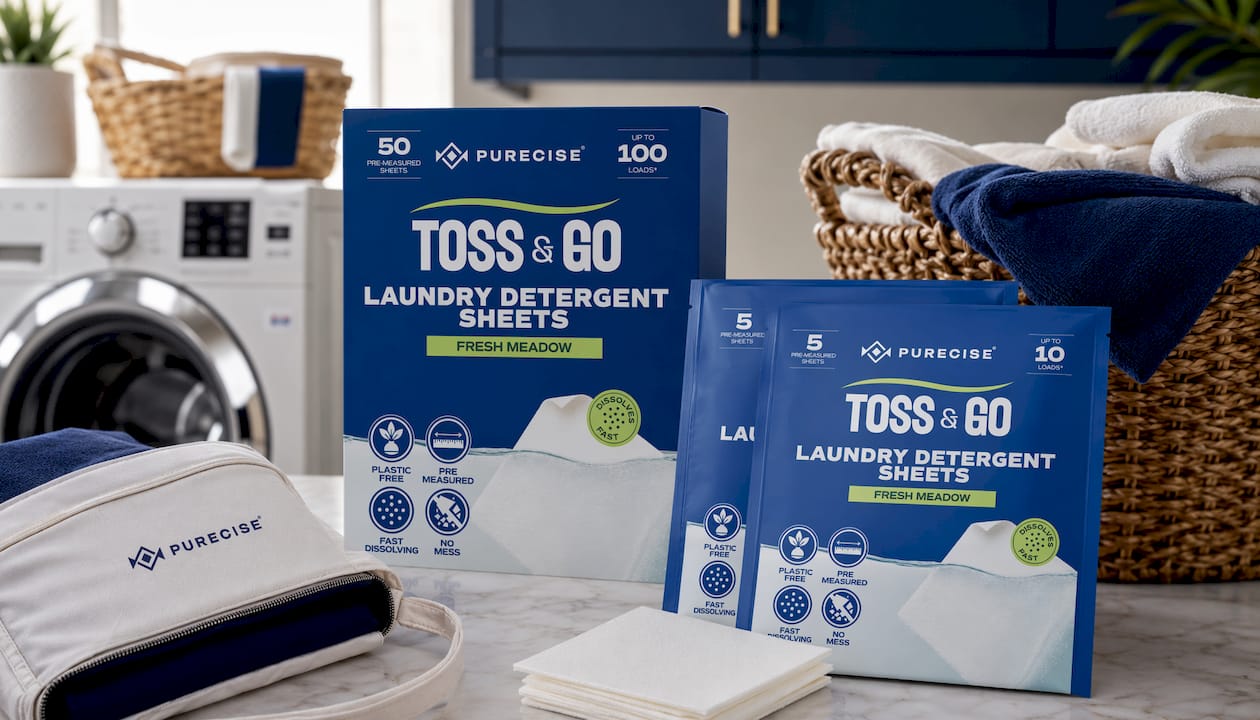
Shop Purecise sheets and do laundry the way it should be: toss it in and walk away.
Key Takeaways
Precise detergent measurement is unnecessary because modern formulas tolerate dosage variation, and over-measuring causes residue, fabric damage, and wasted money.
| Point | Details |
|---|---|
| Two tablespoons is the max | Even a large 12-pound load needs at most 2 tablespoons; a standard 8-pound load needs 1 tablespoon. |
| Cap lines mislead you | Illegible, inconsistent fill lines cause guessing and overpouring every time. |
| More detergent cleans worse | Excess suds reduce the mechanical action that lifts dirt from fabric fibers. |
| Over-measuring costs money and harms waterways | Excess chemicals enter the water supply and empty bottles pile up in landfills. |
| Pre-measured sheets eliminate the problem | One sheet per load removes measuring, residue risk, and plastic waste entirely. |
Recommended
How to Avoid Detergent Overdosing in Shared Machines
Detergent Quantity Control Saves Money: Here's How
Related Posts

Whiten White Clothes, No Chlorine: 4–8 Hour Soak, Premeasured Sheets

Remove Blood Stains from Clothes: Cold Water, Enzyme Soak, No Dryer

Pet Owners: Remove Hair from 5 Surfaces with a Washer and Dryer Trick

Wash Sheets Weekly, Dry Them Fully, and Stop Dosing Guesswork

6 Quick Steps to Remove Oil Stains at Home Without Ruining Clothes

Save Space: 50 Sheets Cover 50–100 Loads for Airbnb Hosts

Cut Detergent 25–50%: Use Premeasured Sheets for Soft Water


