

Cut Detergent Cost Per Load: 6 Budget Moves and When Sheets Save
Most people pay a range of cost per load for laundry depending on format and brand, with pods and premium liquids generally costing more and store-brand powders usually costing less. The fastest way to lower your number is to divide the package price by the actual loads you get, not the loads on the label, then cut your dose to the lowest amount that still cleans the load. Pre-dosed options like Purecise detergent sheets remove the guesswork that usually pushes cost per load higher than it needs to be.
TL;DR:
- Using pre-dosed laundry sheets ensures consistency and prevents overdosing, which can significantly lower your cost per load over time.
- Powder detergents are typically the cheapest on a per-load basis, averaging about $0.10 to $0.20, but are less convenient to measure and store.
- Concentrated liquids and sheets often cost more per load, with pods being the most expensive, mainly due to the convenience factor.
- Properly measuring doses and running full loads can cut your laundry costs by up to half annually, especially if you reduce doses to the smallest effective amount.
- Eco-friendly and cheaper options are concentrated powders, liquids, and sheets, which also tend to generate less plastic waste compared to bulkier, diluted liquid bottles.
Table of Contents
- What Does Cost Per Load Actually Look Like?
- Why Does Cost Per Load Vary So Much?
- How Do You Calculate Cost Per Load Yourself?
- How Does Cost Per Load Compare Across Formats?
- Six Ways to Lower Your Cost Per Load
- What About the Environmental Cost of Your Detergent Choice?
- Do Pods Cost More Than Measuring Your Own Detergent?
- Why Pre-Dosed Sheets Deserve a Look on Cost Alone
- Purecise Sheets: A Pre-Dosed Way to Control Your Laundry Budget
- Calculate and Compare Your Own Numbers
- Sources
What Does Cost Per Load Actually Look Like?
Budget powders and store brands typically land around $0.10 to $0.20 per load. That’s the floor, and it’s where most price comparison guides point budget-conscious shoppers first.
Mid-range liquids and concentrated formulas tend to cost more per load, while premium liquids, name-brand pods, and specialty sheets typically come at a higher price point.
Three quick examples show how this plays out:
- A 100-ounce liquid bottle at $12.99, dosed at 2 ounces per load, gives you 50 loads. That’s $0.26 per load.
- A 42-count pod tub at $14.99 works out to $0.36 per load, assuming you use exactly one pod per wash.
- A box of 60 sheets at $16.99, one sheet per regular load, comes to about $0.28 per load.
A quick reality check: if a bottle claims “up to 64 loads” but your actual dose fills more than the smallest cap line, you might really be getting 40 loads out of it.
Why Does Cost Per Load Vary So Much?
Dose size is the biggest wild card. Manufacturers often print a range of load counts based on the smallest fill line, but plenty of households pour to the second or third line out of habit, doubling their real cost without realizing it.
Format matters too. Liquids and powders let you control exact dose amounts, while pods and sheets are pre-measured, which helps consistency but locks you into one unit’s cost. Household factors shift things further:
- Hard water often requires a slightly higher dose to get the same cleaning result, raising your per-load cost.
- Heavily soiled loads (sports gear, work clothes) usually need more product than a load of lightly worn everyday clothes.
- Cold-water cycles sometimes need a bit more detergent to compensate for reduced solubility, depending on the formula.
Pro Tip: Check the actual fill lines on your liquid cap before you buy. Some caps have three or four markings for “small,” “medium,” and “large” loads, and manufacturers calculate their advertised load count using the smallest one.
How Do You Calculate Cost Per Load Yourself?
The formula is simple: cost per load = package price ÷ number of loads. The tricky part is nailing down the real number of loads, especially for liquids where the count depends on your dose.
- For liquids, divide the bottle’s total ounces by your typical dose in ounces to get real loads, then divide price by that number.
- For pods, divide the total pod count in the tub by however many pods you use per wash (usually one, sometimes more for large loads), then divide price by that.
- For sheets, count the sheets in the box against how many loads you’ll actually run, since one sheet often covers a full regular load.
Once you have a per-load figure, project it forward. A household running about 8 loads a week would multiply their per-load cost by their annual loads to estimate yearly detergent costs; higher per-load costs lead to higher annual spending.
| Format | Package example | Loads | Cost per load |
|---|---|---|---|
| Liquid | 100 oz at $12.99, 2 oz dose | 50 | $0.26 |
| Pods | 42 count at $14.99 | 42 | $0.36 |
| Sheets | 60 count at $16.99 | 60 | $0.28 |
This is the same math cost-per-load calculators use behind the scenes, and you can run it on your phone in about thirty seconds with any product’s price and load count.
How Does Cost Per Load Compare Across Formats?
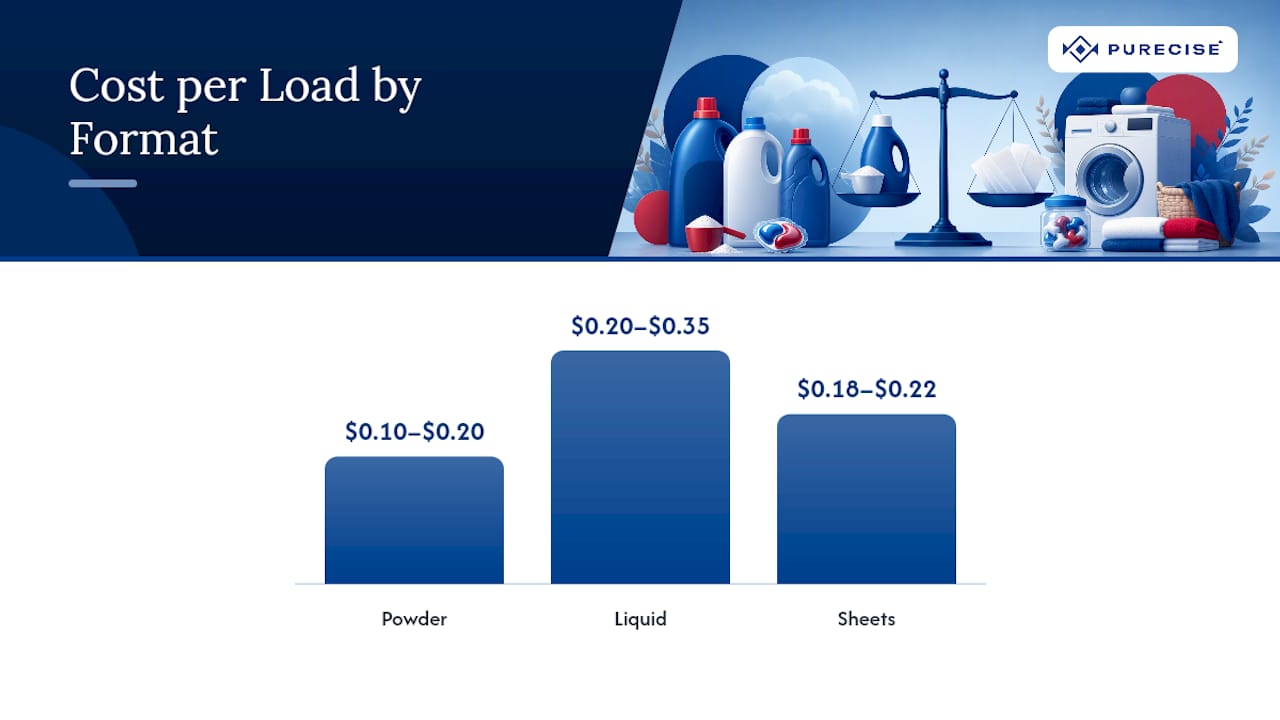
Powders generally win on raw price, often landing near $0.10 to $0.20 per load because they’re cheap to manufacture and ship. Liquids sit a step-up, usually $0.20 to $0.35, with concentrated versions pulling costs down when you resist the urge to oversource.
Pods tend to cost the most on a per-load basis. You’re paying for convenience and portion control, and that convenience carries a price premium most budget guides flag as the trade-off. Sheets fall in an interesting middle zone: priced like pods on a per-unit basis, but often competitive with mid-range liquids once you count actual loads instead of “up to” claims.
- Powder: cheapest per load, but messier to dose and less convenient to store or travel with.
- Liquid: flexible dosing, moderate cost, but easy to overpour if you’re not measuring carefully.
- Pods: highest convenience, highest typical cost, zero measuring required.
- Sheets: pre-measured like pods, but lightweight and often cheaper per load when the sheet count matches real usage.
Here’s a worked example using a sheet product: a 100 count box priced around $18 to $22 works out to roughly $0.18 to $0.22 per load, assuming one sheet per regular wash. That undercuts most pods and lands right in liquid territory, without any measuring cup involved.
Six Ways to Lower Your Cost Per Load
- Cut your dose. Using half to two-thirds of the maximum marked dose cleans most normal loads just fine and can cut your cost per load nearly in half over a year.
- Do the unit math before buying. A bigger bottle isn’t automatically cheaper per load. Divide price by real loads every time, especially when comparing sale prices against regular ones.
- Buy in bulk once you’ve confirmed the per-load price beats your current option. Subscribe-and-save programs and coupons can push an already-good price lower.
- Run full loads only. A half-empty machine still uses close to a full dose, so consolidating laundry days lowers your loads-per-week and your total spend.
- Wash in cold water when you can. It saves on energy costs and most modern formulas, including dissolving sheets, work fine at lower temperatures.
- Accept a higher cost per load when the situation calls for it. Sensitive skin, heavy stains, or delicate fabrics sometimes justify paying more for a formula built for that job.
Pro Tip: Pre-treating stubborn stains before the wash often means you can stick with your standard dose instead of adding extra detergent to compensate, which keeps your cost per load steady even on tougher loads. If you’re dealing with recurring stains, a targeted stain removal approach usually beats just dumping in more soap.
What About the Environmental Cost of Your Detergent Choice?
Plastic jugs add up fast. A household running 8 loads a week using a standard liquid bottle goes through roughly 8 to 10 plastic containers a year, most of which are recyclable in theory but rarely make it there in practice.
Powders often ship in cardboard, which cuts plastic waste but adds bulk weight that raises shipping emissions. Pods use small plastic tubs and individually wrapped units in some cases, adding packaging layers on top of the dissolvable film. Sheets tend to ship flat in lightweight cardboard boxes or paper envelopes, with far less plastic and shipping weight per load than liquid formats.
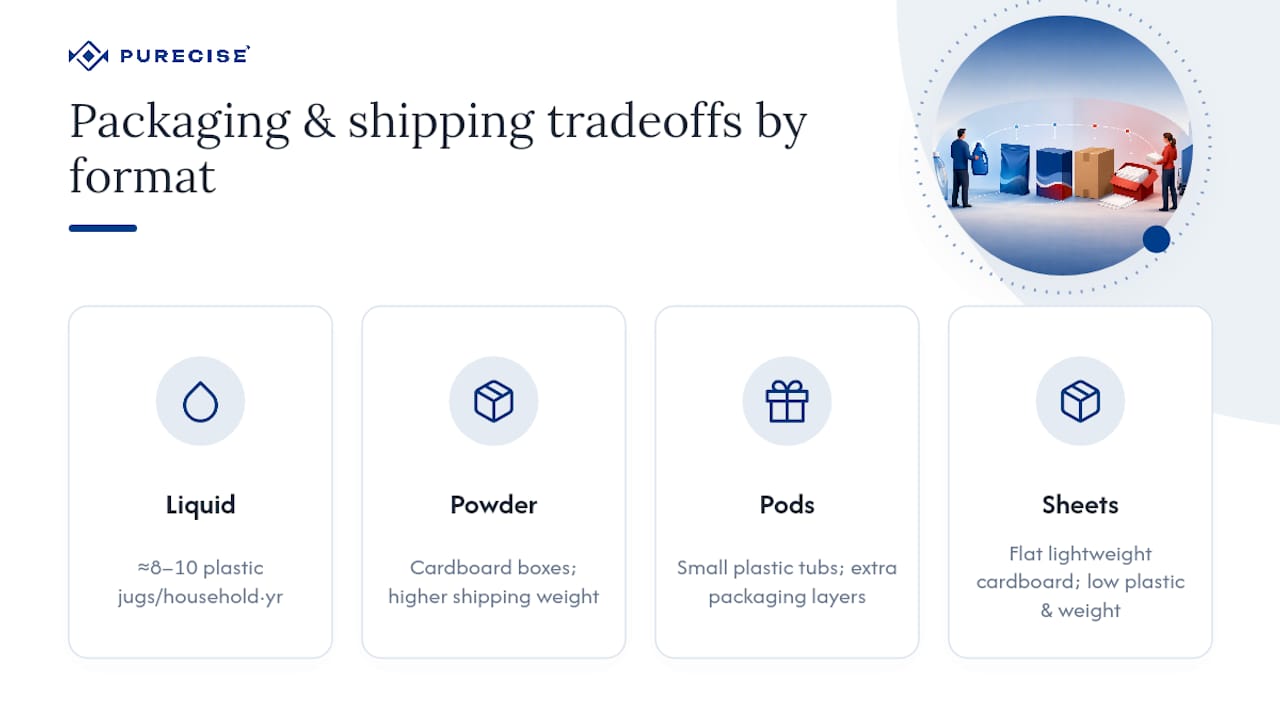
The cost angle and the environmental angle overlap more than most people expect. Concentrated formats, whether liquid, powder, or sheet, need less packaging material per load because you’re not shipping water weight or oversized plastic. That lower shipping footprint often translates to a lower shelf price too, since freight costs get passed on to the buyer either way.
None of this means you need to chase the “greenest” option at any cost. It means the formats that tend to be cheaper per load, concentrated liquids, powders, and sheets, also tend to generate less packaging waste than diluted liquids in oversized bottles. The two goals point in the same direction more often than not.
Do Pods Cost More Than Measuring Your Own Detergent?
Pods almost always cost more per load than a carefully measured liquid or powder. You’re paying for the convenience of zero measuring, and that premium typically runs $0.05 to $0.15 more per load compared to a well-dosed liquid.
The catch with liquids and powders is the word “carefully.” Most people don’t measure precisely. They eyeball the cap or scoop, and that habit tends to push the real dose above the minimum line, which erases some or all of the savings liquids are supposed to offer over pods.
This is where sheets carve out a middle path. They’re pre-dosed like pods, so there’s no measuring error to worry about, but they’re usually priced closer to liquid territory per load. You get the consistency of a pod without the price tag that comes with it, assuming the sheet count on the box matches how many loads you’ll actually run rather than an inflated “up to” figure.
If you’re disciplined about measuring, a liquid or powder can beat both pods and sheets on raw price. If you’re not, and most households aren’t consistent day to day, a pre-dosed format often ends up cheaper in practice than the sticker price suggests, simply because it removes the overdosing that liquids are prone to.
Why Pre-Dosed Sheets Deserve a Look on Cost Alone
The single biggest lever in laundry spending isn’t the brand you buy. It’s whether you’re using more product than the load actually needs, and most households are. Overdosing by even one extra cap fill line can quietly double your real cost per load compared to what the package math promised.
Pre-dosed sheets remove that variable entirely. One sheet, one load, no cap to misread and no scoop to overfill. Purecise built its Toss & Go sheets around that exact problem, backed by a 100% money back guarantee for anyone who wants to test the math against their own laundry routine. For budget shoppers juggling liquid, powder, and pod comparisons, a pre-dosed sheet is worth weighing specifically because it takes human error out of the cost equation.
— Purecise
Purecise Sheets: A Pre-Dosed Way to Control Your Laundry Budget
Purecise’s Laundry Detergent Sheets Box gives you a full supply of pre-dosed sheets built for regular household use, with each sheet designed to dissolve fully in any wash temperature or machine type. Because the dose is fixed at the sheet level, there is no measuring involved, reducing the risk of overdosing that can increase cost per load with liquids and powders.
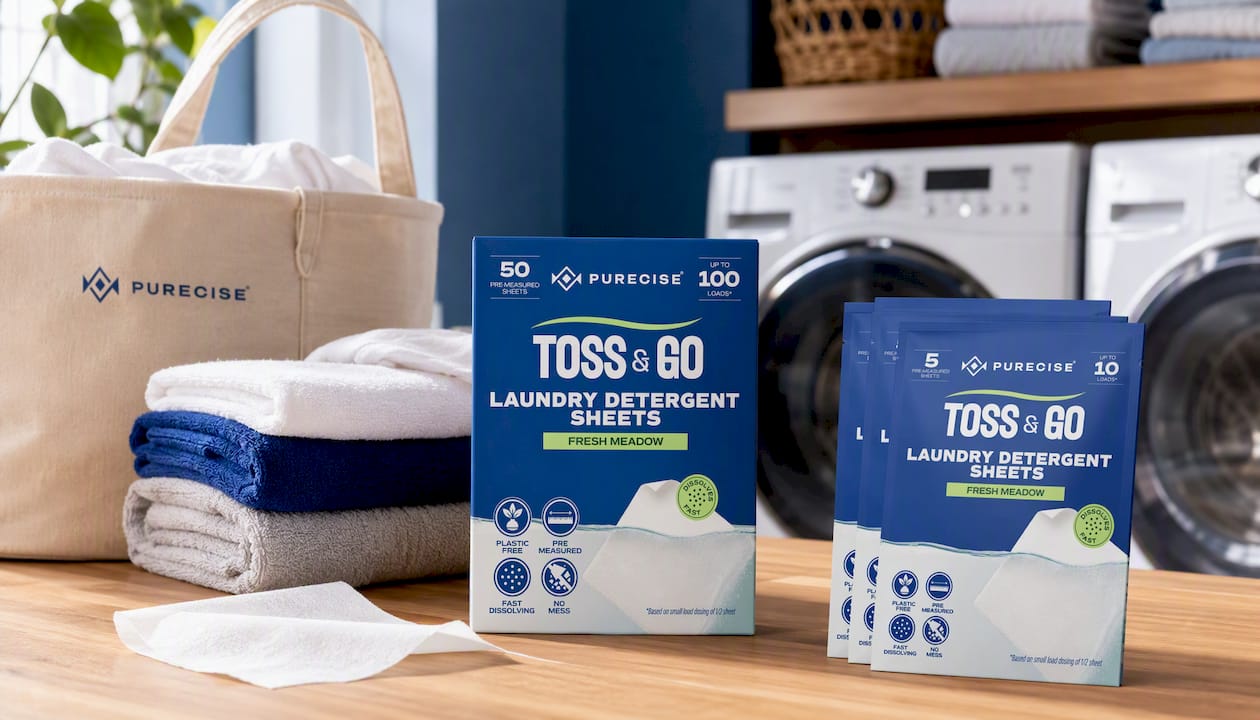 For travelers, students, or anyone who wants to test the formula before committing to a full box, the Laundry Detergent Sheets Envelopes pack a smaller supply that fits in a pocket or carry-on. Both options ship in recyclable packaging instead of a plastic jug, and both are backed by a 100% money back guarantee if the math or the results don’t work out for your household. If you’re trying to nail down a real per-load number for your laundry routine, start with a box or an envelope pack and run the calculation yourself against what you’re using now.
Calculate and Compare Your Own Numbers
Run your own math with this laundry detergent cost calculator, or check format pricing against unit price comparisons and delicate fabric care guidance before you buy.
Sources
- Laundry Detergent Cost Calculator: Cost per Load
- Cost Per Load Calculator – Compare Laundry Detergent Value
- Six laundry tips to save money and your clothes
Recommended
Hotel Sink Laundry: Cut Drying Time in Half With Detergent Sheets
At Home: Remove Grass Stains From Clothes in 10–30 Minutes with Enzymes
Related Posts

6 Quick Steps to Remove Oil Stains at Home Without Ruining Clothes

Save Space: 50 Sheets Cover 50–100 Loads for Airbnb Hosts

Cut Detergent 25–50%: Use Premeasured Sheets for Soft Water

Lab Tests and LCA: When Powder Beats Detergent Sheets

Cold Water Cleans: Evidence, Energy Savings, and When to Use 150°F

Color-Safe Detergent for Sensitive Skin: Premeasured Sheets

Remove Ink Stains With 70% Alcohol and Premeasured Detergent Sheets


